
Does TearCare Work for Meibomian Gland Dysfunction?
See how TearCare compares with LipiFlow, IPL, iLux, and warm compresses for MGD, including candidacy, durability, safety, and coverage.
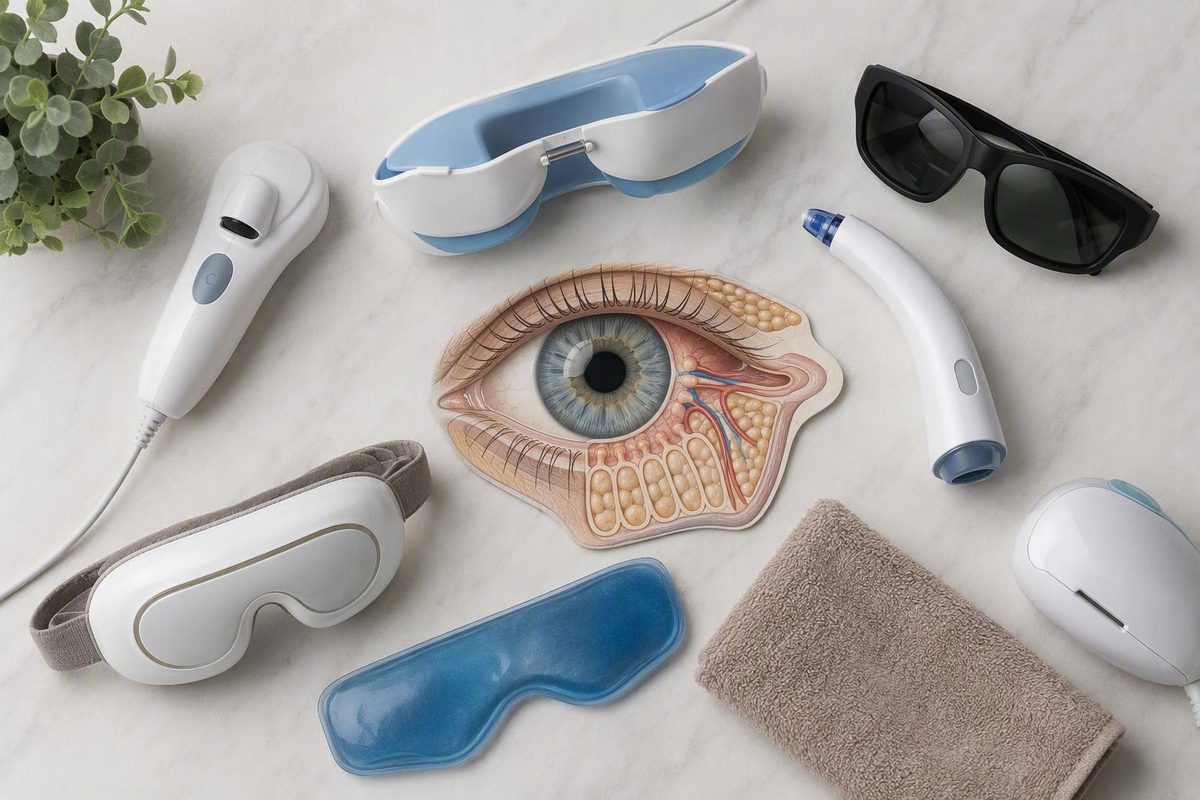
TearCare works on average for selected adults whose evaporative dry eye is substantially driven by obstructive meibomian gland dysfunction (MGD). The best randomized evidence shows improved gland secretion, tear-film stability, and symptoms at one month, but it does not establish that every patient benefits, that TearCare restores atrophied glands, or that it is superior to LipiFlow.
Vision Monday reports that, effective August 18, 2026, the FDA indication includes improving meibomian gland function in adults with evaporative dry eye caused by MGD, with optional debridement. It is reportedly the first MGD device permitted to make that gland-function claim. The supplied report is based primarily on an announcement from manufacturer Sight Sciences; a direct FDA document was not available in the supplied evidence. The expanded indication does not guarantee an individual result. Read the report on the updated indication.
Choose your location, coverage, and gland findings to see the closest evidence-based path and the cost information still missing.
This screen separates evidence fit from coverage. It cannot predict personal success or calculate a dollar balance because the supplied sources report no allowed amounts, clinic prices, deductibles, or coinsurance.
Without findings on obstruction, expressibility, and gland loss, the evidence cannot show whether TearCare, LipiFlow, iLux, IPL, or home care is the better fit.
Pricing result: Exact out-of-pocket cost is — because no allowed amount, clinic price, deductible, or coinsurance is supplied.
What a strong TearCare evidence match looks like: adult with evaporative dry eye, obstructive MGD, short tear-film breakup time, impaired secretion, and enough expressible glands.
What the tool will not claim: that heat restores atrophied glands, that a CPT fee schedule guarantees payment, or that one procedure is superior without comparative evidence.
Evidence And Cost Comparison
| Option | Best-Supported Use Here | Comparative Evidence Supplied | Price Supplied |
|---|---|---|---|
| TearCare | Obstructive MGD with viable, expressible glands | Randomized against LipiFlow; both improved at one month, with no significant measured between-group difference | — |
| LipiFlow | Office thermal treatment for MGD | Direct comparator; trial did not establish either treatment as superior | — |
| iLux | Requires a separate mechanism, safety, and candidacy review | No head-to-head evidence supplied | — |
| IPL | Requires a separate diagnosis and protocol review | No head-to-head evidence supplied | — |
| Warm Compresses | Home gland care when clinically appropriate | Not the control in the supplied TearCare trial | — |
| Drops Or Broader Care | Aqueous deficiency, inflammation, mixed disease, or residual symptoms | May address mechanisms that gland evacuation does not | — |
How To Read The Coverage Result
| Situation | What Is Known | What Remains Unknown |
|---|---|---|
| Medicare in a reported Novitas or First Coast area | Local fee schedule amounts reportedly established for CPT 0563T from January 1, 2025 | Medical necessity, claim approval, allowed amount, deductible, coinsurance, and final balance |
| Medicare elsewhere | The supplied reimbursement report does not establish local pricing | Contractor policy, pricing, coverage, and patient balance |
| Commercial insurance | Plan-specific review required | Coverage, authorization, network status, negotiated amount, and cost sharing |
| Cash or self-pay | Clinic must provide a complete written quote | National cash price; none is supplied |
Sources: randomized TearCare–LipiFlow trial and SAHARA durability record cited in the article; Eyewire News report on Novitas and First Coast fee schedules. State selection is a jurisdiction screen, not a coverage determination. Verify the current Medicare contractor and policy before treatment.
Symptoms such as burning, grittiness, watering, and fluctuating blur do not establish MGD by themselves. An examination must determine whether evaporation is the main problem, whether the glands are obstructed, and whether enough functioning tissue remains to make heat and expression plausible.
TearCare Heats The Lids And Evacuates Expressible Glands
Meibomian glands supply the oily outer layer that slows tear evaporation. In obstructive MGD, their openings may be blocked and the meibum inside may become thick or difficult to release.
TearCare uses flexible devices to apply controlled external heat to the eyelids while the patient can keep the eyes open and blink. The clinician then manually expresses the glands. In the randomized trial, heating lasted 15 minutes before manual evacuation.
The distinction between obstruction and atrophy matters. Heating may soften material in a viable gland, and expression may clear material that can still be released. Neither step replaces a gland that has atrophied or disappeared.
TearCare also does not directly correct every contributor to dry eye. Aqueous tear deficiency, ocular-surface inflammation, medication effects, incomplete blinking, and contact-lens problems may remain after gland treatment. Someone with mixed dry eye may gain better oil secretion yet continue to have substantial symptoms.
The Randomized Trial Supports Short-Term Benefit, Not Superiority
The strongest supplied efficacy evidence is a masked, multicenter randomized trial of 135 adults: 67 received TearCare and 68 received LipiFlow. Outcomes were assessed at one month.
Participants were selected for recent symptoms, regular artificial-tear use, Ocular Surface Disease Index scores from 23 to 79, tear-film breakup time of 7 seconds or less, low meibomian gland secretion scores, and at least 15 expressible glands in each lower eyelid. The findings therefore apply most directly to adults with symptomatic evaporative dry eye, impaired secretion, and enough expressible glands to treat. Review the trial design and results.
At one month, the TearCare group had these mean changes:
| Measure | Mean Change |
|---|---|
| Tear-film breakup time | +3.0 seconds |
| Gland secretion score | +11.2 points |
| Eye-dryness score | −35.4 points |
| SANDE symptom score | −38.2 points |
| OSDI symptom score | −27.9 points |
Both TearCare and LipiFlow produced statistically significant improvements within their groups. No measured difference between the groups was statistically significant. Numerically larger changes in one arm do not prove that treatment is superior when the between-group analysis is not significant.
These numbers are averages, not success rates. A mean 27.9-point OSDI reduction does not mean every participant improved by that amount. The supplied evidence does not report a dependable percentage who obtained relief they personally considered worthwhile, nor does it provide a validated calculator for predicting an individual response.
The trial also did not compare TearCare with a sham procedure, no treatment, or optimized home warm-compress care. It supports short-term performance relative to another office-based thermal treatment, not superiority over less intensive care.
One author was affiliated with Sight Sciences, and the supplied trial text does not identify the funding source. That limitation should be considered alongside the randomized design, selected eligibility criteria, and one-month follow-up.
Durability Is More Certain After Two Treatments Than One
The longer SAHARA durability phase followed 166 participants after a second scheduled localized heat treatment at month 5, then observed them for another 19 months. Tear-breakup time, gland secretion, and OSDI measurements remained statistically better than pretreatment baseline at assessed time points.
The estimated probability of remaining retreatment-free at six months was 92%. Thirty-two participants eventually met the protocol criteria for another treatment, and the median retreatment time among those retreated was eight months. Review the durability study record.
Those figures have narrow meanings. A 92% retreatment-free estimate does not mean 92% were symptom-free. Retreatment depended on protocol-defined combinations of tear-breakup and symptom findings rather than dissatisfaction alone.
The estimate also followed a second scheduled treatment. It does not show that 92% of patients avoid retreatment for six months after one procedure, nor does it establish that everyone should receive another treatment at month 5. The eight-month median describes only the 32 retreated participants; it is not a standard schedule.
This phase had no concurrent randomized control. It cannot fully separate treatment durability from other care, natural symptom fluctuation, or regression toward the mean. Many investigators reported research support, consulting fees, or honoraria from Sight Sciences, and two authors were company employees. PubMed lists a 2026 correction without explaining on the supplied page what changed.
The defensible conclusion is that benefit can persist for many participants after two scheduled treatments. The duration after one treatment and the timing of any necessary retreatment remain uncertain.
Expressible Glands Make Someone A Closer Evidence Match
A closer match to the randomized evidence is an adult with objectively confirmed evaporative dry eye, obstructive MGD as a substantial contributor, short tear-film breakup time, impaired secretions, and enough expressible lower-lid glands to treat.
A clinician may assess secretion quality, the number and ease of expressible glands, eyelid health, ocular-surface integrity, blink completeness, and remaining gland structure. None of the supplied evidence validates one test or cutoff as a dependable predictor of personal success.
Applicability is less certain with predominantly aqueous-deficient dry eye, mild or very severe disease outside the studied range, substantial gland atrophy, few expressible glands, autoimmune-associated dry eye, or mixed disease in which obstruction is only one contributor.
The randomized trial excluded people with autoimmune diseases associated with dry eye, active or recurring eye or eyelid infection, ocular-surface abrasion, ocular trauma, and several recent medications or procedures. Effectiveness and safety are therefore less certain in those groups.
Before scheduling, the examination should answer four specific questions:
- Is obstructive MGD objectively present?
- How many glands remain structurally present and expressible?
- Is obstruction the dominant problem or one part of mixed dry eye?
- Which symptom score and objective finding will be repeated after treatment?
Substantial gland loss does not automatically prove that no benefit is possible, but TearCare should not be presented as regenerating absent tissue. No supplied study provides a gland-loss percentage that reliably predicts failure.
Adverse Events And Labeling Require Screening
Three device-related ocular events occurred among TearCare participants in the one-month trial: superficial punctate keratitis, chalazion, and blepharitis.
Sight Sciences lists possible adverse events including pain, irritation, inflammation, burns or thermal injury, eyelid swelling, infection, abrasion, visual disturbance, allergic reaction, and worsening dry eye. The manufacturer also says eyelid or ocular-surface abnormalities may reduce benefit or be aggravated, and effectiveness has not been established when treatment temperature must be reduced because of pain or discomfort. Review the manufacturer’s safety information.
Manufacturer-listed contraindications and precautions include age under 22, a pacemaker or implantable cardiac defibrillator, recent eye or eyelid surgery, recent ocular injury, active ocular or periocular infection or inflammation, ocular herpes history, impaired ocular or facial sensation, an ocular-surface ulcer, a current stye or chalazion, specified material allergies, and eyelid or ocular-surface abnormalities that could interfere with treatment.
The treating clinician should apply the current labeling to the patient’s complete history. Manual expression is a distinct part of the procedure, and discomfort can occur during heating or expression. Claims that it is painless for everyone or incapable of causing thermal injury are not supported by the supplied evidence.
Significant or worsening pain, sudden vision change, or light sensitivity after treatment warrants prompt clinical attention rather than being assumed to be a routine reaction.
TearCare And LipiFlow Have The Clearest Direct Comparison
The direct randomized evidence does not establish that TearCare is better than LipiFlow. Both improved the measured signs and symptoms at one month, with no statistically significant measured difference between them.
The practical choice may depend on contraindications, clinician experience, procedure design, comfort preferences, availability, follow-up, and total cost. The supplied evidence contains no dollar amounts for either procedure.
Evidence supplied for this review does not allow a sound head-to-head judgment between TearCare and iLux or IPL. It also does not provide procedure prices, comparable durability data, or a randomized direct comparison for those options. A clinic’s claim that one is categorically superior should be matched to the actual study supporting it.
IPL is not simply another version of wearable eyelid heating, and iLux should not be assumed equivalent merely because it also addresses MGD. Their mechanisms, protocols, candidacy, risks, and evidence need separate evaluation. Where no direct comparison is available, choosing solely from marketing language or a quoted package price overstates what is known.
Home warm compresses are less intensive, but the supplied TearCare trial did not compare the procedure with optimized compress use. It cannot quantify the added benefit of TearCare over consistent home care. Artificial tears may relieve symptoms without evacuating obstructed glands, while prescription treatments may address inflammation or another mechanism. These approaches can be complementary rather than interchangeable.
CPT 0563T Does Not Guarantee Insurance Payment
CPT 0563T describes bilateral evacuation of the meibomian glands using heat delivered through wearable open-eye eyelid devices plus manual expression. Eyewire News, reporting on a Sight Sciences reimbursement announcement, says Novitas Solutions and First Coast Service Options established local Medicare fee schedule amounts for dates of service on or after January 1, 2025. Claims remain subject to individual medical-necessity determinations. Read the reimbursement report.
A fee schedule is billing infrastructure, not a coverage guarantee. The supplied evidence does not state the allowed amounts, national Medicare coverage, commercial-plan payment, cash price, deductible, coinsurance, or likely patient balance. A responsible out-of-pocket estimate therefore cannot be calculated from these sources alone.
Request a written estimate showing the procedure, treatment of both eyes, manual expression, optional lid preparation or debridement, follow-up testing, medications, facility charges, and complication care. Ask which diagnosis and procedure codes will be submitted, whether authorization is required, and what you owe if the claim is denied.
For Medicare, confirm which contractor processes the claim and whether a local amount applies at the treatment location. For commercial coverage, verify benefits using the expected codes and the clinician’s network status. Cash patients need the complete clinic quote because no supplied national cash-price figure exists.
A Worthwhile Result Must Include Symptoms And Findings
Before treatment, record a symptom score and at least one relevant objective measure. At follow-up, improvement in tear breakup or gland secretion should be considered alongside the relief the patient actually experiences.
Better gland findings do not guarantee equally large symptom relief, particularly when aqueous deficiency, inflammation, neuropathic pain, incomplete blinking, or another problem remains. Conversely, symptom relief can matter even if an objective measure changes modestly.
Retreatment should not follow an automatic six-month, eight-month, or annual calendar. It is more defensible when the first procedure produced worthwhile benefit, that benefit has diminished, obstruction is again clinically relevant, and the likely gain justifies another procedure’s cost and risk.
TearCare is most reasonable when obstructive MGD is confirmed, viable glands remain, the patient understands that response and duration vary, and the price is acceptable after coverage is verified. It is less compelling when gland atrophy is extensive, another dry-eye mechanism dominates, contraindications apply, or the recommendation depends on promises of permanent relief.