
Blocked Eye Oil Glands: Use Warmth, Not Force
Hot towels commonly fall below the intended warming range within about two minutes unless replaced or reheated. Massage is optional and should stay feather-light.
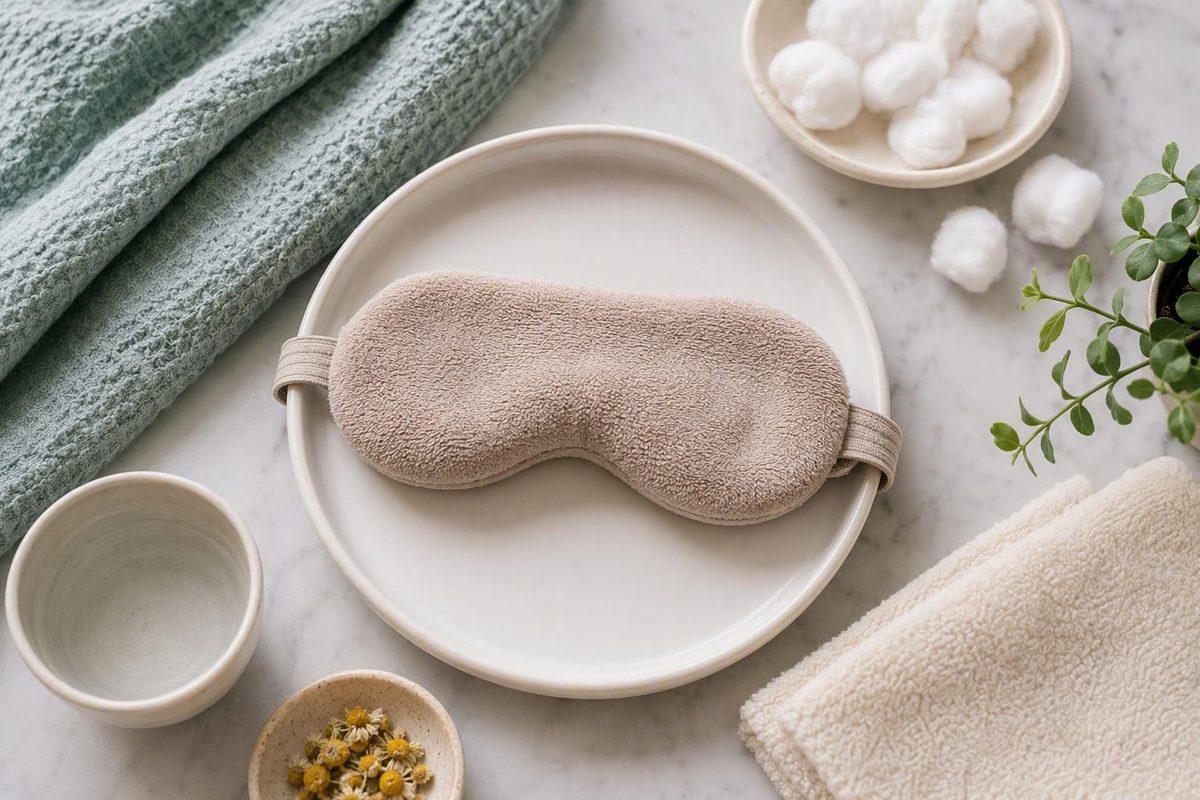
The short answer: use warmth, not force
If you are wondering how to unblock eye oil glands at home, the safest approach is not to squeeze them. Use clean, sustained, comfortable warmth and, if it feels comfortable, follow with feather-light eyelid massage toward the lashes.
A practical starting routine is:
- Wash and dry your hands.
- Remove eye makeup.
- Prepare a clean compress and make sure it feels comfortably warm, not hot.
- Close your eyes gently and rest the compress over your eyelids for about 10 minutes.
- If comfortable, lightly move the upper lids downward and the lower lids upward, toward the lash line.
- If the lash bases are crusty, gently clean them with an eye-safe eyelid wipe or a cleanser recommended by an optometrist or ophthalmologist.
About 10 minutes once daily is a reasonable starting point. Published and clinical protocols vary from roughly 5 to 15 minutes, however, so instructions from your own clinician and the heating directions supplied with a reusable mask take priority. One eye-clinic protocol, for example, uses 10 to 15 minutes and emphasizes testing the compress before use (warm-compress instructions).
The goal is to soften thick or waxy meibomian oil and support its movement from glands that still function. It is not to force out visible material, pop a blockage, or guarantee that every gland will open.
Massage is optional. If you use it, think of it as light directional movement rather than gland expression:
- Upper lid: lightly down toward the upper lashes.
- Lower lid: lightly up toward the lower lashes.
- Pressure: only enough to move the eyelid skin gently.
Stop the heat or massage if it causes pain, increased redness, skin irritation, or swelling. Do not respond by pressing harder, extending the session, or making the compress hotter.
If you wear contact lenses, follow the directions supplied with your lenses and warming product or ask your eye-care professional whether the lenses should be removed. A universal contact-lens rule cannot account for every product, prescription, or eye condition.
This article provides general information, not a diagnosis or individualized treatment plan. Dry Eye Watch’s Terms of Use and urgent-symptom notice treats sudden vision change, eye pain, or light sensitivity as reasons for same-day clinical evaluation. Sudden vision loss or severe, sudden eye pain requires emergency care.
What the eyelid oil glands do—and what “blocked” means
The oil glands people usually mean are the meibomian glands. They are arranged within the upper and lower eyelids and open along the lid margins, close to the lashes.
These glands produce an oily substance called meibum. It spreads across the tears when you blink and forms the tear film’s oily outer component. This oil slows tear evaporation and helps maintain a smoother, more stable surface over the eye.
Meibomian gland dysfunction, usually shortened to MGD, is broader than a single plug. It may involve obstruction at the gland openings, changes in the quantity or quality of gland secretions, or both. When meibum becomes unusually thick or waxy, it may not flow normally. Reduced oil delivery can then allow the watery part of the tears to evaporate faster, contributing to tear-film instability and irritation. Cleveland Clinic provides a clinical overview of these mechanisms, associated symptoms, diagnosis, and treatment in its guide to meibomian gland dysfunction.
Possible symptoms include:
- Burning or stinging
- A gritty, sandy, or foreign-body sensation
- Red or irritated eyelid margins
- Watery eyes
- Sticky or crusty lashes
- Intermittent or fluctuating blur
- Blur that temporarily improves after blinking
- Contact-lens discomfort
- Sore or tired-feeling eyes
These symptoms do not prove that your meibomian glands are blocked. Allergy, infection, blepharitis, medication effects, contact-lens problems, low tear production, environmental irritation, and other ocular-surface conditions can cause overlapping complaints. Even blur that clears after blinking, although compatible with tear-film instability, cannot establish the underlying cause.
That uncertainty matters because treatment should match the actual problem. Warmth may be reasonable for mild symptoms suggestive of poorly flowing oil, but it will not treat every cause of a red, painful, watery, or blurry eye.
It is also important to distinguish widespread gland dysfunction from a focal eyelid lump. Do not diagnose, pierce, squeeze, or pop the lump yourself. A painful, recurrent, persistent, or increasingly swollen lump should be examined, particularly if it affects vision.
Choosing and preparing a warm compress
You do not necessarily need to buy a special product. The main options are a clean warm washcloth, a reusable microwavable eye mask, and a self-heating eye mask. The best option is one you can prepare safely, clean correctly, and use consistently without excessive heat or pressure.
| Consideration | Warm washcloth | Microwavable eye mask | Self-heating eye mask |
|---|---|---|---|
| Heat retention | Usually loses warmth relatively quickly | Generally retains warmth more consistently | Designed to provide sustained warmth for a set period |
| Reheating needs | May need to be reheated several times | Usually heated once per session | Usually does not require reheating during use |
| Convenience | Simple and widely available but requires warm water | Convenient after heating, although microwave access is needed | Convenient for travel or use without a microwave |
| Cleaning | Use a freshly cleaned cloth each time | Wash and fully dry the removable cover as directed | Follow the reusable or single-use instructions |
| Hot-spot risk | Excessively hot water can burn | Uneven microwave heating can create hot spots | Follow activation directions and stop if it feels hot |
| Cost | Usually the lowest-cost option | Higher initial cost but commonly reusable | Ongoing cost may be higher if disposable |
Warm washcloth
A washcloth is an acceptable option. Use a freshly cleaned cloth and warm—not boiling—water. Wring it out, fold it, test it, and place it loosely over closed eyes.
Its main disadvantage is heat retention. Research reviewed in 2024 found that hot towels commonly fell below the intended warming range within about two minutes unless replaced or reheated. Purpose-made masks generally retained heat more consistently, but that does not mean everyone must buy one (2024 warm-compress review).
If the cloth cools, remove it and rewarm it safely. Do not pour very hot water onto a cloth while it is on your face. Sustained warmth should come from careful reheating, not from starting with water hot enough to burn.
Microwavable eye mask
A microwavable mask may be more convenient because it generally retains warmth longer than a wet cloth. That does not make it automatically safer: uneven microwave heating can create hot spots.
Follow the product’s exact heating directions. Before placing the mask over your eyelids:
- Feel across the mask for unusually hot areas.
- Test it against the inner wrist.
- Let it cool if any part feels hot rather than comfortably warm.
- Confirm that its cover is clean, dry, and fitted correctly.
Never extend the heating time beyond the product instructions in an attempt to make the treatment more effective.
Self-heating eye mask
A self-heating mask may provide sustained warmth without a microwave. Follow its activation, positioning, duration, reuse, and disposal instructions. If it is sold as a single-use product, do not improvise reuse unless the manufacturer specifically permits it.
Stop using any mask that becomes uncomfortably hot, leaks, tears, irritates the skin, or presses heavily against the eyes.
How warm should it be?
Research protocols frequently target eyelid warmth around 40°C because thickened meibum may soften above normal body temperature. This is a research target, not a home challenge. You do not need to make your eyelids reach an exact measured temperature, and trying to do so could encourage unsafe overheating.
Use a compress that feels comfortably and steadily warm, never hot. Wrist-testing and checking for hot spots are more practical safeguards than chasing a number. Research on warm-compress methods has identified approximately 40°C as a common target while also emphasizing wide variation in devices and protocols (evidence-based warm-compress strategies).
Whichever option you choose:
- Rest it over gently closed eyelids.
- Do not strap or press it tightly against the eyes.
- Do not rub the compress across the lids.
- Wash reusable covers according to their instructions.
- Let reusable covers dry fully before the next use.
- Do not share masks, covers, washcloths, or towels.
- Never fall asleep while wearing a heated compress.
Step by step: warming and gentle eyelid massage
The following routine prioritizes sustained warmth and minimal pressure. If an eye-care professional has examined you and provided different instructions, follow that individualized plan instead.
1. Wash and dry your hands
Use soap and water, then dry your hands with a clean towel. Remove eye makeup so pigments, oils, and applicator residue are not moved into the lash line.
If you use contact lenses, check the instructions for your lenses and warming product or ask your eye-care professional how to handle them during treatment.
2. Prepare and test the compress
For a washcloth, use warm water and a freshly cleaned cloth. For a reusable or self-heating mask, follow its directions exactly.
Check the full surface for hot spots and test it on the inner wrist. If you hesitate because it feels hot, it is too hot for your eyelids. Let it cool before proceeding.
3. Warm the closed eyelids
Close your eyes gently—do not squeeze them shut—and rest the compress over the eyelids without rubbing or pushing. Maintain comfortable warmth for about 10 minutes as a practical starting routine.
If a washcloth cools, remove and rewarm it safely. It is better to pause than to begin with dangerously hot water.
4. Remove the compress
Lift the compress away without dragging it across the skin. Keep your eyes gently closed if you plan to massage.
Massage is optional. Warmth alone may be the more comfortable choice if your eyelids are tender or sensitive.
5. Move the upper eyelid downward
With a clean fingertip, use very light pressure to roll or stroke the upper eyelid downward toward the upper lash line.
Do not place your finger high on the lid and forcefully drag it downward. The movement should be small, controlled, and painless.
6. Move the lower eyelid upward
Use the same feather-light approach on the lower eyelid, moving upward toward the lower lashes.
A simple way to remember the directions is:
Upper lid:   ↓ toward the upper lashes
             — upper lash line —

             — lower lash line —
Lower lid:   ↑ toward the lower lashes
Both movements point toward the lid margin, where the glands open.
7. Keep massage brief
Some clinical instructions use approximately 30 seconds of gentle massage after warming. Longer or harder massage is not necessarily more effective, and repeated forceful passes are not appropriate (warm-compress and massage protocol).
Massage should never involve:
- Pressing directly on the eyeball
- Pinching the eyelid between two fingers
- Squeezing a focal bump
- Digging a fingernail into the lid
- Trying to make material visibly emerge
- Continuing through discomfort or pain
The American Association for Pediatric Ophthalmology and Strabismus describes light massage toward the lashes after warming and warns that excessive pressure can increase pain and irritation (meibomian gland treatment guidance).
Stop immediately if you develop pain, new or increased redness, irritation, skin sensitivity, or swelling.
People with recent eye surgery, significant skin sensitivity, rosacea, or another existing eye condition should obtain individualized advice before starting eyelid heat or massage. The appropriate precautions depend on the condition, procedure, skin response, and treatment product, so a general routine cannot account for every risk.
Lid cleaning and comfort measures: what each one can and cannot do
Warmth, lid cleaning, and lubricating drops serve different purposes. Keeping those purposes separate prevents an eye-comfort measure from being mistaken for a gland-clearing treatment.
Lid-margin cleaning
If the lash bases are crusty or oily, gentle cleaning after the compress may remove surface debris, crusts, and accumulated oil around the gland openings. This may be useful when gland dysfunction occurs alongside blepharitis.
Use a purpose-made eye-safe eyelid wipe or a cleanser recommended by an optometrist or ophthalmologist, particularly if your skin is sensitive or your eyelids are inflamed. Close your eyes, clean gently along the lash bases, and follow the product’s directions.
Cleaning should not become scraping. Avoid:
- Vigorous side-to-side rubbing
- Using a fingernail to lift crusts
- Scraping inflamed openings with a cotton swab
- Allowing cleanser to run into the eye
- Reusing a wipe when its instructions specify single use
- Using one wipe on both eyes if the product directs separate use
Some older lid-hygiene instructions recommend diluted baby shampoo. It is not the best universal default because it may irritate some people. One clinician-authored eye-clinic guide states that baby shampoo is now used less often, raises concern about its effects on the lid-margin environment, and advises keeping cleansing products out of the eye (clinician-authored lid-hygiene discussion).
If you have inflamed or sensitive eyelids, ask an eye-care professional to recommend a formulation rather than improvising a cleanser.
Lubricating eye drops
Artificial tears may reduce friction, dryness, burning, and irritation by adding lubrication to the ocular surface. They can improve comfort while the underlying eyelid problem is being assessed or managed.
They do not directly melt thickened meibum, express gland contents, or mechanically open gland ducts. If you need lubricating drops frequently or remain symptomatic despite using them, ask an optometrist or ophthalmologist whether a different formulation or further evaluation is appropriate.
Prescription drops are different from over-the-counter lubricants. Anti-inflammatory drops, antibiotics, steroids, and other prescription medicines require clinician selection because the appropriate choice depends on the diagnosis, severity, health history, and potential adverse effects.
Environmental and blinking measures
Several low-risk adjustments may reduce evaporation or eye strain:
- Take regular breaks during sustained screen work.
- Blink deliberately and completely after periods of intense visual concentration.
- Use a humidifier in a dry room.
- Avoid direct air from fans, heaters, vents, and vehicle blowers.
- Consider wraparound glasses outdoors in windy conditions.
- Follow professional and manufacturer guidance for contact-lens wear and replacement.
These measures may improve comfort, but they do not directly unblock meibomian glands.
Hydration, particular foods, and omega-3 supplements also should not be presented as proven ways to open blocked glands. Ask a clinician who knows your medical history before adding a supplement to an eye-care plan.
What not to do to a blocked eyelid gland
Do not use hotter heat or harder pressure.
Avoid:
- Boiling water
- Compresses that feel hot rather than comfortably warm
- A microwaved mask that has not been checked for hot spots
- A household heating pad placed directly on eyelid skin
- Sleeping in a heated mask or compress
- Squeezing, pinching, piercing, or popping an eyelid bump
- Scraping the lid margin
- Inserting a probe, needle, or other tool into a gland opening
- Heated stones or improvised objects with unpredictable heat retention
- Clinician-style forceful gland expression at home
- Sharing masks, covers, towels, washcloths, or wipes
Slow improvement is not a reason to raise the temperature, press harder, lengthen every session, or invent a more aggressive schedule. If a careful routine is not helping, the appropriate next step is an examination rather than escalation.
Do not apply essential oils, undiluted tea tree oil, fragranced facial cleansers, or improvised mixtures along the eyelid margin. Use such products only when an eye-care professional recommends an appropriate eye-area formulation.
A visible eyelid bump should not be popped. Warmth may sometimes form part of clinician advice for a stye or chalazion, but the correct management cannot be determined solely from the presence of a lump.
Finally, distinguish gentle massage from professional gland expression. Light home massage moves the eyelid skin toward the lashes after warming. Forceful expression applies substantially more pressure to gland tissue and may involve topical anesthetic and specialized instruments. Research describing forcible expression identifies it as an office procedure, not a home technique (study of eyelid heating and massage).
How well home treatment works—and its limits
Warm compresses are commonly used as a first-line, palliative approach for meibomian gland dysfunction. “Palliative” means the routine is intended to improve oil delivery and ease symptoms. It does not mean it permanently cures the condition or clears every obstruction.
The realistic goal is modest: sustained warmth may soften thickened meibum so it moves more readily during blinking or very light massage. This may improve tear quality or comfort for some people.
A 2024 qualitative review included 20 English-language studies published from 2004 through 2023. Across those studies, repeated warming generally improved symptoms, and most studies reported improvement in at least some measures of gland health. Benefits were reported with hot towels, microwavable masks, and self-heating masks. The protocols, devices, outcomes, and treatment schedules differed, however, so the review did not establish one universally best method for every person.
The evidence therefore supports warm compresses more strongly as a way to improve symptoms and oil delivery than as proof of permanent gland clearance. A single session may change tear quality or short-term tear-film measurements, but that does not demonstrate that an individual duct has been durably reopened.
The limitations are especially important when interpreting a study of 24 young participants. Researchers assessed the immediate effects of heating and massage on gland imaging and tear-film measurements. The intervention changed some upper-lid imaging and short-term tear measurements, but it did not test lasting symptom relief, durable home-treatment results, or successful clearance of individual glands. People with certain ocular conditions or medicines affecting the ocular surface or tearing were excluded (24-participant heating-and-massage study).
In practice:
- Some people may notice better comfort with consistent care.
- Others may get little benefit because their symptoms have another cause.
- Responses may differ between the upper and lower lids.
- Ongoing care may be recommended after a clinical assessment.
- There is no well-supported deadline by which everyone should improve.
- Lack of rapid improvement does not justify more heat or pressure.
Warmth also cannot be claimed to regenerate meibomian glands that have atrophied or disappeared. Advanced gland loss, substantial inflammation, infection, allergy, low tear production, or another ocular-surface problem may require a different management plan.
Persistent, recurrent, or worsening symptoms should lead to an eye examination rather than indefinite home experimentation.
When to book an eye exam—and when symptoms are urgent
Arrange a routine examination with an optometrist or ophthalmologist if symptoms:
- Persist despite careful home care
- Repeatedly return
- Gradually worsen
- Interfere with reading, driving, screen use, sleep, or work
- Make contact-lens wear consistently uncomfortable
- Occur with a recurrent or persistent eyelid lump
An examination may assess the eyelid margins, gland openings, oil quality and flow, blinking, tear-film stability, and ocular-surface inflammation. It can also investigate overlapping causes such as allergy, infection, blepharitis, medication effects, contact-lens problems, low tear production, or another eye condition.
Seek prompt assessment for:
- Significant eye pain
- Marked or increasing redness
- Increasing eyelid or facial swelling
- Discharge
- Light sensitivity
- New or worsening vision changes
Treat sudden vision change, eye pain, or light sensitivity as same-day clinician territory. Sudden vision loss or severe, sudden eye pain warrants emergency care. Cleveland Clinic likewise advises medical evaluation for eye pain or blurred vision and emergency care for sudden pain or vision loss in its MGD patient guidance.
Persistent or severe gland problems may require clinician-selected treatment. Depending on the diagnosis, options can include prescription drops, oral medicines, professional gland expression, controlled heat-and-pressure procedures, lid-margin cleaning procedures, or light-based therapy.
These treatments are not interchangeable, universally suitable, or necessary for everyone. The American Academy of Ophthalmology notes patient-specific limitations and a lack of independent effectiveness and cost-effectiveness studies for some dry-eye devices (AAO overview of dry-eye treatment devices).
A simple decision path is:
- Mild symptoms without warning signs: cautious, comfortable home care may be reasonable.
- Persistent, recurrent, or activity-limiting symptoms: arrange a routine eye examination.
- Pain, light sensitivity, discharge, marked inflammation, or new vision changes: seek prompt or same-day assessment.
- Sudden vision loss or severe, sudden eye pain: obtain emergency care.
The restrained goal remains the safest one: use clean, sustained, comfortable warmth and, at most, optional feather-light massage toward the lashes. Never substitute hotter heat or harder pressure for a diagnosis.
Frequently asked questions
How long should I use a warm compress for blocked eye oil glands?
About 10 minutes once daily is a reasonable general starting point, but published and clinical protocols range from roughly 5 to 15 minutes. Product directions and individualized clinician guidance take priority. Some clinical instructions use 6 to 10 minutes and adjust frequency according to symptoms and professional advice (warm-compress home protocol).
The essential feature is sustained, comfortable warmth—not reaching an exact temperature or extending the session until the eyelids feel hot. If a washcloth cools, rewarm it safely. Stop if the compress causes pain, irritation, redness, or swelling.
Can I use a warm washcloth instead of a heated eye mask?
Yes. A freshly cleaned washcloth soaked in warm—not boiling—water is acceptable. Its main drawback is that it cools quickly, so it may need to be reheated several times during a session.
A microwavable or self-heating mask generally retains warmth more consistently and may be more convenient, but it is not medically necessary for everyone. Follow product directions, check reusable masks for hot spots, and test them on your inner wrist before use.
Can artificial tears unblock meibomian glands?
No. Artificial tears may lubricate the ocular surface and relieve burning, grittiness, or dryness, but they do not directly soften or express meibomian oil and should not be assumed to unblock gland ducts.
They can still be a useful comfort measure. If you need them frequently or remain symptomatic, ask an optometrist or ophthalmologist to evaluate the cause and recommend an appropriate formulation.
Should I squeeze a blocked gland, stye, or eyelid lump?
No. Do not squeeze, pinch, pierce, or pop a gland opening, stye, chalazion, or unidentified eyelid lump. Doing so can increase irritation, injure the eyelid, or worsen and spread infection when infection is present.
Use only light eyelid movement after warming—not forceful expression. Have a painful, persistent, recurrent, or increasingly swollen lump examined.
Can warm compresses cure meibomian gland dysfunction?
Warm compresses may soften thickened oil, improve its delivery, and reduce symptoms, but they are palliative rather than a guaranteed cure. They may not clear every obstruction, and home warming cannot be claimed to restore glands that have atrophied or disappeared.
If symptoms persist, recur, or worsen, obtain an eye examination rather than increasing the temperature, pressure, duration, or frequency of home treatment.