
Moisture Chamber Goggles for Dry Eye: Benefits, Fit and Use
Learn how moisture chamber goggles reduce drying airflow, what the evidence shows, and how to choose and use daytime or overnight designs.
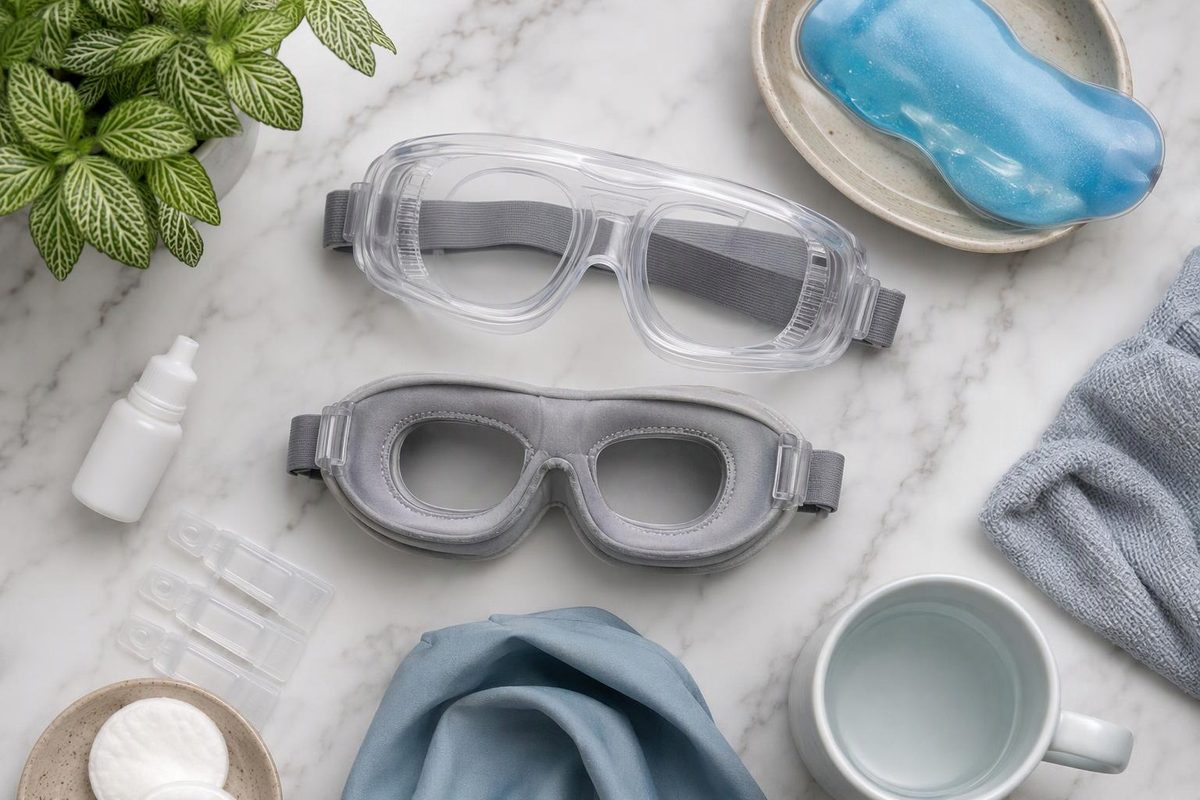
Moisture chamber goggles may ease dry-eye discomfort by trapping humidity around the eyes and reducing exposure to drying airflow. They are worth considering when wind or drafts make symptoms worse—but a comfortable, close-fitting seal is important.
Also called moisture-retaining glasses or spectacles, they enclose the space around the eyes to slow evaporation from the tear film—the thin coating of tears over the eye. The 2025 TFOS DEWS III management report includes them among tear-conservation options. They can complement dry-eye care, rather than replace treatment of its underlying cause.
How much do they help?
The evidence supports short-term comfort and tear-film benefits, particularly during airflow exposure. TFOS DEWS III describes:
- A study of 14 participants exposed to controlled wind for 10 minutes. Moisture-retaining spectacles provided greater comfort than ordinary glasses or no glasses, with lower tear-evaporation rates.
- A short-term study of 30 participants that found improvements in comfort and several tear-film measurements, reaching their highest levels at about 60 minutes before declining.
These are small, short-term studies. They support trying a well-fitting chamber for symptom relief, but do not establish a cure, lasting benefit after removal, or equal effectiveness across every commercial design. See the report’s moisture-retaining spectacles section.
A moisture chamber can also be part of care when an eyelid does not close completely, leaving the eye exposed. That situation needs an eye-care assessment: patient guidance on moisture chambers lists incomplete closure and severe surface dryness among their uses, with overnight treatment depending on the clinician’s recommendation.
Choose daytime glasses or an overnight chamber
For reading, screens or outdoor use: Look for a daytime design with lenses and an eyecup or surrounding barrier. Some are prescription-ready; for example, 7eye describes prescription-ready frames with removable AirShield eyecups. Before ordering, check whether the frame can accommodate your prescription and the lens type you need.
For sleep: Choose a product specifically intended for overnight use, not simply daytime eyewear with a tight strap. EyePromise’s manufacturer guidance distinguishes overnight chambers, which retain a humid pocket without heat, from warm compresses. Ask your eye-care professional about this option if you regularly wake with dryness or suspect incomplete eyelid closure.
These devices serve different purposes from other self-care tools. A room humidifier changes the room environment; a moisture chamber protects the small area around the eyes. A warm compress applies heat to help thickened eyelid-gland oils flow. A passive moisture chamber does not perform that warming treatment.
What to check before buying
- Seal and comfort: Try the frame on if possible. Look for gaps at the nose, cheeks and sides, and check that you can blink comfortably. TFOS emphasizes adjusting the frame to the wearer’s face to minimize leaks. Do not keep tightening a painful fit; a different shape may be needed.
- Clear vision: Check for lens fogging during the task you intend to do. Do not drive or carry out hazardous work if visibility is impaired.
- Practical upkeep: Check whether the eyecup is removable, replacement parts are available, and cleaning is manageable.
- Return terms: Check the seller’s trial and return rules before buying prescription lenses. A frame that looks suitable online may not seal against your face.
Use and clean them without improvising
Start with a short daytime trial in the setting where dryness usually bothers you. Compare comfort with and without the chamber while keeping your usual care routine unchanged. Stop and reassess the fit if it causes pressure, irritation or troublesome fogging.
Follow the instructions for your exact model, including whether it uses damp inserts. Do not assume every chamber should be soaked or filled with water. For example, 7eye’s cleaning guide advises against soaking its Ziena eyecup or using harsh soaps, and warns that alcohol-containing lens cleaners can damage its anti-fog coating.
If you wear contacts, do not use goggles to push through discomfort. The NHS recommends removing contacts and wearing glasses to rest dry eyes.
Arrange an eye exam if symptoms persist despite self-care or morning dryness keeps recurring. Seek same-day attention for eye pain or a red eye while wearing contacts. Seek emergency care for sudden vision changes or loss, or if it hurts to look at light. These symptoms should not be managed by simply adding goggles. NHS dry-eye guidance identifies urgent and emergency warning signs.
This article is general information, not a diagnosis or a substitute for clinical care.