
Omega-3 Gummies for Dry Eye: Evidence and Label Checks
Omega-3 gummies can supply nutrients, but dry-eye benefits are uncertain. Learn how to compare EPA, DHA, serving sizes and safety before buying.
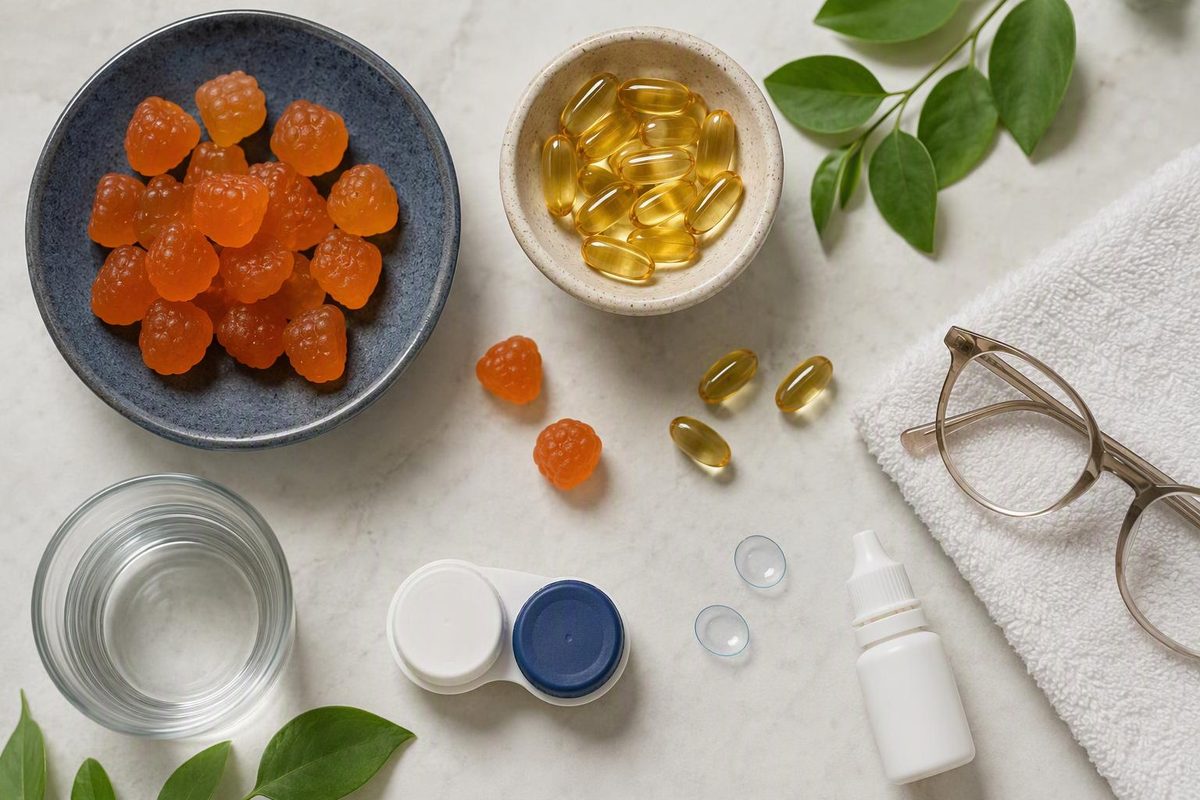
Omega-3 gummies can supply omega-3 fats, but they are not an established treatment for dry eye. Some studies suggest benefits from omega-3 supplements; larger trials have found no meaningful advantage over comparison oils. Choosing a chewable format does not resolve that uncertainty. NIH’s evidence summary distinguishes their nutritional role from the mixed evidence for dry-eye relief.
If swallowing capsules is difficult, a gummy may be a format you prefer. Before buying, check which omega-3s it contains and how much you get per serving—not just the words “fish oil” or “eye health” on the front.
Do omega-3 supplements help dry eyes?
Two important trials give reason to keep expectations modest:
- The 2018 DREAM trial enrolled 535 people with moderate to severe dry eye. Participants taking 2,000 mg EPA plus 1,000 mg DHA daily for a year did not improve significantly more than those taking olive-oil placebo capsules. Both groups could continue their usual dry-eye treatments. National Eye Institute trial summary
- A 2024 trial enrolled 132 people with dry eye associated with meibomian gland dysfunction—problems with the eyelids’ oil-producing glands. It found no significant symptom advantage from a re-esterified triglyceride omega-3 formulation over grape-seed oil after 12 weeks. The study was smaller, with fewer than 60 people evaluated in each group at the end. Published trial abstract
These results do not prove that nobody benefits, but they do not justify promising relief from omega-3 gummies. Nor should you copy the research doses: they are study details, not a recommended gummy dose for dry eye.
How to compare omega-3 gummies
Look for EPA and DHA, not only “total omega-3”
The main omega-3 fats are eicosapentaenoic acid (EPA), docosahexaenoic acid (DHA) and alpha-linolenic acid (ALA). EPA and DHA occur in fish and seafood; algal oil is a vegetarian supplement source. ALA occurs mainly in plant foods and oils. Your body converts ALA into EPA and DHA only in very small amounts, so an ALA-only gummy is not equivalent to the EPA-and-DHA formulations used in these dry-eye trials. NIH omega-3 fact sheet
Check the amount per serving
The Supplement Facts panel lists amounts per serving, which may mean more than one gummy. Add the listed EPA and DHA amounts to compare products on that basis; do not assume the total fish-oil or total omega-3 amount is all EPA plus DHA. NIH label guidance
For an illustration of how much gummy formulas can differ, Nordic Naturals’ pages checked on October 24, 2026, list:
- Nordic Omega-3 Gummies: 82 mg total omega-3s, with a suggested daily serving of two gummies for ages 3 and older.
- Children’s DHA Gummy Chews: 600 mg total omega-3s per gummy, including 355 mg DHA and 145 mg EPA—500 mg EPA plus DHA. The suggested daily serving is one gummy for ages 4 and older.
These are label examples, not dry-eye recommendations or suggested doses for children. Check the current bottle because formulations can change. A higher number alone does not establish better eye comfort.
Check the rest of the formula and quality testing
Review added sugar, sweeteners, oil source, allergens and any extra vitamins, especially if you already take other supplements. Independent quality seals such as NSF or USP can help assess manufacturing and label accuracy, but they do not prove that a product is safe for everyone or effective for dry eye. NIH supplement guidance
Safety and a more useful next step
Omega-3 supplements can cause unpleasant taste, heartburn, nausea or diarrhea. Ask a pharmacist or clinician before starting them if you take warfarin or another anticoagulant, because high doses may increase bleeding problems. For children, pregnancy or breastfeeding, get individualized advice rather than relying on a gummy’s marketing. Omega-3 safety information and NIH supplement precautions
For dry-eye symptoms, prioritize relief matched to the cause. Artificial tears are a common starting option for mild dryness; screen breaks and avoiding dry airflow may also help. Persistent symptoms need an eye examination rather than a larger supplement dose. National Eye Institute treatment guidance explains why treatment depends on the cause. Our guide to choosing dry-eye drops covers practical options.
Seek same-day eye care for eye pain or a red eye while wearing contact lenses. Seek emergency care for sudden vision changes or loss of vision, or if it hurts to look at light. Do not wait for a supplement to work. Urgent eye-symptom guidance
This article is general information, not a diagnosis or an individual treatment plan.