
Does Contact Solution Go Bad? Expiration and Safety Guide
Yes. Contact lens solution expires, and an opened bottle can become contaminated before its printed expiration date.
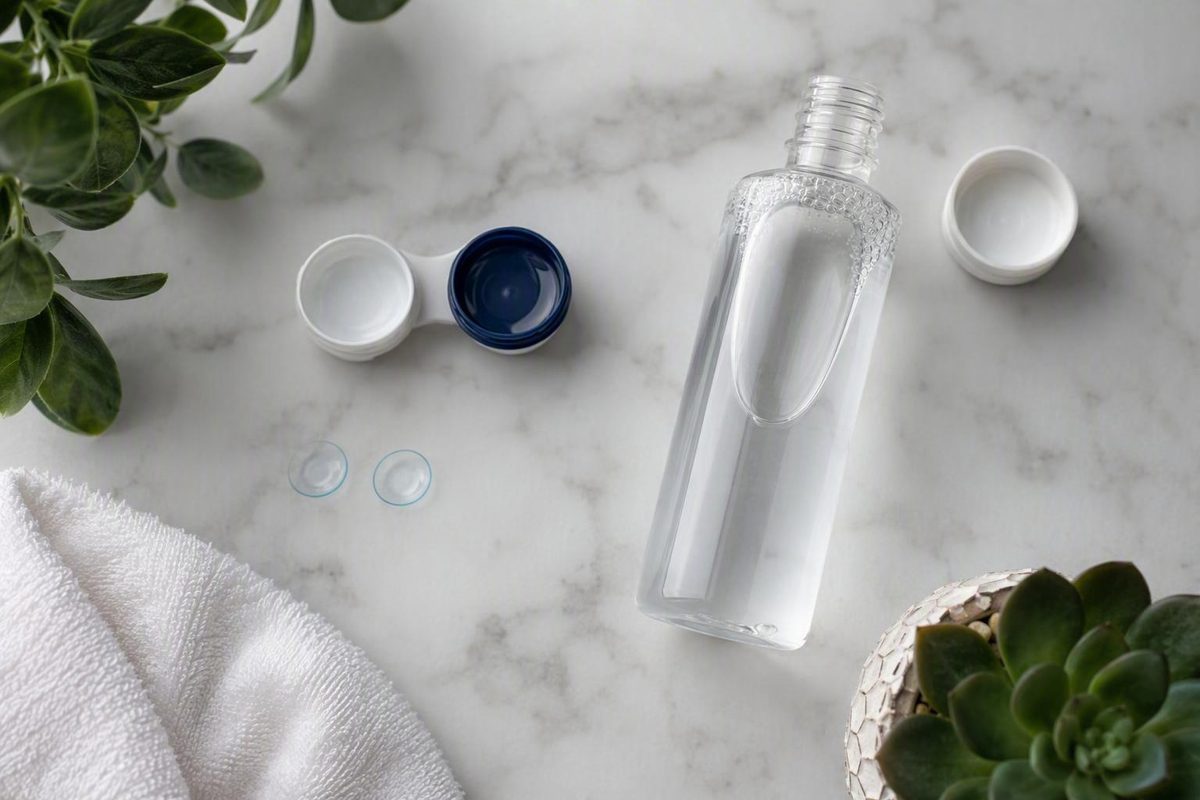
The short answer: yes, contact solution goes bad
Yes. Contact lens solution expires, and an opened bottle can become contaminated before its printed expiration date.
The safest rule is straightforward: discard the solution when either the printed expiration date or the product’s discard-after-opening period arrives, whichever comes first. Opened bottles commonly have a shorter usable period—often around 90 days—but the interval varies by formulation and manufacturer, so the bottle, carton, and package insert control (guidance on contact-solution expiration).
The two deadlines measure different things:
- The printed expiration date generally applies to an unopened, undamaged bottle stored according to its instructions.
- The discard-after-opening period begins when you break the seal. It is usually shorter because opening and routine handling create opportunities for contamination.
Do not turn “about 90 days” into a universal rule. Preservative-free products, unit doses, aerosol packages, multipurpose solutions, hydrogen peroxide systems, saline products, and solutions for rigid gas-permeable lenses can all have different instructions.
If you cannot remember when you opened a bottle, do not estimate its age from how full it is, when you think you bought it, or how often you normally use solution. Replace it. The same applies when the expiration date is missing or unreadable.
This article provides general information, not a diagnosis or individualized treatment. If you are uncertain about a particular lens-care system—or you develop eye symptoms after using questionable solution—contact an optometrist or ophthalmologist.
The two dates that determine when to discard a bottle
Every bottle effectively has two safety clocks. One runs while the product is unopened; the other starts when the seal is broken.
1. The printed expiration date
This is the manufacturer’s outer limit for an unopened product kept under the storage conditions on its label. Look for wording such as:
- EXP
- Expiration
- Use by
- Use before
The date may be printed on the bottle or carton. If the bottle and carton appear to disagree, the date is unreadable, or you are unsure how the date format should be interpreted, do not guess. Check the package insert or contact the manufacturer, pharmacist, or your eye-care professional.
The printed date assumes the bottle remained sealed, undamaged, and properly stored. It does not establish that a bottle is usable when its packaging has been compromised.
2. The discard-after-opening date
This is a product-specific interval beginning on the day the seal is broken. The instructions may say “discard X days after opening,” or the interval may appear in the package insert rather than prominently on the bottle.
An opened bottle can therefore reach its discard date while the printed expiration date is still months or years away. General estimates of one to three years unopened and 30 to 90 days after opening are less dependable than the instructions supplied with the actual product. For example, if a label permits use for 90 days after opening but the printed expiration date arrives in 60 days, the bottle should be discarded in 60 days (general shelf-life and after-opening ranges).
A practical way to manage both dates is to mark the bottle as soon as you open it:
- Opened: Write the date you broke the seal.
- Discard: Calculate the product-specific after-opening date, compare it with the printed expiration date, and write down whichever comes first.
A phone reminder can provide a second safeguard. Record the dates immediately, before the bottle becomes part of your normal routine. An opened bottle that remains unmarked for weeks or months becomes difficult to assess reliably.
Do not assume that infrequent use pauses the clock. The after-opening period is generally counted from when the seal was broken, not from the number of times the solution was dispensed.
Why expired or contaminated solution is a concern
Contact lens solutions are formulated for particular jobs.
Disinfecting ingredients—and preservatives in products that contain them—help control microorganisms. Over time, those ingredients may no longer perform as intended. An expired solution may therefore clean or disinfect inadequately, allowing microorganisms, deposits, or debris to remain on a lens. That can increase the possibility of discomfort, irritation, or infection, although it does not mean that every use of expired solution will cause an infection (EyeCare Associates on reduced effectiveness and contamination).
The evidence does not establish a numerical probability of harm from one accidental exposure. It is neither accurate to promise that nothing will happen nor reasonable to imply that infection or permanent damage is inevitable. The useful response is to stop the exposure and watch for symptoms rather than trying to calculate an unsupported risk.
Expiration and contamination are related but different:
- Expiration concerns how long the manufacturer supports the product’s performance under labeled conditions.
- Contamination can occur earlier through handling, damaged packaging, an uncapped bottle, contact between the nozzle and another object, or storage outside the labeled conditions.
A bottle can therefore be questionable even when its printed date has not passed. The nozzle should not touch a finger, lens, lens case, counter, sink, towel, or other surface. Leaving the cap off also exposes the bottle opening unnecessarily.
Visible changes can indicate deterioration or contamination, but many problems are not visible. A solution that remains clear and odorless is not automatically effective or uncontaminated.
Redness, burning, tearing, blurred vision, or a foreign-body sensation after lens insertion can have many causes. The timing may make a questionable bottle worth considering, but symptoms alone cannot prove that old solution was responsible. Remove the lenses and respond to the symptoms rather than attempting to diagnose their cause from timing alone.
A label-first decision guide: keep it or throw it away?
Use the following sequence whenever you are uncertain about a bottle.
Step 1: Has the printed expiration date passed?
- Yes: Discard the solution.
- No: Continue to Step 2.
- The date is missing or unreadable: Replace the bottle rather than trying to reconstruct its age from memory.
Do not rely on the purchase date unless the manufacturer specifically instructs you to do so. A remembered shopping trip is not a substitute for the expiration information printed on the product.
Step 2: Has the bottle been opened?
- No: Confirm that the seal and packaging are intact and that the bottle was stored as directed.
- Yes: Continue to Step 3.
- Unsure: Treat it as opened.
A bottle found outside its carton is not necessarily unsafe, but you still need a readable expiration date, an intact container, and a reliable storage history.
Step 3: Has the discard-after-opening period passed?
Compare the date you opened the bottle with the instructions on the bottle, carton, or package insert.
- Yes: Discard it, even if the printed expiration date is later.
- No: Continue to Step 4.
- The opening date is unknown: Replace it.
The amount remaining does not reveal when the seal was broken. A nearly full bottle may have been open for too long, while a nearly empty bottle may still be within its interval.
Step 4: Could the bottle or nozzle have been contaminated?
Replace the bottle if:
- The cap was left off.
- The nozzle touched a hand, lens, lens case, counter, sink, or another surface.
- The bottle is leaking, cracked, punctured, or otherwise damaged.
- The seal appeared broken before first use.
Do not assume that wiping the outside of a questionable bottle establishes that its contents remain suitable for use. If the handling history creates reasonable doubt, replacement is the cautious choice.
Step 5: Has the solution changed?
Discard it if you notice:
- Cloudiness
- Visible particles
- Discoloration
- Changed or uneven consistency
- An unusual odor
Eye-care guidance identifies these physical changes, along with a bottle left open or a contaminated nozzle, as reasons to replace the solution. Their absence does not override an expired date, an elapsed after-opening period, or uncertain handling (Clarkson Eyecare on warning signs and bottle handling).
Step 6: Was it stored under questionable conditions?
Review the label if the bottle was exposed to excessive heat, direct sunlight, high humidity, or other conditions outside its storage instructions. If you cannot confirm appropriate storage—or the packaging appears to have been affected—replace the bottle or ask the manufacturer for product-specific guidance.
Proper storage helps preserve a product only during its labeled life. It does not extend the printed expiration date or restart the after-opening period.
When uncertainty remains, discard the solution. “Probably fine” is not a useful safety category for a liquid intended to disinfect something placed directly on the eye.
What to do after using expired or questionable solution
If your lenses were soaking in questionable solution, or you have already inserted them:
- Remove the lenses.
- Switch to glasses.
- Stop using the questionable bottle.
- Do not put the lenses back in until you have checked the instructions for your specific lenses and care system or spoken with an eye-care professional.
Do not panic, but do not ignore the exposure. Available guidance does not show that one accidental use inevitably causes infection or permanent harm. It also does not establish one universal remedy for every lens material and disinfection system.
Whether exposed lenses should be discarded or re-disinfected may depend on:
- The lens type and replacement schedule
- The care system used
- Whether the concern is expiration, contamination, or improper storage
- How long the lenses were exposed
- Whether symptoms developed
Some guidance recommends using fresh, unexpired solution to treat reusable lenses again, but it does not supply a procedure or soaking period appropriate to every product. Remove the lenses, use glasses, and follow the instructions for the exact system before wearing them again (Specialty Vision on responding to expired-solution exposure).
Do not invent a soaking time. A procedure for one multipurpose solution may not apply to another product, and hydrogen peroxide systems have their own case and neutralization requirements. If the instructions do not clearly address the situation, ask an eye-care professional. Mention whether the bottle was merely out of date or may have been contaminated.
Seek prompt professional attention if you develop:
- Eye pain
- Significant or worsening redness
- Discharge
- Light sensitivity
- Persistent burning, irritation, or foreign-body sensation
- Blurred, reduced, or otherwise changed vision
Sudden vision change, eye pain, or light sensitivity warrants same-day clinical assessment rather than continued home troubleshooting. Keep the lenses out unless a clinician tells you otherwise.
Habits that keep solution and lens cases safer
Safe contact-lens care depends on the bottle, lens case, hands, and handling routine working together. A bottle can still become questionable before either date if its nozzle or contents are exposed to contamination.
Use entirely fresh solution for every cleaning and storage cycle. Empty old liquid from the case before adding new solution. Never reuse liquid that has already held lenses, and never “top off” yesterday’s solution with a fresh splash.
Adding more does not turn the old liquid into a new dose.
Wash and dry your hands before handling lenses, the bottle, or the case. Handle the equipment only after your hands are clean and dry.
Keep the nozzle contact-free. Do not let it touch fingers, lenses, the case, counters, sinks, towels, or other surfaces. Avoid placing the cap where its inner surface can contact a wet or unclean area.
Close and store the bottle correctly. Replace the cap securely after each use. Follow the label’s storage instructions and keep the product away from excessive heat, direct sunlight, and humidity. Do not leave it open beside a sink or carry it with a loose cap in a bag.
Mark the dates. Write the opening and calculated discard dates on the bottle as soon as you break the seal. If several household members use similar products, label each bottle clearly so that one person’s dates are not mistaken for another’s.
Include the lens case in the routine. Empty it after use and follow the care system’s instructions for cleaning and drying it with fresh solution. The American Optometric Association gives a general case-replacement range of one to three months, while specialized systems may specify different cases or schedules. Its guidance also advises using fresh solution each time rather than reusing or topping off old liquid (AOA contact-lens and case-care guidance).
Do not confuse two separate time limits:
- Bottle life after opening: How long the opened solution may be used.
- Lens-storage time: How long disinfected lenses may remain stored before the care system requires another procedure.
Both limits vary by product. A bottle that remains within its after-opening period does not mean lenses can remain in a case indefinitely. Conversely, a permitted lens-storage interval does not extend the life of the bottle used to fill the case.
Multipurpose solution, peroxide systems, and saline are not interchangeable
“Contact solution” is an umbrella term, not the name of one standardized liquid. Products can have different purposes, compatibility rules, storage limits, and after-opening periods.
| Product category | Typical role | Important limitation |
|---|---|---|
| Multipurpose solution | May combine cleaning, rinsing, disinfection, and storage functions | Follow its specific rubbing, rinsing, soaking, compatibility, and discard instructions |
| Hydrogen peroxide system | Disinfects through a peroxide-based process | Requires the designated case and complete neutralization |
| Saline | May be permitted for certain rinsing uses | Does not disinfect contact lenses |
| Preservative-free unit dose | Supplies a small quantity for defined uses | May require disposal very soon after opening |
| Aerosol-packaged saline | Dispenses saline through different packaging | Its discard rules may differ from bottled or unit-dose products |
| Rigid-lens care product | Intended for specified rigid or gas-permeable lenses | Do not assume it is compatible with soft lenses or another care system |
A common opened-bottle estimate cannot be applied across all these categories. The American Optometric Association gives the example that preservative-free unit-dose saline should be discarded within 24 hours of opening, while aerosol saline may have a longer period. The same guidance says tap water should not be used to rinse or store lenses because water can contain microorganisms capable of causing serious eye infections (AOA guidance for different lens-care products).
Hydrogen peroxide systems require particular caution. Use the designated case and follow every neutralization step and waiting period in the product instructions. Do not substitute an ordinary flat lens case or shorten the process.
Peroxide-based solution must not be placed directly in the eye. Before neutralization, it can burn and injure the eye, which is why the product’s case and process must not be improvised (ContactsDirect on peroxide solution and direct eye exposure).
Ordinary saline is not a substitute for disinfecting solution. A label may permit saline for a limited rinsing purpose, but saline does not disinfect lenses.
Never use tap water to rinse or store contacts.
If fresh, compatible disinfecting solution is unavailable, wear glasses until you can obtain the correct product. Convenience does not make water, saline, eye drops, multipurpose solution, and peroxide systems interchangeable.
Frequently asked questions
Can unopened contact solution go bad?
Yes. An unopened bottle still has a printed expiration date. That date assumes that the container remains sealed, undamaged, and stored under the labeled conditions.
Do not rely on a general estimate for unopened shelf life. Replace the bottle if the printed date has passed, the date is unreadable, the seal or packaging is damaged, or its storage history is questionable. An intact appearance does not override an expired date (guidance on opened and unopened solution).
How long is contact solution good for after opening?
It depends on the product. Around 90 days is common for some opened bottles, but it is not a universal limit. Certain products have much shorter periods, while others use different packaging and instructions.
Check the bottle, carton, and insert for a discard-after-opening direction. Count from the day you broke the seal, compare that calculated date with the printed expiration date, and follow whichever comes first. If the opening date is unknown, replace the bottle (The EyeDoctors on product-dependent after-opening periods).
Is contact solution safe if it is clear and smells normal?
Not necessarily. Normal clarity and odor cannot confirm that a solution is still effective or uncontaminated. Expiration, reduced performance, and microbial contamination may not produce changes that you can see or smell.
Cloudiness, particles, discoloration, altered consistency, or unusual odor are reasons to discard a bottle. Their absence does not override the dates, handling history, storage instructions, or possible nozzle contamination (guidance on invisible deterioration and contamination).
Should I throw away contacts that were soaked in expired solution?
There is no single answer for every lens and care system. Remove the lenses, switch to glasses, stop using the bottle, and check the instructions for your specific lenses and disinfecting system.
Depending on the lens type and circumstances, the next step may be disposal or product-specific re-disinfection. Do not rely on an improvised rinse or arbitrary soaking time. If the instructions are unclear, ask an eye-care professional before wearing the lenses again.
Can saline or water replace contact lens disinfecting solution?
No. Ordinary saline may be suitable for limited label-specified rinsing uses, but it does not disinfect contact lenses. Tap water must not be used to rinse or store them because it can introduce microorganisms.
If you do not have fresh, compatible disinfecting solution, use glasses until you obtain it. Do not substitute saline, water, eye drops, or a product intended for a different lens-care system (contact-solution and saline safety guidance).
The bottom line
Check both safety clocks: the printed expiration date and the product-specific discard-after-opening date. Stop using the solution when either deadline arrives, whichever comes first.
Replace the bottle sooner if its opening date is unknown, its seal or packaging is damaged, the cap was left off, the nozzle touched another surface, the storage history is questionable, or the liquid has changed in appearance, consistency, or odor. A clear-looking solution is not proof of safety.
Use fresh solution for every cycle, never top off old liquid, keep lenses and cases away from tap water, and follow the instructions for the exact care system you use. If questionable solution is followed by pain, light sensitivity, significant redness, discharge, persistent irritation, or vision changes, keep the lenses out and seek prompt eye care rather than continuing to troubleshoot at home.