
Rewetting Eye Drops: Choosing and Using Them With Contacts
Learn how rewetting eye drops differ from artificial tears, check contact-lens compatibility, and use them safely without masking persistent symptoms.
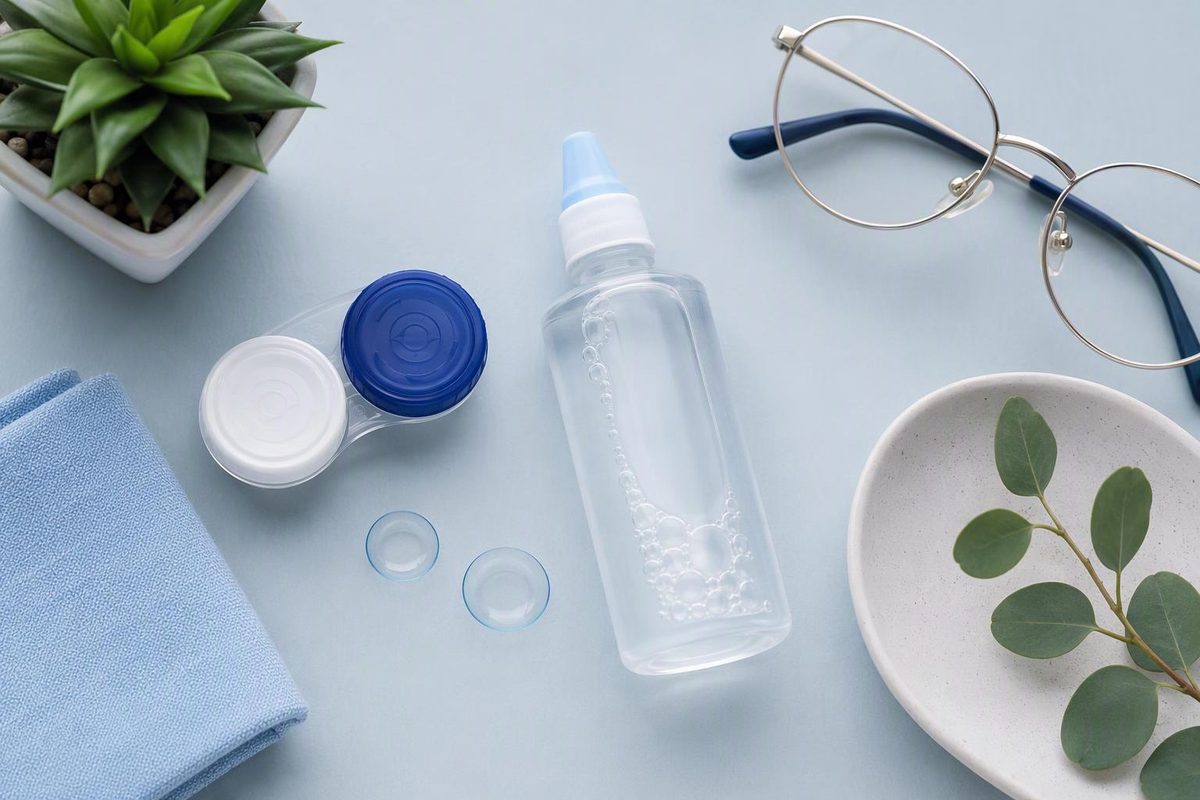
Rewetting eye drops lubricate contact lenses while you wear them, helping relieve lens-related dryness and discomfort. They may also be called contact lens comfort drops or rehydrating drops. Choose a product that explicitly allows use with your type of contact lens—not simply one labeled “lubricating” or “preservative-free.” Bausch + Lomb’s product information illustrates how lens compatibility varies between formulas.
If you have eye pain, light sensitivity, sudden blurry vision, redness or unusual discharge, remove your contacts and seek same-day eye care. Call your eye-care professional immediately rather than trying more drops, and do not resume lens wear until advised. These can be signs of a contact-lens-related infection, according to the CDC.
Rewetting drops vs. artificial tears vs. contact solution
The key difference is what the product is intended to do—and whether it can go into your eye while a lens is in place.
| Product | Main purpose | What to check |
|---|---|---|
| Contact lens rewetting drops | Lubricate and rewet lenses during wear | Your lens type must be included in the directions |
| Artificial tears | Temporarily relieve eye-surface dryness | Only use over contacts if the packaging explicitly permits it |
| Multipurpose contact lens solution | Clean, rinse, disinfect and store soft lenses | Do not assume a lens-care solution is also an in-eye drop |
The American Academy of Ophthalmology (AAO) advises choosing drops clearly labeled for contact lens wear when applying them over lenses. For other lubricants, remove your contacts and follow the product’s instructions about reinsertion.
Rewetting drops do not replace lens cleaning or disinfection. Saline is not a disinfectant either. Hydrogen peroxide lens-care solution requires its special neutralizing case and the full waiting time before lenses can be worn; it is not a substitute for rewetting drops. The CDC’s lens-care guidance explains these distinctions.
If you do not wear contacts, start with our guide to choosing eye drops for dry eyes rather than assuming a contact-lens product is the best fit.
How to choose a compatible drop
Check the exact product, not just the brand. Soft lenses and rigid gas permeable lenses—often shortened to RGP—may have different compatible products.
For example, U.S. manufacturer information checked on October 6, 2026, lists:
- Renu Contact Lens Moisture Drops: a preserved formula for soft contact lenses. Renu package insert
- Biotrue Hydration Boost Contact Lens Rehydrating Drops: a preservative-free formula for soft lenses, including daily disposables, and RGP lenses. Bausch + Lomb product information
These are compatibility examples, not a ranking. Match the full product name and directions on the package you buy; similar names do not establish interchangeability.
Preservative-free does not automatically mean contact-safe. You still need explicit lens-wear instructions. The AAO recommends preservative-free, contact-compatible lubricants for use over lenses, and particularly favors preservative-free drops when lubricants are needed more than four times daily over a prolonged period. See its drop-selection guidance and our preservative-free eye drop guide.
Using rewetting drops safely
- Wash your hands before handling your lenses.
- Use the amount stated on your product. There is no universal dose. For example, Blink Contacts directs users to apply one or two drops to each eye with lenses in place, then blink several times. That instruction applies to that formula, not every rewetting drop. Blink Contacts directions
- Keep the bottle tip from touching your eye, fingers or any surface, and replace the cap after use.
- Follow both the expiration date and the after-opening discard instructions. Do not transfer drops into another container. These precautions appear in the Renu package insert.
If discomfort persists despite using the drop as directed, remove the lens and contact your eye-care professional rather than repeatedly adding drops to keep wearing it. The Renu label gives this instruction explicitly.
When drops are becoming a daily workaround
Rewetting drops can provide comfort, but relief does not establish why your eyes are uncomfortable. Contact-lens-related problems can include dry eye, allergies and other eye-surface conditions; the CDC lists several possibilities.
If you routinely rely on lubricants more than two or three times a day, the AAO recommends an eye examination. Ask your eye-care professional to review both your eye surface and your lens-wear and care routine. A compatible drop is a comfort aid—not permission to push through persistent symptoms.
This article provides general information, not a diagnosis or individualized treatment advice.