
Eyelid Margin: What It Is, Symptoms and Care
See where lashes and oil glands meet, what redness, crusting or a lump may suggest, gentle care for mild irritation, and same-day warning signs.
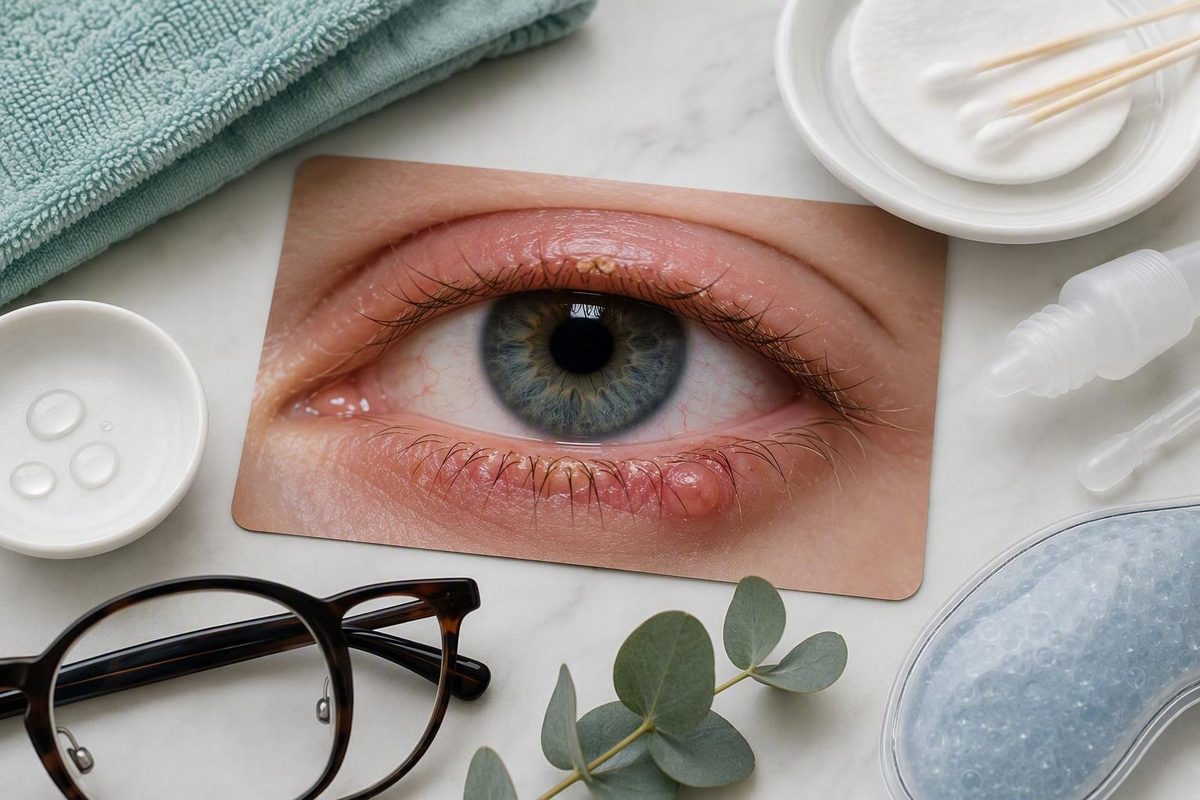
The eyelid margin is the edge of the upper or lower eyelid where the eyelashes grow and the meibomian oil glands open. Redness, crusting, tenderness, or a lump in this small area may fit blepharitis, meibomian gland dysfunction (MGD), a stye, or a chalazion, but overlapping symptoms cannot confirm which condition you have.
Mild, limited irritation may respond to a comfortably warm compress and gentle lash-line cleaning. Sudden vision changes, eye pain, or light sensitivity need same-day clinician attention. Ordinary crusting around the lashes is different from discharge coming from the eye.
What is the eyelid margin?
The eyelid margin is the narrow edge of each eyelid. The eyelashes arise along this edge, while rows of meibomian glands inside the upper and lower lids open just behind the lashes.
These glands release oil onto the tear film. The oil helps lubricate blinking, stabilizes the tears, and slows evaporation. Along the lower eyelid, a small reservoir of tears called the tear meniscus rests against the margin. Together, the lashes, lash bases, gland openings, eyelid edge, tear meniscus, and oily tear-film layer form a connected system rather than separate structures.
This explains why a change at the eyelid margin can affect both the lid and the exposed eye surface. Crusts around the lash bases may irritate the skin and follicles. Thick or obstructed gland secretions may weaken the tear film’s oily covering. Either pattern can feel like dryness, burning, grittiness, or watering rather than simply a sore eyelid. The anatomy and tear-film role of the meibomian glands are described in the Worcestershire Acute Hospitals NHS Trust dry-eye and blepharitis guide.
Why eyelid-margin problems can cause dry, watery, or blurry eyes
If gland openings become obstructed or the secretion becomes thick or altered, the oil may not spread evenly. Tears may then evaporate more quickly, leaving the surface of the eye less stable and more easily irritated.
Possible symptoms include:
- Dryness or burning
- A sandy or gritty sensation
- Itching or soreness
- Reflex watering
- Discomfort during blinking
- Intermittent or fluctuating blur
Watering does not necessarily rule out a tear-film problem. Irritation can trigger extra reflex tears, but those tears may still lack a stable oily covering. Meibomian oil normally lubricates the eye and slows evaporation, while the tear layer also provides a smooth surface needed for clear vision, according to Guy’s and St Thomas’ NHS Foundation Trust.
Changes visible at the eyelid margin may include redness, crusts, scales, swelling, thickened edges, lash loss, or small blood vessels. Symptoms can also include itching, burning, soreness, watering, or blur. No single finding establishes a diagnosis.
Anterior blepharitis, posterior blepharitis, MGD, dry eye, skin inflammation, irritant exposure, and a localized blocked or infected gland can overlap. More than one may be present at the same time.
Rosacea is associated with MGD and eyelid-margin vascular changes, but that association does not show what is causing a particular person’s symptoms. An examination may need to account for the overall pattern, skin findings, medical history, medications, contact-lens use, and other possible contributors.
Blepharitis, meibomian gland dysfunction, stye, or chalazion?
This table is a pattern guide, not a diagnostic test.
| Typical pattern | Location | Possible symptoms | Appropriate next step |
|---|---|---|---|
| Anterior blepharitis: diffuse inflammation, often with crusts or scales | Eyelid skin, lash bases, and eyelash follicles | Itching, burning, redness, soreness, debris, or lashes sticking together | Gentle hygiene may help mild symptoms; arrange an examination if the problem persists or recurs |
| Posterior blepharitis or MGD: altered or obstructed oil secretion | Meibomian glands and their openings behind the lashes | Dryness, grittiness, burning, thick secretions, watering, or fluctuating vision | Try cautious supportive care if mild; seek an eye examination if symptoms continue |
| Stye: localized, usually painful lump | On or inside the eyelid, often near an eyelash | Tenderness, redness, swelling, watering, and sometimes a yellow point | Use a warm compress and do not squeeze it; seek help if it keeps enlarging, affects vision, or persists despite supportive care |
| Chalazion: harder lump that is typically less painful | Within the eyelid | Firm swelling, pressure, or irritation | Arrange an assessment if it persists or repeatedly returns in the same place |
| Urgent pattern | Eyelid, eye surface, or surrounding tissue | Severe pain, marked swelling, light sensitivity, vision change, pus or discharge from the eye, or spreading redness | Seek same-day or other prompt clinical assessment, depending on the symptom |
Blepharitis means inflammation of the eyelid margin. Anterior blepharitis mainly involves the eyelid skin, eyelash bases, and follicles. Posterior blepharitis primarily involves the meibomian glands and their openings. These categories describe where the findings are concentrated, but the two forms frequently overlap, as outlined in the American Academy of Ophthalmology’s EyeWiki overview.
A stye is more consistent with a small, localized, painful lump, often close to an eyelash. A chalazion is generally harder and less painful. Tenderness can change, however, and the appearance or feel of a lump cannot confirm its cause. The NHS stye guidance recommends urgent help when a suspected stye is very painful or swollen, affects vision, produces pus from the eye, or appears to be spreading.
A cautious eyelid-margin care routine
For mild, limited irritation without warning signs, use a simple routine rather than repeatedly adding new products:
- Wash and dry your hands. Use clean materials each time.
- Remove eye makeup gently. Do not apply more makeup over an actively irritated margin.
- Apply comfortable warmth. Place a clean, comfortably warm—not hot—compress over the closed eyelid.
- Clean the lash line gently. After the compress, wipe along the lash bases without rubbing the eyeball or inner eye surface.
- Stop if symptoms worsen. Discontinue the routine if it causes substantial pain, skin irritation, increasing redness, or worsening swelling.
The compress should feel comfortably warm and must not be hot enough to burn the thin eyelid skin.
For a suspected stye specifically, 5 to 10 minutes, two to four times a day is one general regimen in the NHS guidance. It is not a universal schedule for blepharitis, MGD, chalazia, postoperative eyelids, or every unexplained lump.
Do not:
- Squeeze or burst a stye
- Lance or puncture a lump
- Pull out the eyelash beside it
- Rub the eye surface
- Share cloths or applicators
- Start leftover antibiotic or steroid eye medicine
If symptoms began while wearing a lens, remove it rather than continuing to wear it over an uncomfortable or inflamed eye.
Baby shampoo, antibacterial shampoo, and detergent-based wipes should not be treated as universally safe or preferred eyelid cleansers. Some detergent-containing products may affect the tear film’s oily layer. If plain water and gentle cleaning are inadequate, ask an eye-care professional which product is appropriate instead of moving to increasingly strong cleansers. Also ask your surgeon or eye-care professional before massaging an eyelid after recent eye surgery. These cleanser and postoperative cautions are included in the Worcestershire NHS treatment guide.
Why symptoms may return
Blepharitis is often chronic or recurrent. Symptoms may improve, disappear for a time, and then return. Management may therefore focus on controlling irritation and supporting comfortable gland function rather than promising a permanent cure. Mild blepharitis that causes no symptoms may not require active treatment.
Recurring symptoms may be associated with:
- Meibomian gland dysfunction
- Dry eye
- Oily skin
- Dandruff or scalp scaling
- Rosacea
- Repeated styes or blocked glands
These are associations, not proof of the cause in any individual. Someone may have several contributors at once, such as MGD alongside dry eye and skin inflammation.
A new product may irritate the eyelid skin or tear film, while a previous prescription may not suit the current problem.
Arrange a routine examination for:
- Repeated episodes
- Persistent crusting, burning, or irritation
- Unexplained eyelash loss
- Ongoing symptoms mainly affecting one eye
- A lump that persists despite supportive care
- A lump that keeps enlarging
- A lump that repeatedly returns in the same place
These patterns deserve examination rather than an assumption that the problem is ordinary blepharitis.
What an eye-care professional may examine or prescribe
Because symptoms overlap, an eye-care professional will usually combine your history with a close examination. Symptoms alone often cannot distinguish anterior blepharitis, posterior blepharitis, MGD, a stye, a chalazion, dry eye, allergy, or another eyelid disorder.
A slit lamp provides a magnified view and may be used to assess:
- Crusts, scales, or debris around the lashes
- Redness or thickening of the eyelid margin
- Meibomian-gland openings
- The thickness and quality of expressed oil
- Small dilated blood vessels
- The tear meniscus along the lower lid
- The eye surface and possible corneal effects
A 2025 narrative review reports that eyelid-margin vessels may be harder to see in darker skin. This is an assessment limitation, not evidence of less inflammation or milder disease. The same review notes that vascular assessment methods and related protocols are not yet standardized (PMC).
Treatment depends on what the examination suggests. Artificial tears may sometimes support the eye surface. A clinician may prescribe an antibiotic ointment for selected cases or a temporary steroid eye preparation for particular inflammatory patterns. Antibiotics are not routine treatment for every red, swollen, or crusted eyelid, and steroid eye medicine requires correct instructions and appropriate eye monitoring. Do not use someone else’s prescription or leftover medication from an earlier episode; these clinician-directed options are described in Riverside Eye Center’s blepharitis guidance.
Some clinics offer office procedures for gland obstruction or inflammation, and vascular imaging is being investigated. The appropriate pathway begins with identifying the likely condition and its severity.
When eyelid-margin symptoms need medical attention
Choose the level of care that matches the pattern
Mild supportive care
- Limited redness, grittiness, or crusting
- No significant pain, light sensitivity, vision change, discharge from the eye, marked swelling, or spreading redness
- Try a comfortably warm compress and gentle lash-line cleaning
- Monitor the pattern, recognizing that this article cannot determine the cause
Routine eye examination
- Symptoms keep returning
- Irritation or crusting persists despite gentle care
- Eyelashes are falling out without a clear reason
- One eyelid remains affected
- A lump persists, enlarges, or repeatedly returns
- Contact-lens discomfort continues after the lenses are removed
Same-day clinician attention
- Sudden vision change
- Eye pain
- Light sensitivity
Prompt or urgent assessment
- Severe eyelid pain
- Marked swelling
- Vision being affected
- Pus or discharge coming from the eye
- Redness or suspected infection spreading across the eyelid or around the eye
Sudden vision change, eye pain, and light sensitivity are specifically treated as same-day warning signs under Dry Eye Watch’s safety policy. Do not wait for home care to work if one of these symptoms appears.
The eyelid margin is a small area with an important role in both eyelid health and tear stability. Inflamed lash bases or altered oil glands can produce a mixture of crusting, soreness, dryness, watering, grittiness, and fluctuating vision. Mild problems may respond to comfortable warmth and gentle hygiene, but lumps should not be squeezed and prescription medication should not be started without professional direction. Recurrence, lash loss, or a nonresolving lump warrants an examination, while vision change, pain, light sensitivity, marked swelling, discharge from the eye, or spreading redness requires timely care.
Dry Eye Watch provides general information, not diagnosis or individualized clinical care.