
Why Do My Tears Burn My Eyes? Causes, Relief, and Red Flags
If you are wondering, “Why do my tears burn my eyes?” the simplest answer is that tears may be moving across an eye surface that is already irritated,…
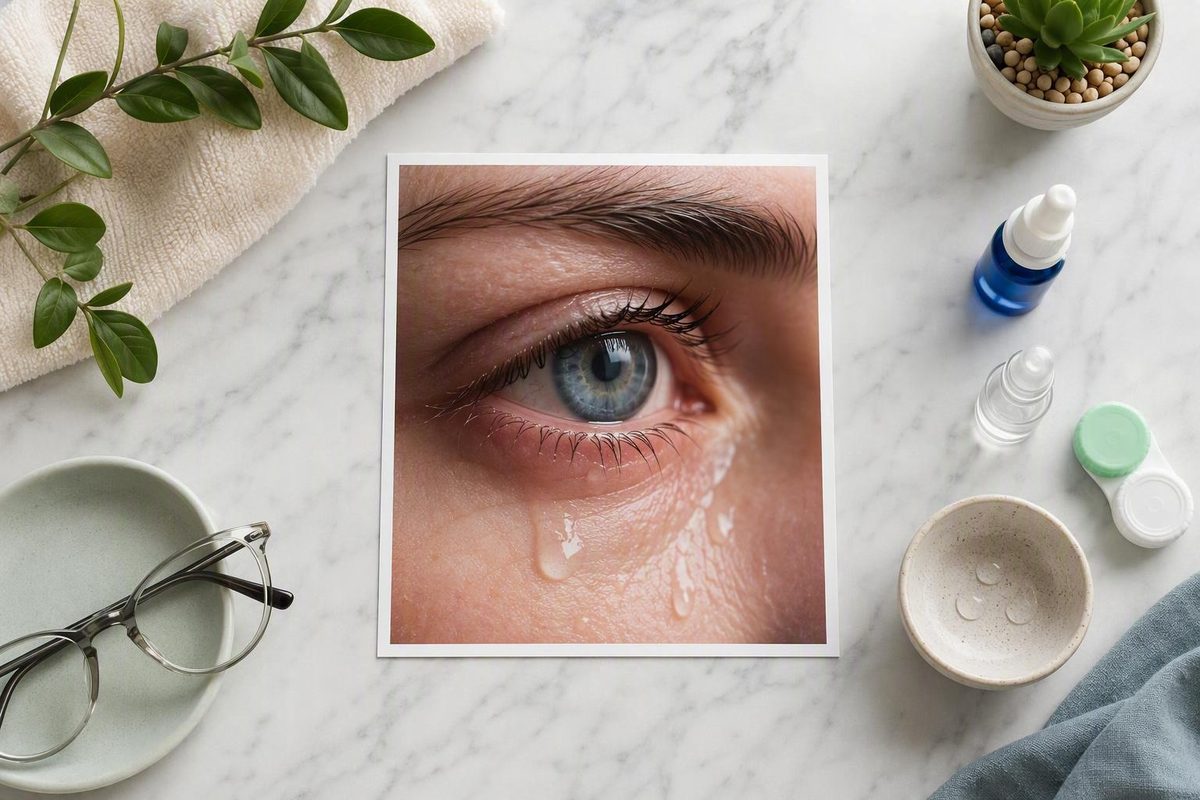
The short answer: the eye surface may be irritated before the tears arrive
If you are wondering, “Why do my tears burn my eyes?” the simplest answer is that tears may be moving across an eye surface that is already irritated, inflamed, or poorly lubricated. Normal tears are not inherently caustic.
Tears ordinarily lubricate the eyes, wash away small particles, and help protect the exposed surface from outside irritants. The tear film is not just water: its watery, oily, and mucus components work together to spread moisture across the eye and limit evaporation. When that balance is disrupted, watering or crying may feel irritating instead of soothing. Cleveland Clinic describes these protective functions and several reasons tears may be accompanied by burning.
It can help to picture the tear film as a coating rather than a stream. A healthy coating spreads evenly, remains on the eye between blinks, and creates a smooth surface for comfort and vision. If there is too little moisture, inadequate oil, uneven spreading, eyelid inflammation, or an outside irritant, the coating may become unstable. A fresh rush of watery tears can then move across a sensitive surface without correcting the underlying problem.
Burning alone cannot identify the cause. Dry eye, allergies, blepharitis, conjunctivitis, environmental exposure, sweat, and facial products can all produce overlapping combinations of stinging, redness, and watering. More than one factor may also be present. Dry air can aggravate an unstable tear film, for example, while rubbing allergy-irritated eyes can add further irritation.
There is not enough evidence to assume that emotional tears universally burn because of extra salt, hormones, proteins, or antibodies. Those substances may be present in tears, but they do not establish the cause of an individual episode. The more practical questions are whether the eye surface was already irritated and whether tears picked up sweat, soap, sunscreen, makeup, or another substance.
Timing and accompanying symptoms are therefore more informative than burning by itself. Consider whether your eyes itch intensely, feel gritty, develop crusting or discharge, become blurry, or burn mainly after a particular exposure. These observations can help you choose a sensible next step, but they cannot replace an eye examination when symptoms persist, worsen, or remain unclear.
Why dry eyes can water and still sting
Watery eyes do not rule out dry eye. Dryness can produce the seemingly contradictory combination of burning, stinging, and tears running down your face.
Dry eye generally involves one or both of these problems:
- The eyes do not produce enough tears to keep the surface comfortably lubricated.
- Tears evaporate too quickly or do not remain evenly distributed over the eye.
Either problem can irritate the exposed surface. That irritation may trigger reflex watering—the eye’s attempt to wash away or compensate for the source of discomfort. Yet the resulting watery tears may drain away quickly and still fail to create a stable, lasting film.
This is the difference between tear quantity and tear quality. You can have plenty of visible water while lacking the balance of oil and mucus needed to slow evaporation, spread moisture, and keep the tear film attached to the eye. Dry eye can consequently cause excessive watering alongside burning, stinging, grittiness, and fluctuating blur. This tear-film overview explains how dry eye can cause both watery tearing and inadequate lubrication.
A possible dry-eye pattern may include:
- Burning or stinging
- Grittiness, sandiness, or scratchiness
- A sensation that something is in the eye
- Redness
-
Intermittent watering
-
Symptoms that worsen during reading, driving, computer work, or other concentrated visual tasks
These clues are suggestive rather than diagnostic. A foreign particle, eyelid inflammation, allergy, infection, or contact-lens problem can cause some of the same symptoms.
Why screens can make the problem more noticeable
People may blink less while concentrating on a computer, phone, game, or detailed task. Longer gaps between blinks give the watery portion of the tear film more time to evaporate, increasing dryness and surface discomfort.
That can create a cycle: the surface dries, vision becomes less stable, the eyes sting, and reflex watering begins. Looking away and blinking may provide temporary relief, only for the discomfort to return when prolonged concentration resumes.
Other possible dry-eye contributors
Dry or windy surroundings can speed evaporation. Indoor heating or air conditioning may reduce humidity, while smoke, dust, and air pollution can combine dryness with direct irritation.
Contact-lens wear may coincide with burning, but lens-associated symptoms should not automatically be labeled as routine dry eye. Fit, contamination, material on the lens, or sensitivity to a lens-care product may also be relevant. Tell an eye-care professional that you wear contacts, particularly if symptoms are persistent or accompanied by pain, redness, light sensitivity, discharge, or reduced vision.
Aging, certain health conditions, and some medications may also contribute to dry-eye symptoms. These possibilities are worth discussing with a clinician, especially if symptoms began after a change in health or medication. Do not stop a prescribed medicine on your own because you suspect it is affecting your eyes.
Dry eye and allergy symptoms are especially easy to confuse. Burning, redness, and watering may occur in either pattern. Intense itching and puffy eyelids lean more toward allergy, while grittiness, fluctuating vision, and worsening during prolonged visual tasks lean more toward dryness. Even so, symptoms alone cannot provide a firm diagnosis.
Other common patterns: allergies, blepharitis, conjunctivitis, and irritants
The aim is not to diagnose yourself from one symptom. Instead, look for clusters of signs and triggers that make one pattern more plausible than another.
Allergy-like symptoms
Eye allergies often cause intense itching. Burning and watering may occur, but the urge to rub may be more prominent than it is with uncomplicated dry eye.
Other possible clues include:
- Redness
- Puffy or swollen eyelids
- Watery discharge
- Symptoms in both eyes
- Sneezing, nasal congestion, or a runny nose
- Seasonal flares
- Symptoms after exposure to pollen, dust, mold, or pet dander
Allergies can coexist with dry eye, so the pattern is not always tidy. Rubbing may further irritate the surface, and cosmetics or skincare products can add another possible trigger. General comparisons of these conditions emphasize that intense itching, tearing, swelling, and allergen-related flares favor an allergy pattern, but an examination is needed to identify the cause reliably. ReFocus Eye Health summarizes the overlapping patterns of dry eye, eye allergy, and blepharitis.
Blepharitis-like symptoms
Blepharitis is inflammation or irritation along the eyelid margins. Problems involving the eyelid oil glands can destabilize the tear film and allow tears to evaporate more quickly, so the eyes may feel both dry and watery.
Possible clues include:
- Red, itchy, or swollen eyelid edges
- Crusts or dandruff-like flakes around the eyelashes
- Lashes stuck together on waking
- Burning or stinging
- Watery eyes
- Foamy tears or small bubbles in the tears
- A gritty or foreign-body sensation
- Intermittent blurry vision
The National Eye Institute identifies burning, watering, crusty eyelashes, swollen eyelids, and foamy tears as possible features of blepharitis. Diagnosis requires an eye examination, and ongoing eyelid care is often part of management. See the National Eye Institute’s blepharitis guidance.
Symptoms may fluctuate and resemble dry eye, allergy, or conjunctivitis. Crusting concentrated along the lash line is a useful clue, but it does not prove the diagnosis.
Conjunctivitis-like symptoms
Conjunctivitis means inflammation of the conjunctiva, the tissue covering the white of the eye and lining the eyelids. It may be viral, bacterial, allergic, or irritant-related, and those forms do not all require the same treatment.
Possible features include:
- Pronounced redness
- Burning or grittiness
- Excessive watering
- Eyelid or eyelash crusting
- Discharge
- Eyelids that stick together
- Recent contact with someone who has similar symptoms
Thick, greenish, colored, or pus-like discharge warrants clinical attention. Redness and watering alone cannot determine whether conjunctivitis is viral, bacterial, allergic, or caused by an irritant. Because management differs, do not assume every red or crusted eye needs an antibiotic. UF Health identifies thick or pus-like discharge, eye pain, reduced vision, light sensitivity, and increasing eyelid swelling as reasons to contact a medical professional. Review UF Health’s guidance on eye burning, itching, and discharge.
Environmental and chemical irritation
A brief episode that begins immediately after exposure may fit an irritant pattern. Possible triggers include:
- Cigarette smoke or other fumes
- Air pollution or smog
- Dust and sand
- Wind
- Low humidity
- Strong fragrances
- Pool chlorine
- Household cleaners
- Soap or facial cleanser
- Makeup or makeup remover
Symptoms caused by an ordinary, low-risk irritant may improve after exposure ends and the material is removed. Cleveland Clinic distinguishes everyday irritants from causes of burning that may require medical care.
Environmental exposure may also uncover an existing tear-film problem. Two people can encounter the same windy or smoky setting, but the person whose eyes are already dry or inflamed may experience more burning.
Because these patterns overlap, arrange an examination when symptoms keep returning, intensify, affect daily activities, or remain difficult to explain.
Why crying, sweat, makeup, and skincare can make the sting worse
When burning occurs mainly during crying, it is tempting to blame emotional tears. A more useful explanation is that crying changes what moves across the eye surface.
A large volume of tears may carry material from the eyelids, lashes, forehead, or surrounding skin toward the eyes. If the surface was already dry, inflamed, or exposed to smoke or dust, the new tears may simply make that sensitivity more noticeable.
Possible contributors include:
- An unstable tear film before crying began
- Sweat entering the eye
- Sunscreen or moisturizer moving from the skin into the eye
- Makeup, makeup remover, or skincare residue mixing with tears
- Smoke, dust, fragrance, or cleanser already on the lashes
- Repeated wiping or rubbing
None of these possibilities establishes the cause in a particular person. Likewise, there is not enough basis to conclude that emotional-tear hormones or proteins are responsible for the burning.
Sweat can carry more than salt
Sweat can sting when it enters the eyes. It may also collect sunscreen, foundation, eye makeup, lotion, cleanser, or hair products as it travels down the face. The resulting mixture may irritate an already sensitive eye surface. This optometry overview describes sweat and facial products as possible contributors to burning tears.
This pattern may occur during exercise, hot weather, yard work, or any activity combining sweat with wind, dust, or facial products. If burning repeatedly follows use of one product, stop applying that product near the eyes while you assess the pattern.
Makeup and skincare can reach the tear film indirectly
A product does not have to be placed directly on the eyelid margin to reach the eye. Tears, sweat, and wiping can move it.
Possible triggers include:
- Sunscreen applied close to the eyelids
- Facial moisturizer
- Foundation or concealer
- Eyeliner or mascara
- Makeup remover
- Face wash
- Fragranced skincare
- Hair products that run down the forehead
A repeatable link between one product and the symptoms is more informative than the product category alone.
Rubbing can make irritation worse
Rubbing adds friction to an already uncomfortable surface and can move material from the eyelids or hands toward the eye. When possible, blot tears from the cheek or closed eyelids rather than pressing, scrubbing, or rubbing the eye itself.
A practical trigger checklist
When burning follows crying, watering, or sweating, ask:
- Did I recently apply sunscreen, makeup, lotion, cleanser, or another facial product?
- Was I sweating before the burning started?
- Was I exposed to smoke, dust, fragrance, wind, or cleaning products?
- Had my eyes already felt dry, gritty, or tired?
- Had I been looking at a screen for a long time?
- Did I rub or repeatedly wipe my eyes?
- Is the episode limited to a particular setting, season, or product?
- Are there additional symptoms such as intense itching, crusting, discharge, pain, light sensitivity, or blurry vision?
A clear, repeatable trigger may support mild irritation as an explanation. Persistent symptoms without an obvious trigger warrant closer assessment.
A symptom-and-trigger guide for narrowing the possibilities
Use this table to organize what you notice, not to make a definitive diagnosis. Dry eye, allergy, blepharitis, and conjunctivitis have overlapping symptoms, so no single row can confirm what is wrong. This dry-eye and allergy comparison illustrates why patterns and triggers are useful but not diagnostic.
| Pattern | Supporting clues | Common triggers or context | Appropriate next step |
|---|---|---|---|
| Possible dry eye | Burning, stinging, grittiness, scratchiness, foreign-body sensation, redness, fluctuating blur, watery eyes | Screens, reading, wind, low humidity, heating or air conditioning; contact-lens wear may be relevant but needs separate consideration | Reduce evaporation and exposure; consider lubricating artificial tears; arrange an examination if symptoms recur or persist |
| Possible eye allergy | Intense itching, watering, redness, puffy eyelids, nasal allergy symptoms, often both eyes | Pollen, dust, mold, pets, seasonal exposure | Avoid the suspected trigger, do not rub, and try a cool compress; ask a professional before choosing medicated drops |
| Possible blepharitis | Crusty lashes, flaky eyelid margins, red or swollen lids, foamy tears, burning, watering | Symptoms on waking, recurring eyelid irritation, oily or flaky debris around lashes | Consider a warm compress and gentle eyelid cleaning; seek an eye examination if symptoms persist |
| Possible conjunctivitis | Pronounced redness, grittiness, watering, crusting, thick or colored discharge, similar symptoms in a close contact | Infectious exposure, allergy, or irritant exposure | Obtain clinical assessment, especially with thick discharge or worsening redness; do not assume the cause or self-start prescription medication |
| Possible ordinary irritant exposure | Burning begins abruptly after contact and may improve when exposure ends | Smoke, dust, pollen, sweat, soap residue, chlorine, makeup, sunscreen | Avoid further exposure, do not rub, and gently rinse away an ordinary suspected irritant |
| Unclear or potentially concerning | Pain, vision change, substantial light sensitivity, persistent foreign-body sensation, marked swelling or redness | Injury, potentially harmful chemical exposure, contact-lens problem, or no clear trigger | Seek prompt professional assessment instead of continuing to experiment with home care |
Before deciding what to do, note:
- One eye or both: This cannot establish a diagnosis, but it helps a clinician assess a localized particle, injury, or infection versus a broader exposure.
- Start time: Record whether symptoms began suddenly or gradually.
- Preceding exposure: Include products, activities, weather, smoke, dust, swimming, cleaning, and contact-lens use.
- Duration and recurrence: Note whether this is the first episode or a repeating pattern.
- Vision: Pay attention to blur, reduced vision, double vision, or a sudden change.
- Light sensitivity: Distinguish mild annoyance from substantial discomfort or difficulty opening the eye in light.
- Discharge: Distinguish ordinary tears from thick or colored material.
- Pain and swelling: These features can change how quickly professional care is needed.
Do not use one clue to rule a condition in or out. Allergies can burn, dry eyes can itch, blepharitis can blur vision, and conjunctivitis can water without obvious discharge. An eye examination is the appropriate way to resolve a persistent or uncertain pattern.
What may help mild burning at home
Home care should match the suspected pattern. Rinsing, artificial tears, cool compresses, and warm compresses are not interchangeable treatments for every cause.
After ordinary dust, pollen, sweat, or product exposure
Move away from the trigger and avoid further exposure. Do not rub the eyes. If an ordinary irritant such as dust, pollen, sweat, soap residue, or a facial product appears responsible, gently rinsing it away may reduce continued contact.
Stop using a suspected cosmetic or skincare product near the eyes while observing whether symptoms improve. This advice is limited to ordinary irritants. Do not treat a potentially harmful chemical splash as a routine product exposure or assume that a brief rinse is a complete response; obtain immediate professional or emergency guidance appropriate to the substance and situation.
For a dryness-like pattern
Lubricating artificial tears may provide temporary support when dryness or tear-film instability is responsible. Avoid choosing a product solely because it is marketed for “red eyes,” allergies, or infection, because different types of drops serve different purposes.
Environmental measures may also help:
- Take breaks during sustained screen use.
- Blink fully several times when concentrating.
- Increase indoor humidity when the air is dry.
- Avoid having fans or vents blow directly toward the eyes.
- Use suitable eye protection in wind, dust, or airborne irritants.
- Note whether contact-lens wear coincides with symptoms.
Artificial tears, screen breaks, humidification, compresses, and ordinary-irritant removal are all described as cause-dependent supportive measures rather than substitutes for diagnosis. Cleveland Clinic outlines these general home-care options and the limits of self-care.
For allergy-like itching
Reduce exposure to the suspected allergen and use a clean, cool compress over closed eyelids. Avoid rubbing, even when itching is intense.
Ask a pharmacist, optometrist, ophthalmologist, or other qualified clinician before selecting medicated allergy drops. Allergy, dry eye, infection, and eyelid inflammation can overlap, and a product suited to one pattern may not address another.
For eyelid crusting or a blepharitis-like pattern
A clean, warm compress over closed eyelids may soften crusts and support eyelid comfort. It can be followed by gentle cleaning of the eyelid margins, without pressing on the open eye.
Persistent eyelid inflammation warrants assessment and an individualized care plan. Do not use someone else’s prescription medication or an old prescription left over from a previous episode.
What not to self-start
Do not independently start antibiotic, antiviral, steroid, or anesthetic eye medication. Treatment depends on the diagnosis: antibiotics do not treat viral infections, and prescription eye medicines should be used under appropriate clinical supervision.
For broader related coverage, Dry Eye Watch lists the educational article “Why Do My Eyes Burn? The Usual Causes & What Fixes Each,” covering dry eye, screens, allergies, blepharitis, and irritants.
When burning tears need an eye examination or prompt care
Occasional mild burning after an obvious, ordinary irritant may improve when exposure ends. Recurrent, unexplained, or worsening symptoms are different.
Arrange an eye examination if the burning:
- Keeps returning
- Becomes more frequent or intense
- Interferes with reading, work, driving, sleep, or contact-lens wear
- Does not improve with basic supportive measures
- Is accompanied by recurring redness, eyelid inflammation, or significant or fluctuating blur
- Produces an ongoing sensation that something is stuck in the eye
- Has no clear trigger
- Occurs with discharge or crusting that does not settle
Do not rely on a rigid number of hours or days when symptoms are severe. Warning signs matter more than an arbitrary waiting period.
Seek prompt or same-day medical assessment for:
- Severe eye pain
- Sudden, reduced, or otherwise significant vision change
- Substantial light sensitivity
-
Extreme or rapidly worsening redness
-
Thick, colored, or pus-like discharge
- An eye injury
- Suspected exposure to a potentially harmful chemical
- A continuing foreign-body sensation, particularly after a particle entered the eye
UF Health identifies excessive pain, light sensitivity, decreased vision, increased eyelid swelling, and thick or pus-like discharge as reasons to contact a medical professional. Its clinical guidance provides further detail on these warning signs.
A suspected chemical exposure or eye injury should not be managed as ordinary dryness. Do not rely on the routine-irritant suggestions in this article as complete treatment. Obtain immediate professional or emergency guidance appropriate to the substance or injury.
This article provides general information and cannot diagnose the cause of an individual’s symptoms. Stinging tears are best treated as a signal to consider the condition of the eye surface and recent exposures—not as proof that normal tears are damaging your eyes. Match simple relief to the symptom pattern, avoid rubbing and unprescribed medication, and seek prompt care when warning signs are present.
Frequently asked questions
Why do my eyes water if I have dry eye?
Dryness can irritate the eye surface and trigger reflex watering. Those visible tears may be mostly watery and may drain or evaporate without restoring the stable coating the eyes need. If the tear film lacks adequate oil or mucus support, abundant tears can coexist with burning, grittiness, and intermittent blur. This explanation of tear-film disruption describes the dry-eye watering paradox.
Watery eyes therefore do not automatically mean the surface is well lubricated. Tear quality and stability matter as well as the amount of liquid you can see.
Does itching mean my burning tears are caused by allergies?
Not necessarily. Intense itching—especially in both eyes, with puffiness, watering, nasal symptoms, seasonal flares, or a clear allergen exposure—supports an allergy-like pattern. Pollen, dust, mold, and pet dander are possible triggers. A comparison of dry eye and eye allergies describes these general distinctions.
Itching can also occur with dryness, blepharitis, or irritation. If the pattern is persistent or accompanied by pain, abnormal discharge, light sensitivity, or vision changes, seek an eye examination rather than relying on itching alone.
Can sweat, sunscreen, makeup, or face wash make my tears sting?
Yes. Sweat may sting directly and can carry sunscreen, makeup, lotion, cleanser, or other products toward the eyes. Crying may do something similar by moving residue from the eyelids, lashes, or surrounding skin across the eye surface. Optometry guidance describes sweat and carried facial products as possible triggers.
Avoid rubbing, gently rinse away an ordinary suspected irritant, and stop using a product that repeatedly triggers symptoms near the eyes. A strong cleaner or another potentially harmful chemical requires immediate professional or emergency guidance rather than routine home care.
Are warm or cool compresses better for burning eyes?
It depends on the symptom pattern. A cool compress may soothe allergy-like itching and puffiness. A warm compress is more commonly used when crusting, flaky eyelid margins, or a blepharitis-like pattern is present. The National Eye Institute includes warm compresses and eyelid cleaning among common blepharitis-management measures.
Neither type of compress identifies or cures every cause of burning. Use a clean compress over closed eyelids, and arrange an examination if symptoms recur, worsen, or include pain, discharge, substantial light sensitivity, or vision changes.
When should I see an eye doctor for burning tears?
Arrange an examination when episodes keep returning, worsen, interfere with daily activities, or do not improve with basic supportive care. Persistent redness or swelling, significant or fluctuating blur, abnormal discharge, and a continuing foreign-body sensation also deserve professional evaluation.
Seek prompt or same-day care for severe pain, sudden or reduced vision, substantial light sensitivity, marked swelling, extreme redness, injury, suspected harmful chemical exposure, or thick pus-like discharge. Severe pain, sudden vision loss, pus, and extreme redness are among the warning signs identified in eye-care guidance.