
How to Check for Eyelash Mites: Clues vs Proof
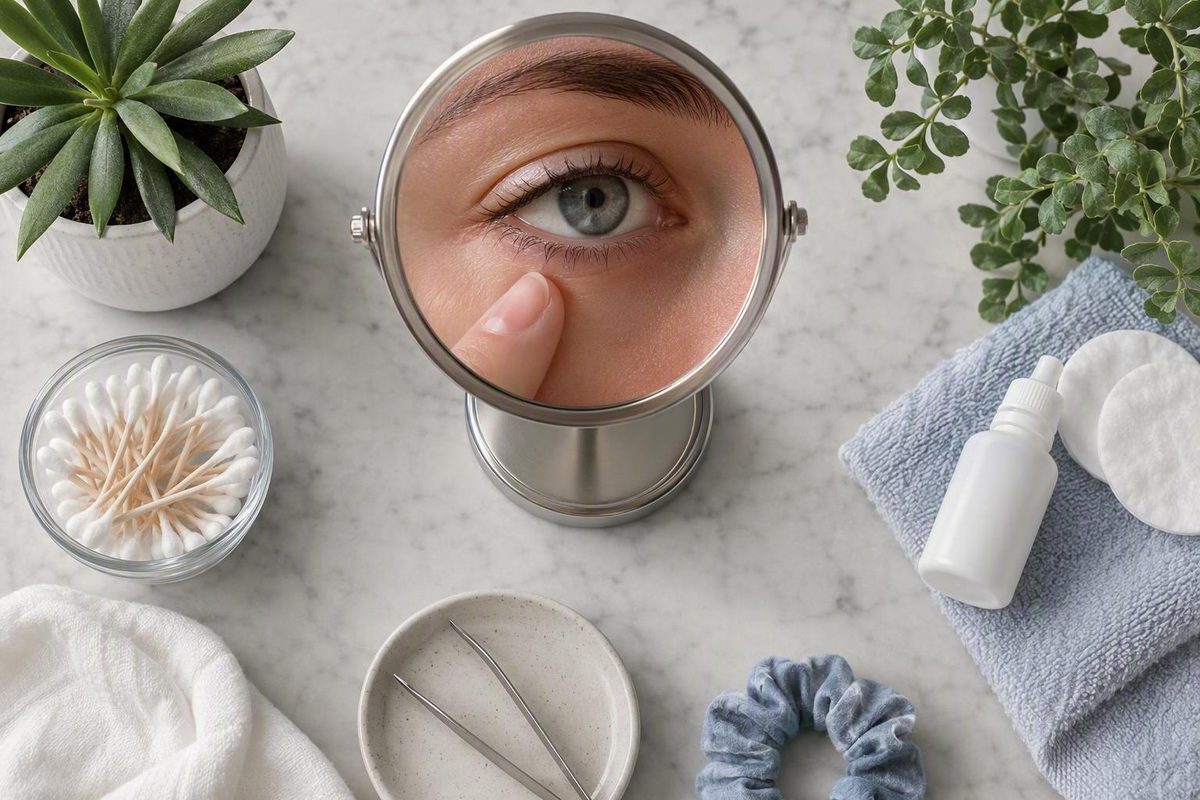
A mirror check may raise suspicion when irritation persists and debris appears fixed around individual lash roots, but it cannot confirm Demodex as the cause.
The short answer: look for clues, but do not treat them as proof
You cannot confirm at home that eyelash mites are causing your symptoms. A mirror check may raise suspicion—especially when irritation persists and material appears fixed around individual lash roots—but it cannot establish that Demodex mites are responsible.
Demodex mites are microscopic, measuring only a fraction of a millimeter. An eye-care professional can inspect the eyelids under clinical magnification and, when necessary, examine a sample microscopically (Cleveland Clinic).
A practical home self-check has three parts:
- Notice whether eyelid symptoms persist. Look for recurring lash-line itching, crusting or sticky lashes after waking, red or swollen eyelid margins, burning, grittiness, dryness, tearing, or irritation.
- Look at where debris is attached. Loose sleep crust is nonspecific. Pale, waxy material wrapped closely around the bases of individual lashes is more suggestive and worth showing an eye-care professional.
- Screen for warning signs. Pain, sudden or significant vision changes, light sensitivity, trauma, marked redness or swelling, or thick colored discharge should not be attributed to mites without prompt clinical assessment.
The useful clue is a pattern rather than one symptom. Persistent lash-line itching, lashes that stick together in the morning, and cylindrical debris around several lash roots are more suggestive together than an isolated episode of mild dryness. Even this cluster does not prove the cause.
Dry eye, allergies, blocked meibomian oil glands, conjunctivitis, bacterial or seborrheic blepharitis, and other eyelid conditions can produce overlapping redness, itching, crusting, burning, or blurry vision. More than one condition can also be present at the same time.
The relevant condition is not simply the presence of a mite. It is mite-associated eyelid inflammation, commonly called Demodex blepharitis. The clinical question is whether Demodex plausibly explains the inflammation and symptoms—not whether a microscopic organism could be found somewhere on the skin.
Eyelash mites can be normal; inflammation is the concern
Demodex are microscopic mites that live in or near facial hair follicles and eyelid glands. Two species are relevant around the eyes:
- Demodex folliculorum primarily inhabits eyelash follicles.
- Demodex brevis inhabits eyelid oil glands, including the meibomian glands.
You cannot distinguish these species by looking at your eyelids. Their locations matter mainly because they help explain why a possible Demodex-related problem may involve both the lash roots and the glands that contribute oil to the tear film. UCLA Health describes the mites as organisms that live in or near facial hair follicles and notes that small populations are ordinarily harmless parts of the body’s microbiome (UCLA Health).
It helps to separate three situations that are often confused:
- Normal colonization: Mites are present but cause no noticeable trouble.
- A larger population without symptoms: A person may have relatively high numbers without obvious inflammation or discomfort.
- Demodex blepharitis: The overall clinical picture suggests that Demodex is associated with inflamed eyelid margins and related symptoms.
There is no agreed mite-count threshold in the supplied evidence that cleanly separates harmless colonization from disease. Some people can have many mites without noticeable symptoms, and irritated eyelids may have several contributing causes. The relationship is not necessarily one-way: mites may contribute to an unhealthy eyelid environment, while inflammation or blocked glands may also create conditions in which mites multiply.
For that reason, the word “infestation” can be misleading when used without context. It can make normal colonization sound like an emergency and encourage overly aggressive cleaning. Mites do not necessarily require treatment when they are causing no problems.
Having Demodex is also not evidence that you are unclean. The American Academy of Ophthalmology describes Demodex as part of the normal skin microbiome, notes that some people with many mites have no symptoms, and states that their presence is not related to poor personal hygiene (American Academy of Ophthalmology).
The useful distinction is simple: mites can be present without disease; persistent inflammation is the concern.
Symptoms that may occur with Demodex blepharitis
Possible Demodex-related symptoms are easier to understand when grouped by location. Cleveland Clinic lists itching, swollen eyelids, redness, crusting, dryness, irritation, and a foreign-body sensation among possible features, while emphasizing the role of an eye examination in diagnosis (Cleveland Clinic).
None of the following should be treated as a stand-alone diagnostic sign.
Eyelid-margin symptoms
Possible findings along the edge of the eyelid include:
- Persistent itching, particularly around the lash line
- Red or swollen eyelid margins
- Crusting or flakes around the eyelashes
- Sticky lashes
- Lashes stuck together after waking
- Ongoing irritation at the lash roots
- Waxy, tube-shaped material around individual lash bases
Itching or crusting may be more noticeable late at night or after waking. Demodex are described as being active at night, but symptom timing is only a supporting clue. Allergies, dry eye, the sleeping environment, and other forms of blepharitis can also cause morning discomfort.
Eye-surface sensations
The eyes themselves may feel:
- Burning or stinging
- Gritty or sandy
- Dry
- Irritated
- Watery
- As though something is in them
These sensations are highly nonspecific. Someone with ordinary dry eye or meibomian-gland dysfunction may describe the same discomfort. Tearing does not rule out dryness because an irritated eye may feel dry at one time and water at another.
Fluctuating blurry vision can accompany eyelid and tear-film problems, but it has many possible causes. It should not be used to conclude that mites are present. New, sudden, substantial, or persistent vision change deserves clinical assessment rather than self-diagnosis.
Lash changes and other supporting clues
Additional possible clues include:
- Recurrent styes
- Eyelashes that thin or fall out
- Brittle or easily broken lashes
- Lashes growing in the wrong direction
- Persistent debris at the lash roots
These findings may justify an examination, but they are not specific to Demodex. Styes involve eyelid glands and can occur without a clinically important mite problem. Lash loss or misdirection can also have other causes that require evaluation.
An exam-worthy pattern would be morning itching plus sticky lashes and persistent, closely attached debris around several lash roots.
The conditions are not mutually exclusive, however; gland dysfunction and Demodex-associated inflammation may coexist.
The key is persistence and clustering. One itchy evening, one flake, or an occasional dry sensation is not a reliable “eyelash-mite symptom.” Recurrent lash-line findings that fail to settle are more informative, but they remain clues rather than a diagnosis.
Collarettes: the most characteristic lash-line clue
A collarette is a waxy, cylindrical or tube-shaped sleeve wrapped tightly around the base of an individual eyelash. In plain language, it may resemble a white or pale dandruff-like cuff encircling a lash exactly where it emerges from the eyelid.
The attachment pattern distinguishes a suspected collarette from ordinary crust:
- Collarettes closely surround individual lash shafts at their bases.
Cylindrical lash-root debris draws clinical attention because it is a characteristic finding associated with Demodex blepharitis. The American Academy of Ophthalmology describes waxy cylindrical sleeves around lash bases as an important sign used to support a probable diagnosis, while noting that direct microscopy may be used to observe mites (American Academy of Ophthalmology).
That does not mean a reader-identified collarette proves that mites are causing the problem. Even genuine cylindrical debris must be interpreted alongside symptoms and the rest of the eye examination.
If you want to look, observe in good room lighting without manipulating the eyelid. Do not:
- Pull out eyelashes to inspect them
- Scrape the lash roots
- Use tweezers, needles, or sharp tools near the eye
- Dig at fixed debris with a fingernail
- Aggressively scrub in an attempt to remove mites
Removing a lash for microscopic examination is a clinical procedure, not a home test.
Persistent cuff-like sleeves around several lash bases are a reason to schedule an eye examination, especially when they occur with itching, redness, swelling, recurrent styes, or changes in the lashes. Think of collarettes as a characteristic reason to ask whether Demodex could be involved—not as permission to diagnose yourself.
How eyelash-mite symptoms compare with common look-alikes
Demodex blepharitis is only one possible explanation for itchy, crusty, red, dry, or irritated eyelids. The location and combination of findings may make one cause more plausible, but symptoms overlap substantially.
| Condition | Clues that may fit | Why symptoms alone cannot settle the diagnosis |
|---|---|---|
| Possible Demodex blepharitis | Persistent lash-line itching, morning stickiness or crusting, red eyelid margins, and cylindrical sleeves fixed around individual lash bases | The sensations overlap with dry eye, allergies, gland dysfunction, infection, and other forms of blepharitis. Suspected collarettes may also be misidentified at home (clinical overview). |
| Dry eye or meibomian-gland dysfunction | Grittiness, burning, dryness, foreign-body sensation, watering, and fluctuating vision | These symptoms can also accompany inflamed eyelids, and gland dysfunction may coexist with Demodex-associated inflammation (dry eye and blepharitis comparison). |
| Eye allergies | Intense itching, watery eyes, puffy lids, possible sneezing, and a relationship to pollen or another environmental trigger | Itching and redness also occur with blepharitis. Nighttime or morning symptoms alone do not reliably separate allergies from a mite-associated problem (allergy comparison). |
| Other forms of blepharitis | Red, crusty, irritated eyelid margins; greasy or flaky lashes; burning and morning discomfort | Bacterial overgrowth, seborrheic disease, and blocked eyelid oil glands can inflame the same area. Blepharitis does not automatically mean that Demodex is excessive. |
| Conjunctivitis or another infection | Eye redness and discharge, sometimes with eyelid swelling or irritation | Redness and discharge vary by cause, and infection cannot be diagnosed safely from one symptom. Pain, significant vision changes, severe redness, or worsening symptoms need professional attention. |
Dry eye and meibomian-gland dysfunction commonly produce grittiness, burning, dryness, and fluctuating vision. If discomfort is concentrated on the eye surface without fixed lash-base sleeves, these may be stronger possibilities. However, inflamed eyelids can destabilize the tear film, and gland problems may exist alongside lash-follicle findings.
Allergies often involve pronounced itching and watering. Sneezing, nasal symptoms, or a clear relationship to pollen, animals, or another environmental exposure may add useful context. Neither itching alone nor the time of day conclusively distinguishes allergies from Demodex.
Blepharitis is a broad description of inflammation along the eyelid margin, not a statement about its cause. Bacteria, seborrheic skin disease, oil-gland blockage, and Demodex may all be considered.
Conjunctivitis or another infection can also cause redness, irritation, and discharge. The amount and type of discharge, pain, vision, light sensitivity, contact-lens use, and examination findings all matter. Do not decide from discharge alone that a problem is infectious, allergic, dry-eye-related, or mite-related.
An eye examination can evaluate these possibilities together. A clinician can inspect the eyelid margins and lash roots, assess the eye surface and tear film, and evaluate meibomian-gland function rather than relying on one symptom in isolation.
How an eye doctor checks for Demodex
Either an optometrist or an ophthalmologist can evaluate persistent eyelid symptoms. The exact examination varies, but it generally follows a logical sequence.
1. Symptom and history review
The clinician may ask:
- Where the itching or irritation is located
- Whether symptoms are worse after waking
- How long the problem has persisted
- Whether lashes stick together or appear to be changing
- Whether styes recur
- Whether you use contact lenses or eye makeup
- What drops, cleansers, or skin products you have tried
- Whether you have relevant allergy, dry-eye, skin, immune, or other medical issues
This history does not diagnose mites. It helps the clinician identify which findings to prioritize and whether another cause may be more plausible.
2. Examination of the eyelid margins and lash roots
A slit lamp is a clinical instrument that illuminates and magnifies the front of the eye. It allows close inspection of the eyelid edges, lash roots, tear film, and eye surface.
The clinician may look for:
- Redness or swelling along the lid margin
- Collarettes around individual lash bases
- Loose crust, flakes, or discharge
- Missing, brittle, or misdirected lashes
- Blocked gland openings
- Signs of another form of blepharitis
- Conjunctival or corneal findings requiring separate attention
Characteristic collarettes, persistent inflammation, and a compatible symptom pattern may support a probable clinical diagnosis, but the findings still require professional interpretation.
3. Eye-surface and oil-gland assessment
Because dry eye and meibomian-gland dysfunction can mimic or coexist with Demodex blepharitis, the clinician may also assess the eye surface and eyelid oil glands. This helps determine whether symptoms arise mainly from lash-follicle inflammation, the tear film, blocked glands, allergies, infection, or a combination.
4. Microscopic examination when needed
A clinician may remove an eyelash or collect another sample and inspect it under a microscope for mites, eggs, or immature mites. This supplies direct evidence that Demodex is present in the sample, but it does not by itself prove that the mites are responsible for all symptoms. UCLA Health describes both magnified eyelid inspection and possible microscopic examination of an eyelash, skin, or oil sample (UCLA Health).
Lash removal is not required at every visit. Clinical approaches differ, and not every office has the equipment needed for direct microscopic examination. A clinician may instead rely on collarettes, inflammation, symptoms, and the broader differential diagnosis to make an initial care plan.
Professional interpretation matters because the task is more complex than finding one mite. The clinician must decide whether Demodex plausibly explains the inflammation, whether its presence is incidental, and whether dry eye, allergy, bacterial or seborrheic blepharitis, gland dysfunction, infection, or another disorder also needs attention.
Retinal imaging is not the test used to identify eyelash mites. The relevant examination focuses on the eyelids, lash roots, glands, tear film, and front surface of the eye. Nor should a particular mite count be treated as a universal dividing line between harmless colonization and disease.
What to do while waiting for an eye examination
Until you know the cause, focus on avoiding harm rather than attempting to eradicate mites.
Do not rub, scrape, or aggressively scrub irritated eyelids. Do not pull out a lash to create a home microscope sample, and do not use tweezers or sharp tools near the eye.
Avoid putting undiluted tea tree oil, essential oils, harsh facial cleansers, medicated skin products, or other unapproved substances on the eyelid margin or in the eye. Full-strength tea tree oil can sting or harm thin eyelid skin, and over-the-counter eyelid scrubs may not eliminate Demodex (WebMD).
A warm compress may loosen crust and provide temporary relief. Improvement after warmth does not identify the cause, because several eyelid conditions can respond temporarily. Warm compresses should not be assumed to kill or eliminate mites.
Likewise, routine eyelid wipes or lid scrubs should not be promised to eradicate Demodex. Products differ in their ingredients and intended uses, and increasingly aggressive cleaning is not a substitute for diagnosis.
Avoiding shared eye makeup is reasonable general hygiene, particularly when someone has eye irritation or a possible infection. However, the supplied evidence does not settle how readily Demodex spreads between people or through shared mascara. Do not assume that you caught mites from someone else or that you are necessarily contagious.
If eye makeup appears to worsen irritation, pausing it may reduce additional exposure to potential irritants and make the lash roots easier to examine. Do not use cosmetic or skin-care products to cover, scrape away, or dissolve fixed lash debris.
Most importantly, seek a diagnosis before choosing mite-directed treatment. A measure intended for Demodex may not address allergies, infection, dry eye, or blocked oil glands—and harsh self-treatment may worsen irritation.
When to schedule an exam—and when to seek same-day care
Use a three-level framework based on duration and severity.
Monitor briefly
Brief observation may be reasonable when irritation is mild and short-lived and there is:
- No eye pain
- No vision change
- No light sensitivity
- No significant swelling
- No trauma
- No thick or colored discharge
This does not identify the cause. If symptoms persist, worsen, recur, or begin to interfere with daily activities, move to the next level.
Schedule an eye examination
Arrange a routine appointment when symptoms:
- Persist for more than a few days
- Continue to worsen
- Interfere with reading, screens, work, sleep, or contact-lens wear
- Recur despite ordinary gentle eyelid care
- Include fixed cylindrical debris around the lash roots
An examination is also appropriate for recurrent styes, persistent eyelid swelling, eyelash thinning or loss, brittle lashes, or lashes growing in the wrong direction. Persistent symptoms and visible lash-line debris are reasons to obtain professional assessment rather than relying on a symptom checklist (Demodex examination guidance).
Seek prompt or same-day assessment
Obtain prompt professional care for:
- Sudden or significant vision changes
- Eye pain
- Light sensitivity
- Eye trauma or chemical exposure
- Marked redness or swelling
- Thick or colored discharge
- Rapidly worsening symptoms
Pain, significant vision changes, trauma, severe redness, and worsening symptoms warrant professional attention rather than an at-home mite remedy (eye-care warning signs). Thick or colored discharge is also a reason to contact an eye-care provider promptly.
Do not attribute these warning signs to mites or delay care while trying to clean the lash line. Dry Eye Watch provides general information rather than a diagnosis, as stated in its Terms of Use.
Frequently asked questions
Can I see eyelash mites in a mirror or with my phone camera?
No—not reliably. Demodex mites are microscopic. A mirror or ordinary phone camera may show redness, flakes, crust, or suspected collarettes, but it cannot confirm that mites are present or causing inflammation.
Phone zoom can also make shadows, mascara residue, skin flakes, and image-processing artifacts look more significant than they are. Persistent cylindrical material around several lash bases is something to show an optometrist or ophthalmologist, not something to scrape or remove at home.
Does blepharitis mean I have too many eyelash mites?
No. Blepharitis means that the eyelid margins are inflamed; it does not identify the cause.
Demodex may contribute in some cases, but bacterial overgrowth, seborrheic disease, blocked meibomian glands, skin conditions, and other factors can produce similar inflammation. More than one contributor may be present.
Can I have eyelash mites without any symptoms?
Yes. Small numbers may be present without irritation, and some people with relatively high numbers may have no noticeable symptoms.
That is why finding a mite is not always the same as explaining a person’s symptoms. The important question is whether the overall examination supports mite-associated eyelid inflammation.
Are eyelash mites caused by poor hygiene or spread by sharing mascara?
Their presence is not evidence of poor hygiene. Demodex can be part of the normal skin environment.
Avoiding shared mascara and other eye cosmetics is reasonable hygiene, especially when someone has eye irritation or a possible infection. Evidence about Demodex transmission is inconsistent, however, so do not assume that another person caused your symptoms.
Do warm compresses or eyelid wipes get rid of eyelash mites?
Do not assume so. A warm compress may loosen crust or temporarily soothe irritation, but improvement does not confirm Demodex and warmth should not be expected to eradicate mites.
Routine eyelid wipes may remove surface debris, but over-the-counter scrubs are not guaranteed to eliminate a mite population. Persistent lash-root debris or recurring symptoms call for a magnified professional examination, not increasingly aggressive cleaning.
The bottom line
Demodex mites are not automatically a problem, and ordinary eye irritation does not prove an infestation.
The practical decision rule is straightforward: persistent lash-line itching, morning stickiness, fixed cylindrical debris, recurrent styes, or lash changes justify an eye examination. Pain, significant vision changes, light sensitivity, marked redness or swelling, trauma, or colored discharge require more urgent care.
Avoid harsh self-treatment. A magnified eyelid examination can help determine whether Demodex, dry eye, allergies, blocked oil glands, infection, or another form of blepharitis most plausibly explains the symptoms.