
A Stye Usually Isn't Contagious, but Bacteria Can Spread
Routine isolation from family, coworkers or classmates is generally unnecessary for a typical stye at home, work or school.
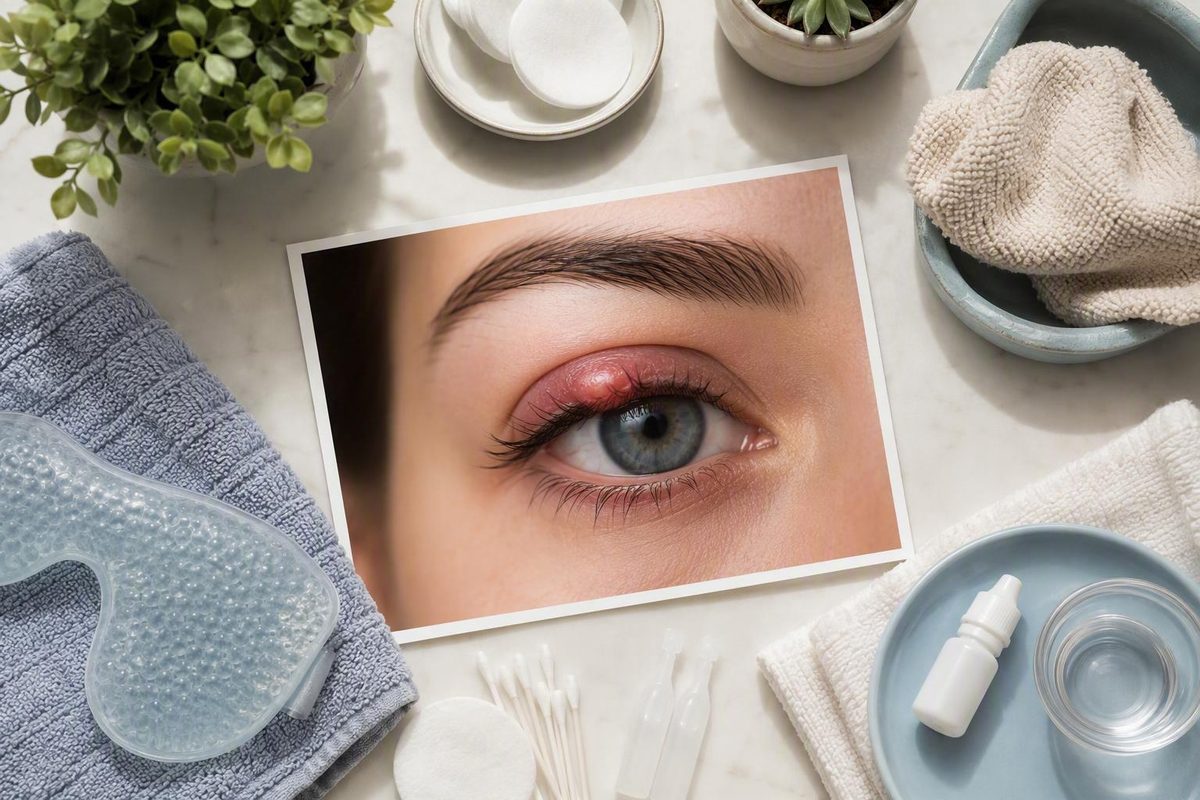
The short answer: a stye is generally not contagious
Quick answer
A typical stye does not usually spread through ordinary casual contact the way a cold or infectious conjunctivitis can. You generally do not need to avoid hugging, talking to, sitting near, or sharing a room with someone who has one.
However, bacteria associated with the infected eyelid gland may be transferred on unwashed hands or shared personal items. Wash your hands before and after eye care, avoid rubbing the affected eye, and keep towels, cosmetics, compress cloths, and other eye-contact items personal.
The key distinction is between passing along a stye and transferring bacteria. A stye is a localized eyelid problem: a small oil-producing gland becomes blocked and infected. The bump itself cannot pass from one person to another. Bacteria may move between an eyelid, hands, and objects, but exposure does not mean another person will develop a stye. Cleveland Clinic describes styes as infected, blocked eyelid glands and recommends hygiene while they heal (Cleveland Clinic’s medically reviewed stye overview).
For most households, schools, and workplaces, ordinary proximity is considered low risk. You can usually be in the same room, eat at the same table, speak face to face, hug, or sit beside someone who has a stye.
That reassurance assumes the lump actually is a stye. A painful, localized eyelid bump may fit the description, but redness, swelling, discharge, and discomfort can also occur with conjunctivitis, a chalazion, or a more serious infection around the eye. Online information cannot confirm a diagnosis from symptoms alone.
Why a stye forms—and why bacterial exposure is not enough
A stye, also called a hordeolum, is typically a painful, red, tender bump on or within the eyelid. It develops when a small oil-producing gland near an eyelash or inside the eyelid becomes blocked and infected. Some styes resemble pimples at the lash line; others cause a deeper area of swelling.
The process has two main parts:
- An eyelid gland becomes blocked.
- Bacteria multiply within the blocked gland, producing a localized infection.
This two-part mechanism helps explain why styes do not generally pass from person to person through normal social contact. Bacteria associated with styes may already live on the skin. Encountering those bacteria is not the same as having them multiply inside a blocked eyelid gland.
Bacterial transfer is therefore possible without making styes readily contagious. If bacteria move from an affected eyelid to someone else’s hand, towel, or eye area, the recipient does not automatically develop a blocked gland or infection.
Styes may also be described by their location:
- External stye: A tender bump near the lash line, involving a gland associated with an eyelash.
- Internal stye: A deeper swelling involving a gland within the eyelid.
These terms describe where the stye forms. They do not establish that one type is more contagious than the other.
The practical conclusion is balanced: ordinary exposure to someone with a stye is unlikely to give you the same eyelid problem, but reducing direct eye-to-hand and item-to-eye transfer remains sensible.
How bacteria may transfer: low-risk contact versus avoidable exposure
You do not need to treat every interaction as hazardous. Focus on behaviors that can move material from the affected eyelid directly to another eye, another person, or an eye-contact item.
| Activity or exposure | Practical risk level | What to do |
|---|---|---|
| Talking, sitting nearby, or sharing a room | Generally low | No special distancing is normally needed |
| Hugging or routine family contact | Generally low | Continue normal contact and ordinary hand hygiene |
| Touching the stye and then the other eye | Avoidable exposure | Wash your hands before touching either eye |
| Rubbing the affected eye and then touching another person’s face | Avoidable exposure | Avoid rubbing and wash your hands |
| Sharing towels, washcloths, or compress cloths | Avoidable exposure | Keep them personal while the stye is active |
| Sharing pillows or pillowcases that contact the face | Avoidable exposure | Use separate items during the active episode |
| Sharing mascara, eyeliner, brushes, or applicators | Avoidable exposure | Do not share eye cosmetics or tools |
| Sharing eye drops | Avoidable exposure | Keep bottles personal and avoid touching the tip to the eye area |
Touching or rubbing the affected eyelid may put bacteria or drainage on the fingers. Those fingers can then transfer material to the opposite eyelid, another person’s eye area, or an object. Shared towels, pillows, and similar personal items are also plausible indirect routes, although sharing an item does not mean that another person will necessarily develop a stye (physician-authored guidance on indirect bacterial transfer).
While the stye is active, keep these items personal:
- Towels and washcloths
- Pillowcases and pillows that contact the face
- Cloths used for warm compresses
- Mascara, eyeliner, eye shadow, brushes, and applicators
- Reusable eye masks
- Eye drops and other eye-care supplies
These are low-burden precautions under uncertainty, not evidence that styes spread readily. You do not need to disinfect every household surface after normal contact. Concentrate on hands and objects that directly touch the eyelid, eye area, or drainage.
A simple eye-care routine is usually enough:
- Wash your hands before caring for the eyelid.
- Use a clean cloth for a warm compress.
- Avoid pressing, rubbing, or squeezing the bump.
- Put the used cloth aside for laundering rather than sharing it.
- Wash your hands again.
Can a stye spread to your other eye?
A stye cannot jump, travel, or migrate from one eye to the other. If a bump later develops on the opposite eyelid, it is a separate stye, not the original lump moving across the face.
A plausible sequence is:
- You touch or rub the affected eyelid.
- Bacteria transfer to your fingers.
- You touch the opposite eyelid.
- A gland in that second eyelid is or becomes blocked.
- Under suitable conditions, a separate infection develops.
This is possible, but it is not inevitable. Touching the first stye does not mean the other eye will develop one; the local conditions needed for a stye must also be present.
Myth vs. fact
Myth: A stye can spread across your face and move into the other eye.
Fact: The original bump remains in the gland where it formed. Bacteria may be transferred by the hands or a cloth, after which a different blocked gland may develop its own stye.
To limit hand-to-eye transfer, wash your hands after applying a compress, avoid rubbing either eye, and do not move the same soiled cloth directly from one eye to the other.
Keep eye drops personal. With a multidose bottle, do not let the nozzle touch the eyelashes, eyelid, fingers, or skin. If it touches the affected area, follow the product instructions or ask a pharmacist or eye-care clinician for product-specific advice. The evidence does not support a blanket rule that every bottle used during a stye must be discarded (eye-care guidance on transfer between eyelids).
The same qualification applies to cosmetics, contact lenses, and lens cases. Avoid using a potentially contaminated item on the unaffected eye, but do not assume that every product must automatically be thrown away.
Work, school, family, makeup, and contact lenses
Routine isolation from family, coworkers, or classmates is generally unnecessary for a typical stye. If you otherwise feel well and can maintain basic hygiene, ordinary daily activities are usually reasonable.
Washing your hands, avoiding eye rubbing, and keeping eye-contact items personal address the plausible transfer routes more directly than staying several feet away from other people.
At work
Most adults do not need to stay home solely because of a localized stye. Normal conversations, meetings, and use of shared rooms are generally reasonable.
Consider modifying your routine or seeking clinical advice if discomfort interferes with your ability to work safely, swelling affects vision or makes it difficult to open the eye, or your symptoms suggest something other than a simple stye. Workplace policies may also differ when there is unexplained eye redness or discharge.
Fever, rapidly worsening swelling, severe pain, or visual symptoms are not merely attendance issues. They warrant prompt clinical assessment rather than simply staying home.
At school or daycare
A child with a typical stye can generally attend school if otherwise well and able to follow reasonable hygiene. Pediatric guidance similarly supports school attendance when a child feels well and can avoid spreading bacteria through eye rubbing or shared personal items (pediatric guidance on styes and school attendance).
A child may need reminders to:
- Avoid touching or squeezing the bump
- Wash their hands after touching the face
- Keep towels and face cloths personal
- Avoid sharing pillows, cosmetics, or eye products
School and daycare policies can vary, especially when staff cannot determine whether redness is caused by a stye or contagious conjunctivitis. Follow the institution’s policy and seek an examination if the diagnosis is uncertain.
Around family and household members
You generally do not need to avoid normal conversation, meals, hugging, or time in shared living areas. Instead, give the affected person a separate face towel and washcloth, keep compress cloths out of communal towel piles until washed, and store eye drops and cosmetics separately.
Use ordinary judgment: avoid direct contact with the affected eyelid and do not share objects that touch the eyes.
Eye makeup
As a general precaution, pause mascara, eyeliner, eye shadow, false eyelashes, and similar products until the eyelid has healed. Applying makeup can irritate the area and requires repeated contact near the infected gland.
Do not share cosmetics. If a product or applicator directly touched the affected lid, follow its cleaning instructions or ask an eye-care professional whether replacement is appropriate. There is no supported universal rule that every cosmetic used near a stye must be discarded.
Contact lenses
Wear glasses temporarily rather than contact lenses until the eyelid has healed. Lens insertion and removal require touching near the eye and may add irritation to an already uncomfortable area. Government health guidance recommends avoiding both contact lenses and eye makeup during healing (MyHealth Alberta’s stye and chalazion care instructions).
If a lens, case, or solution bottle may have contacted the affected lid or drainage, follow the manufacturer’s instructions or seek product-specific advice. Do not assume that every lens or case must automatically be discarded after every stye.
Safe home care while the stye heals
Most uncomplicated styes can initially be managed with gentle home care. The aim is to encourage natural drainage and keep the eyelid clean without traumatizing the tissue.
Apply a comfortably warm compress
Use a clean cloth dampened with comfortably warm—not hot—water. Close the eye and rest the compress gently against the eyelid for about 10 to 15 minutes several times a day. Re-warm the cloth as needed, checking the temperature before placing it back on the sensitive eyelid skin.
Do not press hard. Warmth, rather than force, is the goal.
A straightforward method is:
- Wash your hands with soap and water.
- Wet a clean washcloth with comfortably warm water.
- Wring it out so it is damp rather than dripping.
- Close the eye and place the cloth lightly over the eyelid.
- Leave it in place for about 10 to 15 minutes, reheating it gently as needed.
- Wipe away loosened crust delicately if necessary.
- Put the cloth aside for washing.
- Wash your hands again.
Warm compresses, gentle cleaning, and—when appropriate for the individual—over-the-counter pain relievers are among the usual supportive measures for a stye (Cleveland Clinic’s treatment and recovery guidance).
Clean gently
If crust or drainage is present, clean the eyelid delicately. Avoid aggressive scrubbing, which may worsen irritation. Keep soap and other cleansers out of the eye unless a clinician has recommended a particular eyelid-cleaning product and explained how to use it.
Use a clean cloth that is not shared. If both eyes need care, do not move a soiled cloth directly from the affected eyelid to the other eye.
Do not squeeze, pop, puncture, or lance it
Do not use a needle, tweezers, fingernails, or other tools.
If the stye drains on its own, blot the material gently with clean gauze or a clean cloth, dispose of or launder the material as appropriate, and wash your hands. Do not force additional drainage.
Manage discomfort conservatively
An over-the-counter pain reliever may help when it is safe and appropriate for you. Medication choice can be affected by allergies, pregnancy, health conditions, and interactions with other medicines. Follow the product label and ask a pharmacist or clinician if you are uncertain.
Allow time, but watch the trend
Many styes improve or resolve without a procedure in roughly one to two weeks. Improvement may be gradual, and the lump can remain visible after tenderness begins to settle.
Arrange a nonurgent evaluation if the lump:
- Is not improving as expected
- Persists beyond the usual course
- Repeatedly returns
- Appears frequently in either eye
- Remains as a firm, less painful lump after the acute tenderness settles
- Interferes with opening the eye or normal activities
A persistent or recurrent lump may need examination to determine whether it is a stye, chalazion, or another eyelid condition.
Is it really a stye? Look-alikes and warning signs
A painful, localized bump at the eyelid margin fits a stye better than generalized redness across the white of the eye. Symptoms can overlap, however, so the following table is a comparison—not a diagnostic tool.
| Feature | Stye | Chalazion | Conjunctivitis |
|---|---|---|---|
| Main location | A gland at the eyelid edge or within the lid | A blocked gland within the eyelid | The conjunctiva over the white of the eye and inside the lids |
| Typical appearance | Red, tender bump that may resemble a pimple | Firm, rounded eyelid lump | More diffuse redness, sometimes with watery or thicker discharge |
| Pain | Often painful or tender | Often less painful, particularly after early inflammation | Burning, grittiness, irritation, or discomfort may occur |
| Underlying problem | Infected eyelid gland | Usually a blocked, noninfected gland | Viral, bacterial, allergic, or irritant-related inflammation |
| Contagiousness | The bump is not ordinarily passed between people | Not considered contagious | Viral and bacterial forms may be contagious; allergic and irritant forms are not |
Clinical descriptions distinguish a stye’s acute, tender infection from a chalazion’s usually firmer, less painful blocked gland (Rhode Island Eye Institute’s comparison of styes and chalazia).
Conjunctivitis affects the conjunctiva and tends to cause broader redness or discharge rather than one focal eyelid bump. Viral and bacterial forms may be contagious, whereas allergic and irritant forms are not (overview of conjunctivitis versus styes).
Stye
A stye is usually a localized, painful, tender eyelid bump associated with an infected gland. An external stye often sits close to the eyelashes. An internal stye may be deeper and cause broader eyelid soreness without an obvious surface bump.
Chalazion
A chalazion forms when an eyelid oil gland is blocked. It is usually noninfected, often becomes firmer and less painful than an active stye, and is not considered contagious.
The two can resemble each other, particularly as an acute stye becomes less tender. A persistent lump may therefore need an examination.
Conjunctivitis
Conjunctivitis may cause diffuse redness, irritation, watering, or discharge instead of one focal eyelid bump. A red or discharging eye without a localized bump should not automatically be labeled a stye.
It is also possible to have more than one eye condition at the same time. Seek diagnostic guidance if the pattern is unclear.
Seek same-day or prompt clinical care for:
- Sudden or significant vision changes
- An eye that is swelling shut
- Fever with eyelid redness or swelling
- Redness or swelling that is rapidly worsening or spreading around the eye or face
- Severe or increasing pain
- Pain when moving the eye
- Restricted eye movement
- Significant light sensitivity
These are not routine “wait and see” symptoms. Eye-practice guidance identifies spreading swelling, fever, visual changes, painful or restricted eye movement, and severe light sensitivity as reasons for prompt assessment (warning signs associated with a suspected stye).
Seek nonurgent clinical evaluation for a lump that persists, repeatedly returns, or fails to improve as expected. A clinician can determine whether it is a stye, chalazion, or another eyelid problem and whether care beyond home treatment is appropriate.
This article provides general information, not a diagnosis or individualized treatment advice. As explained in Dry Eye Watch’s Terms of Use, online eye-health content cannot replace a clinical assessment.
Frequently asked questions
Can you catch a stye from sharing a towel or pillowcase?
You do not literally catch the eyelid bump from a towel or pillowcase. An item that has contacted the affected eye may, however, transfer bacteria to another person’s hands or eye area.
That transfer does not guarantee a new stye. A practical precaution is to keep towels, face cloths, compress cloths, pillows, and pillowcases personal while the stye is active, then launder reusable items normally.
Can I go to work or can my child go to school with a stye?
Usually, yes. Routine exclusion is generally unnecessary when the person otherwise feels well, can avoid rubbing the eye, and can maintain good hygiene.
Follow workplace, school, or daycare policies, particularly if staff cannot distinguish a localized stye from conjunctivitis. Fever, visual symptoms, severe pain, an eye swelling shut, or rapidly worsening redness or swelling warrant prompt clinical assessment; staying home is not a substitute for seeking care.
Should I wear contact lenses or eye makeup with a stye?
As a general precaution, pause contact-lens wear and eye makeup until the eyelid has healed. Use glasses temporarily.
Keep cosmetics, applicators, lenses, cases, and solutions personal. If an item directly touched the affected eyelid or drainage, follow its cleaning or replacement instructions or ask an eye-care professional for advice. Not every item must automatically be discarded.
How long is a stye contagious, and how long should I use extra hygiene precautions?
There is no established contagious period comparable to the contagious period of a cold or infectious conjunctivitis. The bump itself is not ordinarily transmitted, and the evidence does not identify an exact day when bacterial-transfer precautions can stop.
A practical approach is to continue hand hygiene and keep eye-contact items personal while the stye is active and until the eyelid has healed.
Many styes improve within roughly one to two weeks. Arrange an examination if the lump persists, worsens, or repeatedly returns.
Can a stye turn into pink eye?
A stye does not normally transform into conjunctivitis. The conditions affect different structures: a stye is a localized eyelid-gland infection, while conjunctivitis is inflammation of the conjunctiva.
Conjunctivitis can develop separately, and the conditions may share symptoms such as redness, watering, irritation, or discharge. Diffuse redness across the white of the eye or substantial discharge without a distinct tender eyelid bump should not automatically be treated as part of a stye.
The overall message is reassuring: you generally do not need to avoid other people because of a typical stye. Wash your hands, avoid touching or squeezing the bump, keep eye-contact items personal, and pause contact lenses and eye makeup until healing. Most styes improve within one to two weeks, but vision changes, significant light sensitivity, fever, severe pain, or rapidly spreading swelling require prompt clinical attention.