
Pink Eye vs. Stye: Eyelid Bump or Eye Redness?
A sore, localized eyelid bump favors a stye; broad redness without a lump favors pink eye. Compare discharge, contagiousness, care and warning signs.
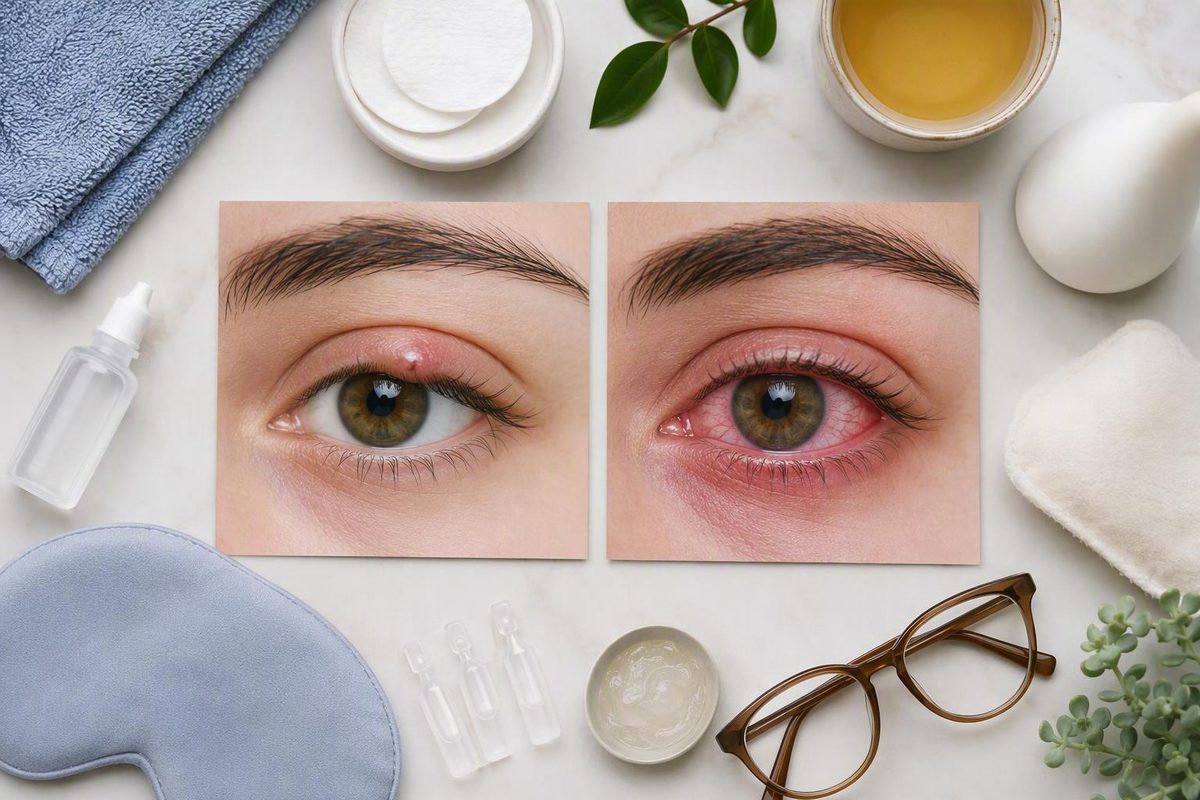
Pink eye vs. stye at a glance
The quickest clue is where the problem is centered:
- Diffuse pink or red coloring across the white of the eye, without a distinct lump, is more consistent with pink eye.
- Focal tenderness around a pimple-like bump on or inside the eyelid is more consistent with a stye.
This is a rule of thumb, not a diagnosis. An internal stye may cause localized pain and swelling without an obvious external bump. Allergies, dry eye, eyelid inflammation, foreign bodies, and more serious eye conditions can also cause redness or swelling. Location and the presence or absence of a tender bump are useful starting clues, but they cannot confirm the cause (Ascension’s pink-eye and stye comparison).
Pink eye, also called conjunctivitis, is inflammation of the membrane covering the white of the eye and lining the eyelids. A stye, also called a hordeolum, involves inflammation or infection of an eyelid oil gland or eyelash follicle. Both can cause redness, watering, swelling, grittiness, crusting, and discomfort, so redness alone is not particularly helpful.
| Feature | Pink eye | Stye |
|---|---|---|
| Affected area | Conjunctiva over the white of the eye and inside the eyelids | An oil gland or eyelash follicle in the upper or lower eyelid |
| Usual appearance | Broad pink or red coloring across the eye surface, usually without a distinct lump | Localized red, swollen, pimple-like bump at the lid edge or inside the lid |
| Pain or itching | Burning, irritation, grittiness, or itching; allergy-related cases may itch intensely | Focal soreness and tenderness, often worse when touching the lid or blinking |
| Discharge | May be clear, watery, white, yellow, or green; lashes may crust | Usually less diffuse discharge, although the bump or lashes may crust |
| One eye or both? | May affect one or both and can spread from one eye to the other | Often centered in one area of one eyelid, although more than one stye is possible |
| Contagiousness | Viral and bacterial forms can spread; allergic and irritant forms do not spread person to person | Generally not considered contagious, although bacteria can transfer on hands or personal items |
| Typical first step | For mild symptoms without warning signs, a clean cool compress and artificial tears may provide comfort while the cause is clarified | Apply a clean, comfortably warm compress for 10–15 minutes several times daily |
| Major warning signs | Pain, light sensitivity, sudden or reduced vision, intense redness, or rapid worsening | Vision effects, severe or increasing pain, a growing lump, fever, or swelling spreading beyond the eyelid |
The listed pink-eye symptoms and warning signs are consistent with CDC patient guidance. Warm compresses for 10–15 minutes several times daily are commonly recommended for a suspected uncomplicated stye (iCare’s pink-eye and stye guidance).
This comparison can help you choose a safer next step, but it cannot confirm what is causing your—or your child’s—symptoms. Dry Eye Watch provides general information rather than an individual diagnosis.
Why they look different: eye surface inflammation versus an eyelid gland problem
The conjunctiva is the thin, clear membrane covering the visible white of the eye and lining the inner eyelids. When it becomes inflamed, its small blood vessels become more noticeable, producing the broader pink or red appearance associated with conjunctivitis.
“Pink eye” describes the inflamed tissue, not one single cause. Conjunctivitis may be:
- Viral, sometimes occurring alongside cold or respiratory symptoms
- Bacterial
- Allergic, often associated with prominent itching and other allergy symptoms
- Irritant-related, such as after exposure to smoke, chemicals, dust, or another source of irritation
That distinction matters because not every case is an infection, not every case is contagious, and not every case needs the same treatment. Appearance and discharge can provide context, but they do not reliably identify the exact cause without the full history and, when needed, an eye examination. The CDC describes differences among viral, bacterial, allergic, and irritant-related symptom patterns while emphasizing that symptoms vary by cause (CDC pink-eye symptoms).
A stye develops in the eyelid rather than across the eye’s surface. It commonly forms when bacteria become involved in a blocked oil-producing gland or eyelash follicle, creating a tender, inflamed area that may resemble a pimple.
There are two general locations:
- An external stye forms toward the outside of the eyelid, often near an eyelash follicle. It may create an obvious bump along the lash line.
- An internal stye develops within an eyelid gland. It may produce deeper tenderness and swelling without an easily visible external pimple.
Either type can occur in the upper or lower eyelid. Cleveland Clinic describes external styes as forming on the outer eyelid and internal styes as forming on the inner lid, with both involving infection in a blocked gland or follicle (Cleveland Clinic’s stye overview).
This anatomical difference explains the most useful visual shortcut: conjunctival inflammation tends to create widespread eye-surface redness, whereas a stye tends to concentrate pain and swelling in one part of the eyelid.
A symptom-by-symptom comparison
Start with one practical question:
Is there a discrete, sore eyelid bump?
- A tender bump at the lash line or a painful spot inside the lid favors a stye.
- Widespread redness across the white of the eye without a distinct lump favors pink eye.
- If there is no visible bump but one part of the eyelid is distinctly tender and swollen, an internal stye remains possible.
- If symptoms include significant pain, light sensitivity, or a vision change, do not rely on this decision path; arrange prompt assessment.
Symptoms that lean toward pink eye
Pink eye commonly produces diffuse pink or red coloring over the white of the eye. Other possible symptoms include:
- Burning, itching, or irritation
- A gritty or foreign-body sensation
- Tearing
- Clear, watery, white, yellow, or green discharge
- Crusting along the lashes, particularly after sleep
- Swelling of the conjunctiva or eyelids
- An urge to rub the eye
Pink eye may begin in one eye or affect both. Infectious conjunctivitis can move from one eye to the other, while allergic conjunctivitis more often affects both eyes and tends to feature intense itching, watering, and accompanying allergy symptoms. These recognized symptom patterns—including discharge in several colors—are described in the CDC’s conjunctivitis guidance.
Discharge provides context but not proof:
- Watery discharge with cold symptoms may fit viral conjunctivitis.
- Thicker discharge and lashes that stick together may raise suspicion for bacterial conjunctivitis.
- Intensely itchy, watery eyes on both sides during allergen exposure may fit allergic conjunctivitis.
Symptoms overlap, however. In particular, yellow or green discharge does not by itself prove that bacteria are responsible. Diagnosis should not rest on discharge color alone.
Symptoms that lean toward a stye
A stye more often causes:
- A localized red bump resembling a pimple
- Focal eyelid pain or tenderness
- Swelling concentrated around the bump
- Soreness when blinking
- Tearing
- Crusting near the eyelashes
- A scratchy or foreign-body sensation
- Localized warmth or irritation
A stye can make the eye water or feel gritty, and surrounding inflammation may make more of the eyelid or eye look red. Those symptoms do not rule it out. The stronger clue is whether there is a focal center of pain or swelling in the eyelid.
Three examples
-
Red eye whites, watery drainage, mild burning, and no eyelid bump: This pattern is more consistent with conjunctivitis, particularly if it occurs with a cold. It does not prove that the cause is viral.
-
A sore bump at the lash line that hurts when blinking: This pattern favors an external stye, especially when the tenderness is concentrated around the bump.
-
Intensely itchy, watery eyes on both sides during pollen or pet exposure: This pattern is more consistent with allergic conjunctivitis. The lack of a focal painful bump makes a stye less likely.
These examples identify tendencies, not diagnoses. A person may have overlapping problems, and potentially serious conditions can begin with nonspecific redness or discomfort.
Which condition is contagious?
Contagiousness depends on the cause of the redness.
Viral and bacterial conjunctivitis can spread between people. Allergic conjunctivitis and conjunctivitis caused by noninfectious irritation do not spread person to person. A stye is generally not considered contagious in the same way as infectious conjunctivitis, although bacteria may transfer through unwashed hands or shared personal items (iCare’s contagiousness and hygiene overview).
While symptoms are active:
- Wash your hands before and after touching the eye area.
- Do not rub your eyes.
- Avoid sharing towels, washcloths, pillowcases, cosmetics, cosmetic tools, or other items used near the eyes.
- Use a fresh, clean cloth for every compress.
- Do not use the same compress cloth on the other eye.
- Help children wash their hands and discourage them from touching or rubbing their eyes.
There is no single contagious period that fits every form of conjunctivitis. Timing depends on the cause and clinical circumstances, so avoid using one fixed day count to decide that transmission is no longer possible.
School and daycare rules also vary. Some institutions base attendance on symptoms, clinical advice, the child’s ability to avoid close contact, or local policy. Caregivers should check the institution’s rules rather than assuming that antibiotics are always required before a child can return. Antibiotics are not appropriate for every form of pink eye.
What to do at home—and what not to do
Home care should match the likely location and cause of the problem. It should not delay assessment when warning signs are present.
For mild pink-eye discomfort
For mild symptoms without pain, light sensitivity, vision changes, or rapid worsening, a clean cool compress over the closed eyelid may reduce discomfort. Artificial tears may also help with mild surface irritation. These measures support comfort; they do not identify or eliminate the underlying cause.
Pink-eye treatment varies:
- Viral conjunctivitis is not treated with antibiotics.
- Allergic conjunctivitis may improve by reducing exposure to the trigger and using allergy-focused care recommended by a clinician.
- Irritant-related symptoms call for avoiding the suspected source and obtaining professional advice if symptoms are significant, persistent, or uncertain.
- Suspected bacterial conjunctivitis should be assessed when treatment is uncertain rather than self-treated with leftover medication.
The treatment may not be appropriate for the present cause. Cause-specific treatment, cool compresses, artificial tears, and avoiding contact lenses while symptoms are active are described in Ascension’s patient guidance (Ascension’s treatment overview).
For a suspected stye
Apply a clean, comfortably warm compress for 10–15 minutes several times daily. Warmth may help the blocked area open and drain naturally; the cloth should not feel hot enough to hurt the skin.
For safer compress use:
- Wash your hands.
- Wet a clean cloth with comfortably warm—not hot—water.
- Wring it out and place it gently over the closed eyelid.
- Rewarm it as needed during the session.
- Wash your hands again afterward.
- Use a different clean cloth if treating the other eye.
Clean the eyelid gently without vigorous rubbing or pressure. Most importantly, do not squeeze, pop, puncture, or try to drain a stye yourself. If a procedure is needed, it should be performed by a clinician.
Pause contact lenses and eye makeup
Avoid contact lenses and eye makeup while either the eye surface or eyelid is inflamed. There is no universal restart date that is safe for every cause. Wait until symptoms have resolved and follow the examining clinician’s guidance when professional treatment was needed.
Contact-lens wearers should be especially cautious when redness occurs with pain, light sensitivity, blurred or reduced vision, or rapid worsening. Remove the lenses and obtain prompt clinical assessment rather than relying on home treatment alone.
Three myths to avoid
- Myth: Every red eye is contagious. Allergies, irritation, dry eye, and a stye can all cause redness without being contagious conjunctivitis.
- Myth: Every case of pink eye needs antibiotics. Antibiotics do not treat viral or allergic conjunctivitis, and treatment should match the cause.
- Myth: Popping a stye makes it heal faster. Forced drainage is not safe home care.
Avoid relying on redness-relief drops, supplements, branded treatments, or reused prescriptions to solve an undiagnosed red eye. The appropriate approach depends on what is causing the symptoms.
When it may be neither pink eye nor a stye
A red or swollen eye is not automatically conjunctivitis or a stye. Other possible causes include:
- Dry eye
- Allergies
- Blepharitis, or inflammation along the eyelid margins
- A trapped eyelash or another foreign body
- Chemical or environmental irritation
- A corneal problem
- Inflammation deeper within the eye
- Infection or inflammation of the skin around the eye
For a broader look at surface irritation, see Dry Eye Watch’s guide to common causes of burning eyes.
Stye versus chalazion
A chalazion is another eyelid lump, but it usually behaves differently:
- A stye is typically painful, tender, inflamed, and relatively acute.
- A chalazion is often deeper, firmer, and relatively painless.
The distinction is not always obvious at home, particularly after a stye has been present for a while. A persistent, enlarging, recurrent, or unusual lump may need an eye examination.
An internal stye may not look like a pimple
An internal stye can produce localized eyelid pain and swelling even when there is no obvious bump on the outside.
Diffuse eyelid swelling deserves caution
Redness, warmth, pain, or swelling extending across the eyelid or surrounding skin—especially without an acne-like focal bump—may indicate something other than a simple stye. HealthPartners notes that widespread eyelid redness, swelling, warmth, and pain without a characteristic bump may fit another condition and should not automatically be treated as a stye (HealthPartners’ guide to stye symptoms and mimics).
Assessment is particularly important if swelling is spreading, the eye is becoming harder to open, symptoms are rapidly worsening, or fever or facial swelling develops. Persistent, recurrent, bleeding, crusting, or otherwise unusual eyelid lumps should also be examined rather than repeatedly treated as styes.
Pink eye and a stye can occur at the same time. For example, a person could have diffuse conjunctival redness as well as a localized, tender eyelid bump. Symptoms alone cannot establish that both are present, so a mixed or unclear pattern is a reasonable reason to arrange an examination.
When to seek prompt eye care
Same-day evaluation
Seek same-day clinical care for:
- Eye pain rather than mild surface irritation
- Light sensitivity
- Sudden vision changes
Dry Eye Watch identifies sudden vision change, eye pain, and light sensitivity as symptoms requiring same-day clinical attention (Dry Eye Watch’s medical-use notice).
Other symptoms needing prompt assessment
Arrange prompt care for:
- Reduced or persistent blurred vision
- Intense eye redness
- Rapidly worsening symptoms
- A stye that is growing or becoming increasingly painful
- Redness or swelling extending beyond the eyelid
- Fever or facial swelling
- An eyelid lump affecting vision
- Bleeding or an unusual-looking lesion
- Persistent or recurrent styes
- Symptoms that do not respond to appropriate home care
Health-system guidance also flags severe pain, vision reduction, spreading redness or swelling, recurrence, immune compromise, and pre-existing eye disease as reasons for professional evaluation (Mount Nittany Health’s pink-eye versus stye guidance).
Contact-lens wearers
Remove your lenses. If redness occurs with pain, light sensitivity, blurred or reduced vision, or rapid worsening, seek prompt assessment rather than attempting home treatment alone. Ask the examining clinician when it is safe to resume lens wear.
Newborns and higher-risk patients
Eye redness or discharge in a newborn requires immediate professional assessment. People with immune compromise or pre-existing eye disease should also have a lower threshold for contacting a clinician.
Arrange an eye examination whenever symptoms are persistent, recurrent, worsening, diagnostically uncertain, or not responding to appropriate supportive care. Source recommendations for unimproved symptoms vary from about 48 hours to approximately one week, illustrating why one deadline does not fit everyone (Cleveland Clinic’s stye guidance; Mount Nittany Health’s comparison). Urgency depends on pain, vision, contact-lens use, age, medical risk, severity, and whether symptoms are progressing.
This article provides general information and cannot diagnose the cause of an individual red eye.
What recovery may look like
Recovery time is an estimate, not a diagnostic test. Uncomplicated pink eye or a stye often improves over several days to two weeks, but the range varies with the cause, severity, ongoing exposure, and treatment. Some viral conjunctivitis cases can last longer than two weeks, while allergic symptoms may continue or repeatedly flare as long as exposure to the allergen continues (Willoughby Doctors of Optometry’s recovery overview).
Many styes gradually become less tender and swollen with time and warm-compress care. A bump that persists, recurs, enlarges, or begins to affect vision should be examined rather than treated indefinitely at home.
Judge improvement by the direction of the symptoms:
- Is redness fading rather than spreading?
- Is discharge decreasing?
- Is the eyelid less swollen?
- Is the focal bump becoming smaller or less tender?
- Is blinking more comfortable?
- Is vision normal and stable?
A condition that looks unchanged on one particular day may still be improving slowly. Conversely, worsening pain, expanding redness, increasing swelling, or a new vision problem matters even if only a short time has passed.
The practical recap is simple:
- Decide whether symptoms appear centered on the eye surface or in one part of the eyelid.
- Use a clean cool compress and artificial tears for mild conjunctivitis discomfort without warning signs while clarifying the cause.
- Use a clean warm compress for 10–15 minutes several times daily for a suspected stye—and never squeeze it.
- Pause contact lenses and eye makeup while inflammation is active.
- Seek same-day care for pain, light sensitivity, or sudden vision changes, and prompt assessment for other worsening warning signs.
Frequently asked questions
Can pink eye and a stye happen at the same time?
Yes. Conjunctival inflammation and an inflamed eyelid gland can occur together, although this is not the most common presentation. Diffuse redness or discharge plus a separate tender eyelid bump could suggest both problems, but symptoms alone cannot confirm that interpretation.
Because treatment depends on the cause of the conjunctivitis—and because other conditions can mimic either problem—an examination is appropriate when the pattern is mixed, worsening, or unclear.
Can you have a stye without seeing a bump?
Yes. An internal stye develops within an eyelid gland and may cause localized pain, tenderness, and swelling without an obvious external pimple. A bump may become more apparent later, or it may remain difficult to see.
Do not press, flip, or aggressively manipulate the eyelid to look for one. Use a clean warm compress if symptoms are mild and otherwise consistent with a stye, and seek an examination if pain or swelling worsens, vision is affected, or the diagnosis remains uncertain.
Will antibiotic pink-eye drops treat a stye?
Do not assume so. Antibiotic drops intended for bacterial conjunctivitis do not treat viral or allergic pink eye, and they are not a universal treatment for styes. A stye is centered in an eyelid gland or follicle, and most uncomplicated cases begin with warm compresses and gentle eyelid hygiene.
Some persistent or complicated styes may require clinician-directed medication or drainage, but that choice depends on an examination. Do not reuse leftover pink-eye drops or apply another person’s prescription.
How is a stye different from a chalazion?
An acute stye is usually painful, tender, red, and inflamed. It often appears near the eyelid edge or as a sore area inside the lid.
A chalazion is generally deeper, firmer, and less painful. The two may be difficult to distinguish as a lump evolves, so a persistent, recurrent, enlarging, or unusual eyelid bump should be examined.
What should a contact-lens wearer do about a red, painful eye?
Remove the contact lenses and do not put them back in while the eye remains red or painful. Redness accompanied by pain, light sensitivity, blurred or reduced vision, or rapid worsening requires prompt clinical assessment rather than home care alone.
Do not reuse old prescription drops. Ask the examining clinician when it is safe to resume lenses and whether the lenses, case, or solution should be replaced.
The central difference between pink eye and a stye remains useful: eye-surface redness without a lump points more toward pink eye, while a sore eyelid bump points more toward a stye. It is a starting point, not a diagnostic test. Use cool supportive care only for mild conjunctivitis symptoms without warning signs, use warm compresses without squeezing for a suspected stye, pause contacts and eye makeup, and seek timely care when pain, light sensitivity, vision changes, spreading swelling, or worsening symptoms develop.