
Eye Drops for Dry Eyes: How to Choose the Right Type
Compare liquids, gels and ointments by time of use, learn when preservative-free formulas may help, and verify contact-lens compatibility.
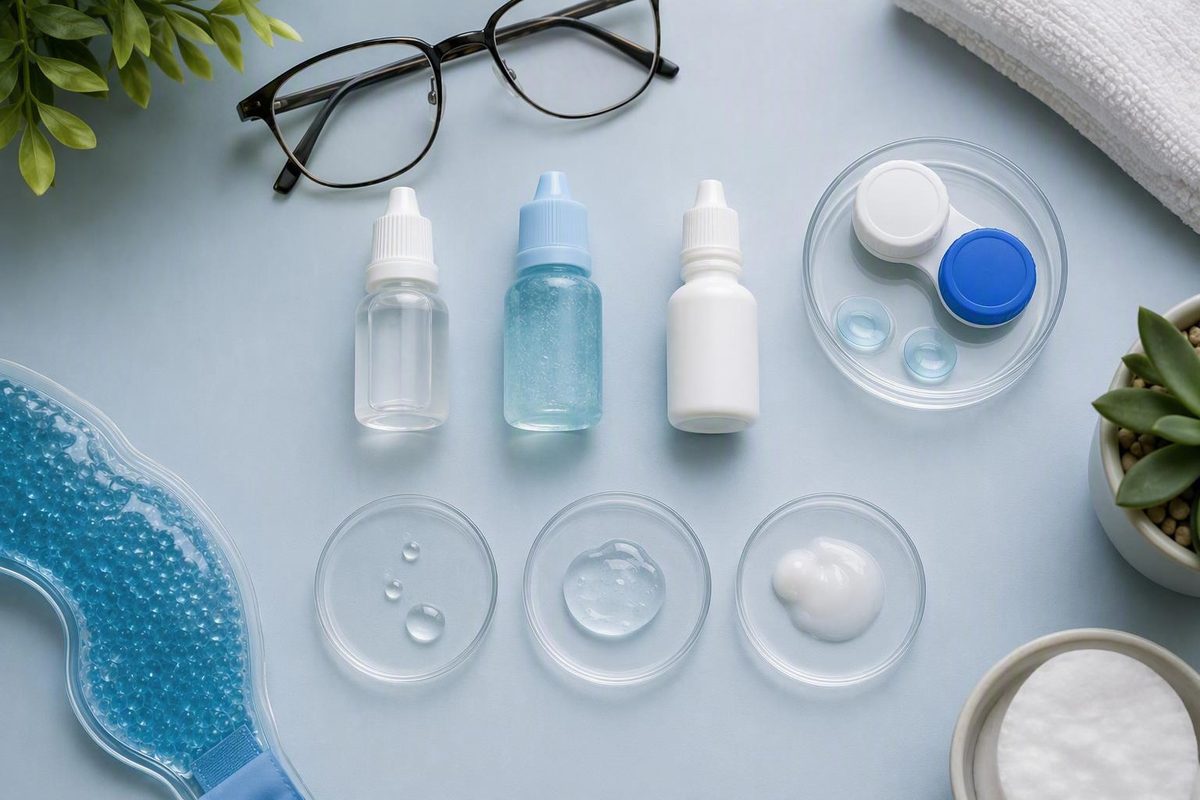
Start Here: A Quick Decision Path for Dry-Eye Drops
If dryness is your main concern, begin with lubricating eye drops, also called artificial tears. These over-the-counter products add moisture to the eye’s surface and reduce friction associated with dry eye. No single brand or formulation works best for every form of dry eye, so finding a suitable option may require careful trial or an eye examination. Mayo Clinic explains the main artificial-tear options and their tradeoffs.
Artificial tears can relieve symptoms without necessarily treating why those symptoms developed. Allergy, eyelid disease, inflammation, medication effects, infection, contact-lens complications, prior surgery, and systemic medical conditions can all produce or contribute to eye discomfort.
A practical five-step decision path is:
- Confirm the main problem. Dryness, burning, grittiness, and fluctuating comfort point toward a lubricant. Prominent itching suggests allergy may be involved, while isolated redness is not a reason to assume the eye needs more moisture.
- Consider the tear-film pattern—but do not self-diagnose it. Dry eye can involve tears evaporating too quickly, too little watery tear production, or both.
- Choose a texture for the time of use. Liquid drops are generally the most convenient daytime starting point. Thicker gels and ointments may suit nighttime or morning symptoms but can blur vision.
- Consider frequency and preservatives. Occasional users may tolerate a preserved multidose bottle. Frequent users and people whose eyes react to preserved drops may prefer preservative-free packaging.
- Check contact-lens compatibility. Use a drop over lenses only if its label explicitly permits that use.
Do not treat these symptoms as routine dryness: significant pain, sudden or worsening vision changes, marked redness, light sensitivity, discharge, trauma, chemical exposure, or a painful red eye in a contact-lens wearer. Seek prompt professional assessment. Severe pain, sudden vision loss, chemical injury, or a curtain-like area of missing vision requires urgent evaluation. These warning signs are outlined in eye-care triage guidance.
Dry Eye Watch provides general information, not diagnosis or a substitute for clinical care. Its informational-use notice identifies sudden vision changes, eye pain, and light sensitivity as reasons for same-day clinician attention.
Make Sure You Are Shopping in the Right Eye-Drop Category
Products placed together in the eye-care aisle can perform very different jobs. Before comparing ingredients, package sizes, or prices, check the intended purpose on the label.
Artificial tears are lubricants. They supplement moisture on the eye surface and reduce friction. If your main symptoms are dryness, burning, stinging, grittiness, irritation, or tired-feeling eyes, this is generally the relevant over-the-counter category.
Allergy drops target allergy-related symptoms rather than replacing moisture. Itching—often accompanied by watering—can suggest an allergy pattern, although dry eye and allergy may overlap. An antihistamine drop may address an allergic response but is not interchangeable with an artificial tear. A lubricant may make the eye temporarily more comfortable without treating the allergy itself.
Redness relievers temporarily constrict surface blood vessels. That can make the eye look less red, but it does not replenish the tear film. Repeated use of vasoconstrictor redness relievers may be followed by returning or worsening redness. Tetrahydrozoline and naphazoline are examples, rather than a complete list, of ingredients found in this category. The American Academy of Ophthalmology’s lubricant-selection guidance cautions against relying on red-eye products for dry-eye management.
Contact-lens rewetting drops are formulated and labeled for use with particular lens types. A general lubricant sold beside them is not automatically safe to apply while lenses are in place. The words “lubricant” and “preservative-free,” shelf placement, or familiar branding do not establish lens compatibility.
Watery eyes can make these distinctions less intuitive. Surface irritation associated with dry eye may coexist with excessive watering, but watering can also have other causes. It therefore neither proves nor rules out dry eye.
If itching, discharge, persistent redness, pain, light sensitivity, or worsening vision is part of the picture, seek professional advice rather than rotating through unrelated products. For more context on overlapping causes—including dry eye, screens, allergy, blepharitis, and irritants—see Why Do My Eyes Burn? The Usual Causes & What Fixes Each.
Match the Formulation to the Dry-Eye Pattern—Without Self-Diagnosing
The tear film is not simply water. In practical terms, dry eye may develop because tears evaporate too quickly, because the eye produces too little of the watery tear component, or because both problems occur together.
With evaporative dry eye, the tear film loses moisture too quickly. Problems involving the oil-producing meibomian glands may contribute because the oily tear-film layer helps slow evaporation. If an eye-care professional has identified evaporative dry eye or meibomian gland dysfunction, a lipid- or oil-containing lubricant may be considered.
With aqueous-deficient dry eye, the eye does not produce enough watery tears. Some professional guidance notes that products considered for this pattern may carry terms such as hypotonic or hypoosmolar on the packaging. Those words are formulation clues, not a home diagnostic test or a guarantee that the product will help. The same guidance emphasizes that many cases are mixed and that several formulations may need to be tried. The American Academy of Ophthalmology discusses these formulation distinctions.
Retail collections show that oil-containing preservative-free products are sold in both vials and multidose formats. That availability can help when comparing packaging, but a retailer’s category does not establish that an oil-containing drop is clinically superior or suitable for a particular person. Labels such as “MGD,” “advanced,” “complete,” “intense,” or severity-based wording also do not prove suitability.
Dry eye may be influenced by screens, reduced blinking, dry or windy environments, aging, contact lenses, eye surgery, medications, and medical conditions. Changing drops alone may therefore fail to solve a persistent problem. A formulation can support the tear film while an unresolved contributor continues to irritate the eye.
If symptoms persist, you rely on drops frequently, or you are unsure which mechanism is involved, arrange an assessment with an optometrist or ophthalmologist. A clinician can also determine whether eyelid-directed care, environmental changes, contact-lens adjustments, or another treatment should accompany artificial tears.
Choose the Right Texture for Daytime or Overnight Relief
Viscosity—the product’s thickness—affects convenience and visual clarity immediately after application. Thicker is not automatically better. It changes the balance between coverage and temporary blur.
| Format | Relative thickness | Practical timing | Main tradeoff | What to verify on the label |
|---|---|---|---|---|
| Liquid artificial tears | Thinnest | Often convenient during the day | May not feel substantial enough for some users | Lubricant purpose, preservative status, dose, lens instructions |
| Gel drops | Thicker than liquids | Day or bedtime, depending on tolerance | Temporary blurred vision | Gel designation, directions, lens restrictions, discard instructions |
| Ointment | Thickest | Commonly reserved for bedtime | More noticeable temporary blur and residue | Ophthalmic use, bedtime directions, contamination precautions |
Liquid artificial tears
Liquid drops are generally the simplest starting point for occasional daytime symptoms. They are less likely than gels or ointments to interfere with vision, which matters when reading, working, driving, or moving between tasks.
For example, occasional daytime grittiness after prolonged screen use may point toward a liquid artificial tear, paired with screen breaks and deliberate blinking. That is a practical starting point, not confirmation that screens are the only cause.
Gel drops
Gels are thicker than ordinary liquid drops and may provide longer coverage. Their central tradeoff is temporary blur. That may be acceptable at home or near bedtime but inconvenient before driving, detailed work, or another visually demanding activity.
Ointments
Ointments are the thickest option and are commonly reserved for bedtime when liquid drops or gels do not provide enough overnight comfort. They may be worth considering when dryness is most noticeable during the night or on waking.
Mayo Clinic notes that gels and ointments can temporarily blur vision, with ointments often better suited to bedtime. The evidence does not establish one universal duration for that blur.
Temporary blur immediately after applying a thick product may be expected. Persistent, worsening, or otherwise unexplained blur should not automatically be attributed to the gel or ointment.
Preserved or Preservative-Free: Weigh Frequency, Tolerance, and Packaging
Preservatives serve a practical purpose. Once a multidose bottle is opened and repeatedly handled, it needs a mechanism to discourage microbial growth. A preserved bottle can therefore be convenient, compact, and less expensive than repeatedly purchasing single-use vials.
The tradeoff is repeated exposure. Preservatives can irritate an already compromised eye surface in some users, particularly when drops are used frequently. That does not mean everyone will react to preserved drops or that all preserved formulations have the same effects.
Benzalkonium chloride, often abbreviated BAK, is the most commonly discussed ophthalmic preservative. It has detergent-like antimicrobial properties, and concern centers on cumulative effects on the tear film and ocular surface with repeated exposure. A peer-reviewed review of preservatives in dry-eye drops reports that detrimental effects may increase with concentration and repeated exposure. However, some evidence comes from preserved glaucoma medications, so it should not be transferred uncritically to every artificial-tear formulation or user.
The choice is not simply “BAK-preserved” versus “preservative-free.”
When preservative-free drops are worth considering
Preservative-free artificial tears are commonly considered when:
- You apply lubricants frequently throughout the day.
- Preserved drops cause persistent irritation.
- Dryness is moderate or severe.
- The ocular surface is already compromised.
- You have a known or suspected preservative sensitivity.
- Long-term, repeated use is expected.
Using artificial tears more than four times per day is a commonly cited reason to consider preservative-free drops, not a universal safety boundary. Frequency is only one factor; the formulation, duration of use, eye-surface condition, and individual tolerance also matter. Published preservative-free guidance presents this threshold as a consideration rather than proof that one format is always best.
For an occasional user who has no evident sensitivity and follows the label, a preserved multidose product may be reasonable. If use steadily increases, reconsider both preservative exposure and the possibility that the underlying problem needs assessment.
Single-use vials versus preservative-free multidose bottles
Single-use vials avoid the need for a chemical preservative. Depending on the package and user, they may be convenient to carry or difficult to open and control. “Single use” should be interpreted according to the package directions—not as permission to recap and retain a vial indefinitely.
Preservative-free multidose bottles reduce the number of separate containers and may be more convenient for regular use. Their dispensing mechanisms vary, so ease of squeezing and dose control can differ by product. The bottle still requires clean handling and must be discarded according to its own instructions.
For either format, compare:
- How easily you can open and control the container
- Whether the package fits your routine away from home
- The discard period printed on the package
- Cost per usable amount rather than box price alone
- The amount of packaging involved
- Your ability to keep the tip from touching other surfaces
Preservative-free does not mean free of inactive ingredients, incapable of causing irritation, immune to contamination, or automatically compatible with contact lenses.
Possible signs of intolerance include persistent burning or stinging, increasing redness, worsening dryness, itching, eyelid swelling, or irritated skin around the eyes. Stop repeatedly challenging the eye with the same product and seek advice if these symptoms persist or intensify.
Using Dry-Eye Drops With Contact Lenses
The governing rule is simple:
Put drops over contact lenses only when the individual product label explicitly says they are safe or designed for use with those lenses.
Preservative-free status alone does not establish compatibility. A preservative-free lubricant may still contain ingredients or carry directions that require lens removal.
Contact-lens rewetting drops and general artificial tears are not necessarily the same. Rewetting drops are specifically labeled for lens wear, sometimes for particular lens materials or types. General lubricants may direct you to remove lenses before application. Follow the selected product’s removal and reinsertion directions because timing differs among products; no single interval should override the package or your clinician’s instructions. Eye-care guidance likewise directs contact-lens wearers to select drops labeled as lens-compatible.
Do not infer compatibility from:
- Placement in a retailer’s dry-eye or contact-lens section
- A store filter
- Brand familiarity
- The word “lubricant”
- A preservative-free claim
- An online review saying that someone else used the product over lenses
Contact lenses can also complicate the symptom picture. Recurrent redness, worsening blur, or increasing inability to tolerate lenses warrants professional evaluation.
A painful red eye in a contact-lens wearer should not be covered up with repeated drops.
Read the Label and Use Every Bottle Safely
A good purchase decision ends with the actual package, not the front-of-box marketing.
Label-reading checklist
Before buying or applying a drop, verify:
- Intended purpose: lubricant/artificial tear, allergy treatment, redness relief, or lens rewetting
- Preservative status: preserved, alternatively preserved, or preservative-free
- Format: liquid, gel, or ointment
- Contact-lens instructions: whether lenses may remain in and any reinsertion directions
- Package type: single-use vial or multidose bottle
- Dosing directions: the labeled amount and frequency
- Expiration date
- Storage requirements
- Discard-after-opening instructions
- Warnings: including when to stop use and seek care
How to apply eye drops hygienically
- Wash your hands with soap and water, then dry them.
- Check that the container is intact and that the solution looks as the label describes.
- Tilt your head back.
- Pull down the lower eyelid to create a small pocket.
- Hold the bottle above the eye without touching the eye, eyelashes, fingers, or surrounding skin.
- Place the labeled amount into the lower-lid pocket.
- Close the eye gently if directed; avoid squeezing or rubbing it.
- Replace the cap promptly without touching the tip.
Contaminated drops can cause dangerous infection and permanent eye damage. U.S. consumers should also buy from reputable sellers and check applicable recalls, as advised in Cleveland Clinic’s eye-drop safety guidance.
In the United States, avoid products marketed as homeopathic eye drops and products containing silver sulfate or methylsulfonylmethane. These warnings apply even when a product is sold online or described as “natural.” Cleveland Clinic identifies these as products or ingredients that should not appear in U.S. eye drops.
Prices, package quantities, stock indicators, star ratings, and review totals are shopping data—not clinical evidence. As a September 2026 retail illustration, several oil-containing preservative-free packages in one supplied collection were listed at approximately $22 to $27, but package formats and quantities differed and prices can change. The retailer listing provides that dated price and packaging context. A higher price, larger review count, or label such as “intense,” “advanced,” or “complete” does not prove better relief.
Stop using a product and seek advice if it appears contaminated or causes worsening pain, redness, discharge, swelling, or vision problems. If you use prescription eye medication, recently had eye surgery, or are being treated for an eye condition, ask the treating clinician how an over-the-counter lubricant fits into that regimen.
When Drops Are Not Enough
A brief, mild, clearly situational episode is different from discomfort that persists, repeatedly returns, progressively worsens, or requires frequent treatment.
Arrange a routine eye examination when:
- Symptoms persist or repeatedly return.
- Appropriate liquids, gels, or ointments do not provide meaningful relief.
- You need drops increasingly often.
- Preserved and preservative-free products both irritate your eyes.
- Contact lenses are becoming difficult to tolerate.
- You are unsure whether dryness, allergy, eyelid disease, or another problem is responsible.
- Symptoms interfere with reading, screens, work, sleep, driving, or daily activities.
Frequent reliance on preservative-free drops is still frequent reliance. Removing preservatives may improve tolerance, but it does not determine why the eye needs repeated lubrication.
An eye examination can help distinguish dry eye from allergy, infection, eyelid disease, contact-lens complications, medication effects, or another condition. Clinician-directed treatment may extend beyond artificial tears to address inflammation, eyelids, tear conservation, contact lenses, environmental contributors, or a medical cause. Those choices depend on examination findings and should not be replaced by a generic prescription-drug regimen.
Low-risk supportive measures can complement suitable drops:
- Take regular breaks from sustained screen viewing.
- Blink deliberately, especially during concentrated work.
- Reduce direct exposure to fans, vents, smoke, and dry wind.
- Consider a humidifier in a dry room.
- Review symptom patterns, product use, and possible medication contributors with a clinician rather than stopping prescribed medication yourself.
Seek prompt or same-day eye care for: significant pain, marked redness, light sensitivity, discharge, sudden or worsening vision changes, trauma, or a painful red eye associated with contact-lens wear.
Seek urgent evaluation for: severe eye pain, sudden vision loss, chemical injury, new flashes or floaters, or a curtain-like area of missing vision.
Symptom relief after applying a drop can be useful, but it does not prove that the underlying problem has been identified or treated.
Frequently Asked Questions
Are preservative-free eye drops always better for dry eyes?
No. They are often worth considering for frequent use, moderate or severe dryness, a compromised ocular surface, or preservative sensitivity. Occasional users who tolerate preserved drops may find a multidose bottle convenient and economical.
Preservative-free products can still sting, become contaminated, contain inactive ingredients, or carry contact-lens restrictions. Packaging and individual tolerance matter as much as the front-label claim.
Can I use artificial tears every day?
Many people use artificial tears regularly, but the label and individual circumstances should guide use. If you apply them more than four times daily, preservative-free drops are commonly considered to reduce repeated preservative exposure. That is a rule of thumb, not an absolute safety cutoff.
Daily or increasingly frequent use can also signal that the cause has not been addressed. Arrange an eye examination if symptoms persist, worsen, or require repeated treatment despite suitable formulations.
Why are my eyes watering if they are dry?
Surface irritation associated with dry eye can occur alongside excessive watering.
What should I do if eye drops sting or make my eyes redder?
A brief sensation can occur with some formulations, but persistent stinging, increasing redness, worsening dryness, itching, eyelid swelling, or skin irritation around the eyes means the product should be reassessed. Stop repeatedly applying it and check the label, expiration date, bottle condition, storage history, and recall status.
Seek professional advice if the reaction persists. Obtain prompt care for substantial pain, discharge, swelling, light sensitivity, or vision changes.
Do expensive eye drops or highly rated brands work better?
Not necessarily. Retail price, star ratings, review counts, sales rank, and labels such as “advanced” or “intense” do not establish comparative effectiveness. Reviews reflect other shoppers’ experiences and may not account for diagnosis, tear-film pattern, contact-lens status, or application technique.
Compare intended purpose, formulation, preservative status, texture, package design, label directions, and usable quantity. The most suitable option is one that fits the likely problem, can be used safely, and is tolerated—not simply the most expensive or highly reviewed product.
The Bottom Line
Choose a lubricating artificial tear rather than an unrelated redness or allergy drop. Match the formulation to the suspected tear-film problem and time of use, consider preservative-free packaging when use is frequent or preserved drops irritate your eyes, and verify contact-lens compatibility on the label. No price, rating, brand, or marketing phrase identifies a universal winner. Persistent, worsening, frequently treated, painful, light-sensitive, discharging, markedly red, or vision-changing eyes need professional assessment.