
Vitamin Brands to Avoid: Red Flags in Eye-Health Supplements
Shopping for eye-health vitamins? Check misleading claims, recalls, testing and doses—and learn why AREDS2 and dry-eye supplements are not interchangeable.
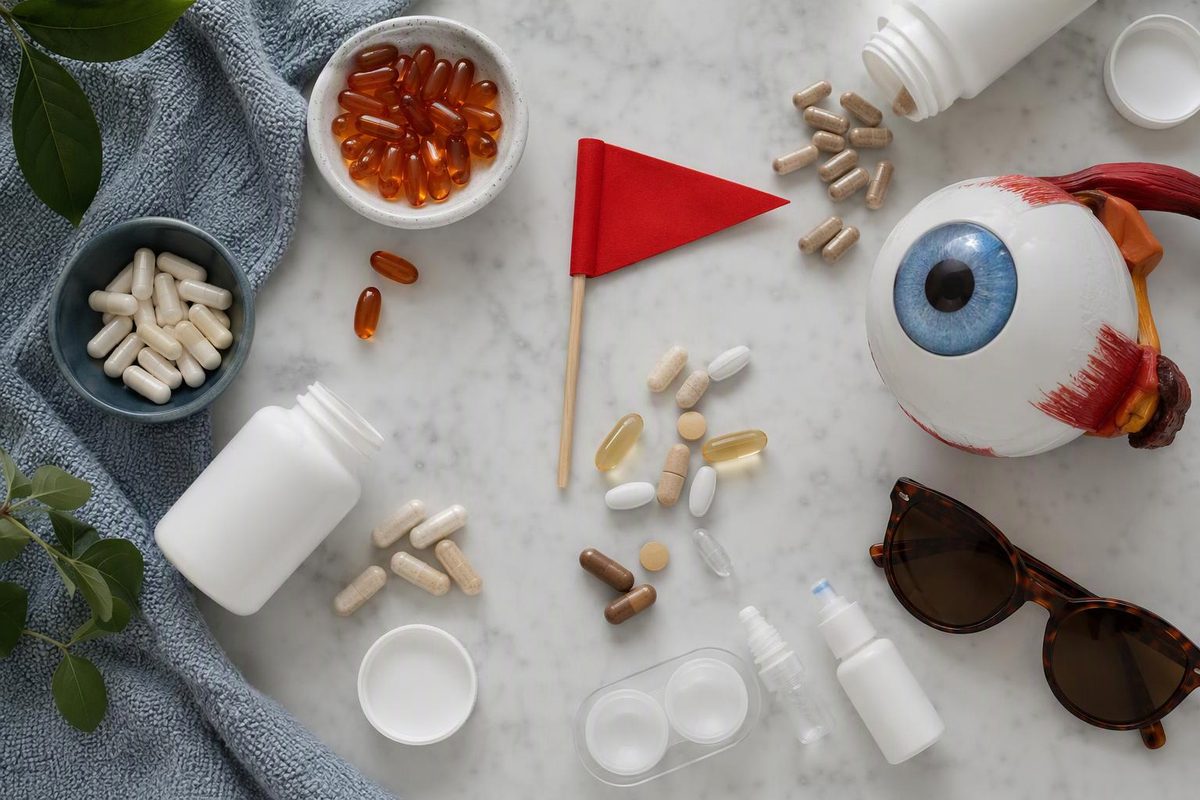
For eye-health vitamins, the most useful “avoid” list is about specific products, claims and doses—not a blanket blacklist of brands. A familiar name does not tell you whether a formula suits your condition, and a quality seal does not establish that it will relieve dry eye.
Before buying, separate three questions: Does the bottle contain what it claims? Is there evidence for your eye condition? Is the dose safe for you? The checks below apply to supplements sold in the United States.
Skip misleading claims and recalled products
These are practical reasons to pass on a product or stop and investigate:
- “FDA-approved” vitamins. FDA does not approve dietary supplements for safety or effectiveness before sale. A claim of FDA approval for the supplement is misleading.
- Promises to cure dry eye or replace prescribed treatment. FDA explains that products intended to treat, cure or prevent disease are drugs, even when labeled as supplements. Do not substitute a supplement for prescription medicine.
- No readable Supplement Facts panel. Before ordering, look for the serving size, ingredients and amounts per serving. FDA requires supplement labels to provide this information. If the seller will not show you the label, choose a more transparent listing.
These checks follow FDA’s consumer guidance on dietary supplements. “Natural” is not a safety guarantee, either.
For a safety concern about a named brand, search the exact product and company on FDA’s recalls and safety-alerts page. Read the notice and match any listed lot numbers, strengths or expiration dates to your bottle; follow its instructions if yours is affected. Do not turn a notice about one product or batch into a claim that everything from that brand is unsafe.
FDA notes that its public-alert page does not include every recall. No search result is not proof of safety.
Look for verifiable quality testing—not just reassuring wording
One useful quality check is the USP Verified mark. According to U.S. Pharmacopeia, it means the product:
- Contains the listed ingredients in the declared amounts.
- Does not contain harmful levels of specified contaminants.
- Meets manufacturing requirements.
- Breaks down and dissolves within a specified time.
Check the exact formula in the USP Verified Product Finder, rather than assuming verification covers an entire brand.
These are manufacturing and composition checks, not evidence that a product treats dry eye. Conversely, the absence of this particular mark is not, by itself, a reason to call a product unsafe. Treat vague “lab-tested” language as a prompt to ask who tested it and what they checked.
Avoid the wrong formula for your eye condition
Dry-eye promises without matching evidence
Fish oil is not a vitamin, but it is commonly sold alongside eye-health vitamins. In the 2018 DREAM trial, 535 people with moderate-to-severe dry eye received either 3 grams daily of fish-derived omega-3s or an olive-oil placebo. At 12 months, there was no statistically significant difference between the groups in improvement of symptoms or clinical signs, according to the National Eye Institute’s trial report.
That finding does not establish that every fish-oil brand is defective or unsafe. It does mean that you should not assume an expensive “dry-eye” formula will work because it contains omega-3s. Our guide to food supplements for dry eyes explains the evidence and safety limits in more detail.
AREDS2 bought for ordinary dryness
AREDS2 is a specific high-dose formula for certain stages of age-related macular degeneration (AMD), a disease affecting central vision—not a general eye-comfort supplement. NEI recommends considering it for intermediate AMD in one or both eyes, or late AMD in one eye to help protect the other. Ask your eye doctor whether your diagnosis calls for it before buying. See NEI’s AREDS2 guidance.
If you smoke or previously smoked, avoid the older beta-carotene-containing AREDS formula. NEI warns that it can increase lung-cancer risk in these groups; AREDS2 replaces beta-carotene with lutein and zeaxanthin. This is an ingredient-specific risk, corroborated by NIH’s vitamin A fact sheet, not a reason to blacklist a manufacturer.
Check the total dose before adding another bottle
Vitamin A supports normal vision, but extra is not automatically better. For adults 19 and older, NIH lists an upper limit of 3,000 micrograms RAE daily for preformed vitamin A from all sources, except medically supervised use. RAE means retinol activity equivalents, the unit used to express vitamin A amounts. This is an upper limit, not a daily intake target; it applies to preformed vitamin A, not beta-carotene.
Excess preformed vitamin A can cause headache, blurred vision and other harms; high doses during pregnancy can also cause birth defects. On labels, preformed vitamin A may appear as retinyl acetate or retinyl palmitate. These limits and warnings come from NIH’s vitamin A guidance.
Bring the proposed supplement label—and your existing vitamins and medicines—to a pharmacist or clinician. Ask whether it duplicates ingredients, interacts with treatment or has a clear purpose for you. A well-made product can still be the wrong product.
Do not wait for supplements to help sudden vision changes, eye pain or new light sensitivity: seek same-day eye care. Sudden vision changes and pain can signal problems requiring emergency attention, as the American Academy of Ophthalmology warns. NHS guidance also advises urgent assessment for light sensitivity.