
USP Verified Supplements: What the Seal Means for Eye Health
Learn what USP verification checks, how to confirm the exact supplement, and why the seal does not prove a benefit for dry eye.
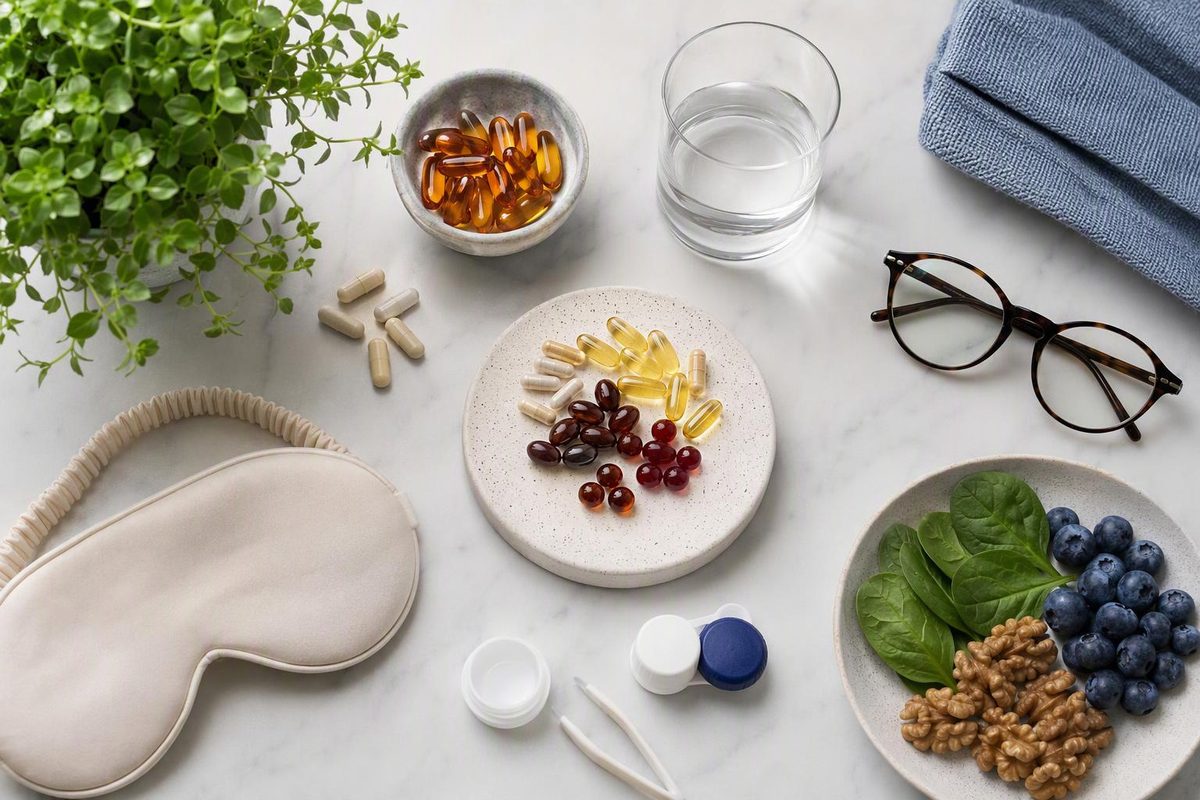
USP Verified is a product-quality mark—not proof that a supplement will relieve dry eye. It helps answer whether a bottle contains what its label says, in the stated amounts, and meets specified quality standards. It does not establish whether you need those ingredients or whether they will improve your eye symptoms. NIH explains that quality seals do not guarantee safety or effectiveness.
For someone comparing fish oil or eye-health vitamins, those are two separate decisions: whether the supplement is appropriate, and whether the particular product has reliable quality verification.
What USP verifies
USP stands for United States Pharmacopeia, an independent, scientific nonprofit organization that develops quality standards for medicines, supplements and foods. It does not manufacture or sell supplements. USP’s consumer information explains its role.
According to USP’s description of the Verified Mark, a verified supplement:
- Contains the labeled ingredients in the declared strength and amounts.
- Does not contain harmful levels of specified contaminants, such as heavy metals and pesticides. This is not a promise of zero contaminants.
- Is made according to FDA Good Manufacturing Practices, using sanitary, well-controlled processes.
- Breaks down and dissolves within a specified time, allowing its ingredients to become available for absorption. This is not a measure of clinical benefit.
The process includes manufacturing-facility audits, documentation review and laboratory testing. Verification is not a one-time event: USP describes ongoing annual evaluations and market-surveillance testing. That does not mean every bottle is individually tested. USP verification-process details
USP verification is also not FDA approval. Unlike medicines, dietary supplements do not require FDA approval before sale. NIH’s explanation of supplement regulation
How to find and check a verified product
Use the official USP Verified Product Finder, rather than relying on a retailer’s “high quality” description. It lets you filter by supplement type, brand and delivery form, such as tablets, gummies or softgels.
- Find the exact product. Match its name, strength and form—not just the brand. A listing for one formula is not evidence that every product from that company is verified.
- Look for the full USP Verified Mark on the bottle. A general “tested” claim is not a substitute for this specific mark. USP recommends checking the label and its product list.
- Read the Supplement Facts and other ingredients. Check the serving size, amounts per serving and potential allergens. Also check the expiration date. USP’s shopping guidance
- Resolve mismatches before buying. If the packaging differs from the listing, ask the manufacturer to confirm the exact formula. USP also advises contacting the manufacturer about a marked product that appears damaged, counterfeit or illegibly labeled.
As of October 27, 2026, examples in the official finder include Nature Made Omega-3 from Fish & Algae Oil 1200 mg (600 mg Omega-3) Softgels and Member’s Mark Lutein 25 mg with Zeaxanthin 5 mg Softgels. These are examples of listed products, not recommendations for dry eye, and the names illustrate why the exact formula matters. Current USP listings
What the seal cannot tell you about dry eye
A verified fish-oil supplement can meet quality standards without providing additional dry-eye relief. In the 2018 DREAM trial, 535 people with moderate-to-severe dry eye were assigned to omega-3 supplements or an olive-oil placebo. After 12 months, the omega-3 group had no significantly greater improvement in symptoms or clinical signs. Participants could continue their usual dry-eye treatments. National Eye Institute’s trial report
That finding concerns the tested treatment—not supplement manufacturing quality. For a broader look at ingredients promoted for dryness, see what evidence shows about food supplements for dry eyes.
Before using a supplement to treat eye symptoms, show its label to your eye-care professional or pharmacist, along with your other medicines and supplements. High doses, overlapping ingredients and medicine interactions can cause problems even when a product is accurately labeled. NIH supplement-safety guidance
Use USP verification to check product quality after deciding whether the ingredient and dose make sense for you—not as the reason to start taking it.