
What to Do for a Scratched Eye: Rinse, Don’t Rub
Chemical splashes, embedded objects, suspected penetration, bleeding, severe or worsening pain, or significant vision changes require emergency action.
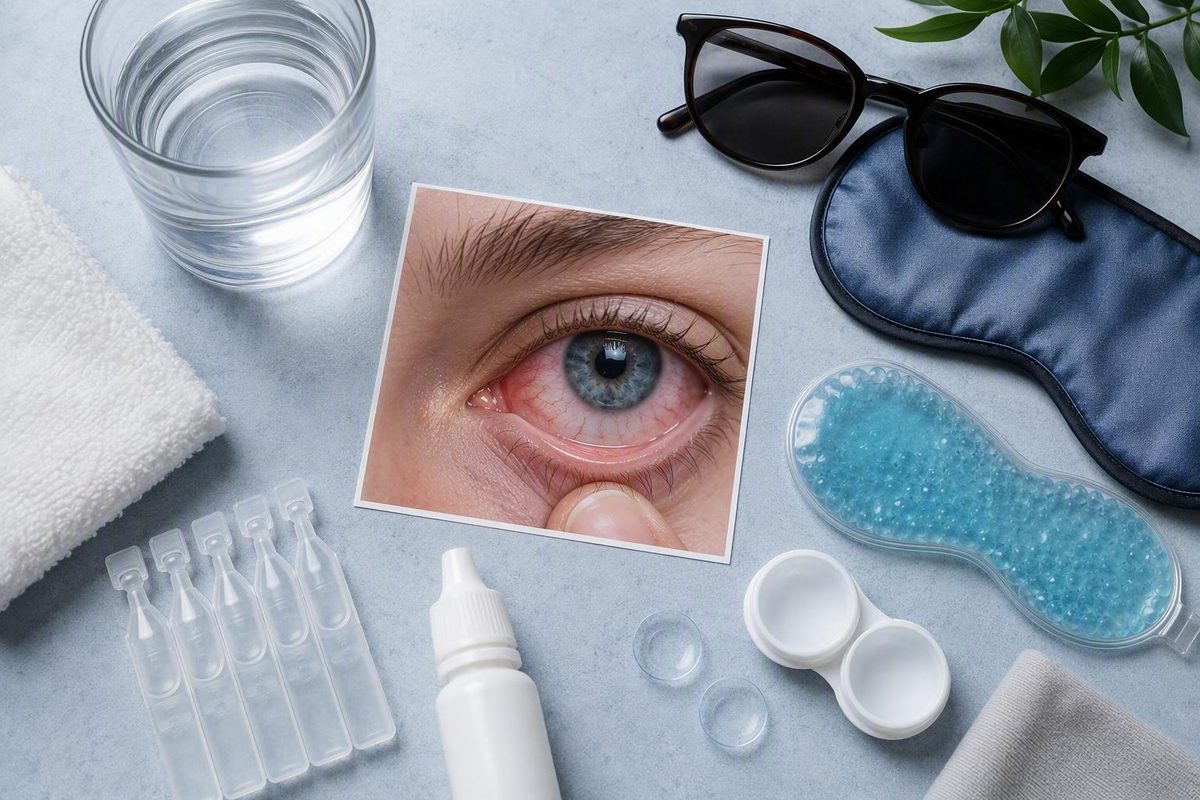
If you may have scratched your eye, wash your hands, gently rinse the eye with clean water or saline, and blink several times. Do not rub, press, or probe the eye. Arrange prompt assessment if pain, grittiness, light sensitivity, or blurred vision continues after rinsing.
Sudden vision change, eye pain, or light sensitivity warrants same-day clinician attention. A chemical splash, embedded object, suspected penetration, bleeding, severe or worsening pain, or significant vision change requires emergency action rather than routine scratch care. The American Academy of Ophthalmology advises prompt medical attention for a suspected scratch and emergency care for severe pain or vision trouble in its scratched-eye first-aid guidance.
What to do right now
This checklist is for a possible surface scratch or loose speck only when there is no chemical exposure, embedded object, or suspected penetration. Use the emergency pathway in the next section for any of those situations.
-
Wash your hands with soap and water. Do this before touching the eyelid or handling a contact lens.
-
Gently rinse the eye. Use clean water or sterile saline. Do not delay rinsing simply because saline is unavailable. Blink several times to help tears move loose surface debris.
-
Try one gentle eyelid maneuver if a small, loose particle still seems trapped. Pull the upper eyelid over the lower eyelid once. The resulting tears or the lower lashes may help move a particle from beneath the upper lid. Stop if this hurts or does not work; do not keep manipulating the eye.
-
Do not rub, press, or probe. Do not use a finger, cotton swab, tweezers, tissue, or another tool to search for material.
-
Arrange prompt professional assessment if symptoms remain. Continued pain, a stuck-object sensation, light sensitivity, redness, or blurred vision after rinsing may reflect a scratch, hidden debris, infection, or deeper damage.
Rinsing may remove a loose surface particle, but it cannot prove that the eye is uninjured. A scratch or retained object may remain even if the eye briefly feels better.
Emergency decision table: match the action to the injury
You cannot reliably distinguish a superficial abrasion from a deeper injury based only on symptoms or appearance. The mechanism of injury, vision changes, and other warning signs should determine the safer level of care.
MedlinePlus guidance on corneal injuries supports emergency evaluation for chemical exposure, a stuck object, severe pain, and possible injury from high-speed particles.
Contaminated material, structural changes to the eye, worsening pain, and major vision changes also lower the threshold for urgent or emergency assessment, as outlined in this eye institute’s scratched-eye emergency guidance.
| Situation | What to do | What not to do |
|---|---|---|
| Chemical splash | Begin continuous flushing immediately with clean water or saline for at least 15 minutes; some eye-care guidance specifies 20 minutes. Remove a contact lens only if it comes out easily and doing so does not interrupt flushing. Obtain emergency evaluation. | Do not wait for saline, try to neutralize the chemical, or delay flushing to remove a lens. |
| Object stuck in or protruding from the eye; irregular pupil; leaking fluid; bleeding; or suspected penetration | Seek emergency care immediately. Leave the eye and object undisturbed, and prevent anything from pressing on the eye. | Do not remove the object, press the eye, probe the injury, or apply a pressure dressing. |
| High-speed metal, glass, wood, or other debris from grinding, drilling, mowing, hammering, or similar work | Treat the injury as possible embedded or penetrating trauma and obtain emergency evaluation. | Do not assume a tiny speck is superficial or attempt to remove it. |
| Severe or worsening pain, significant or sudden vision change, painful red eye, increasing redness, discharge, worsening blur, or persistent foreign-body sensation | Obtain immediate eye care for severe symptoms or significant vision change. Seek prompt assessment for persistent or worsening symptoms that may indicate retained material or infection. | Do not follow a routine healing timeline or continue trying to find the object with tools. |
| Injury involving a fingernail, branch, thorn, plant matter, dirty object, or contaminated debris | Arrange urgent evaluation, particularly if pain, redness, grittiness, or blur persists. | Do not dismiss the injury because the object was small or the eye looks normal. |
For chemical exposure, start rinsing before arranging transportation or making calls. For suspected penetration, leave the eye undisturbed and avoid pressure. High-speed particles can become embedded or travel deeper into the eye even when the visible mark appears small.
What not to put on or do to the injured eye
Avoid these common responses:
- Do not rub or press the eye.
- Do not use fingers, cotton swabs, tweezers, tissues, or other instruments to search for or remove material.
- Do not remove anything embedded in the eye.
- Do not use numbing eye drops at home. Drops used during an examination are not intended for unsupervised use and may conceal worsening symptoms.
- Do not self-start redness-relief drops, leftover antibiotics, or steroid drops. Appropriate treatment depends on what an examination finds.
- Do not apply a home eye patch. Patching generally does not speed healing for most abrasions and may slow recovery. Any selected patching should be directed and monitored by an eye professional.
- Do not place a compress or dressing where it presses on the eye.
Clinical sources differ on whether artificial tears should be used before medical advice. Some include lubricants as a comfort measure, while others advise using no drops until a clinician has been consulted. Ask an eye professional which lubricant, if any, is appropriate rather than treating artificial tears, redness relievers, antibiotics, steroids, and numbing drops as interchangeable.
A therapeutic bandage contact lens is not the same as a home patch or an ordinary corrective lens. It is selected, placed, and monitored by a clinical team. Sunglasses and eye rest may reduce light-related discomfort, but they cannot remove retained debris, prevent infection, or treat deeper damage. These precautions are consistent with the Academy’s advice not to rub the eye, use instruments, wear contact lenses during healing, or use unapproved drops in its first-aid recommendations.
Possible signs of a corneal abrasion—and why an exam matters
A corneal abrasion is a scratch or scrape on the surface of the cornea, the clear tissue at the front of the eye. Possible symptoms include:
- Pain, including pain with blinking
- Tearing or watering
- Redness
- A gritty feeling or sensation that something is stuck
- Light sensitivity
- Blurred or hazy vision
The cornea contains many pain receptors, so even a small surface injury may be very painful. However, symptoms alone cannot confirm an abrasion. A loose or retained particle, conjunctival scratch, infection, chemical injury, or deeper laceration can cause overlapping symptoms.
An eye examination commonly begins with a vision check. A clinician may then use fluorescein dye and a slit lamp to highlight surface damage, inspect beneath the eyelids for hidden material, and look for evidence of a deeper injury. The American Academy of Ophthalmology describes these symptoms and examination methods in its corneal abrasion overview.
Treatment depends on the examination findings rather than a universal home remedy. Clinician-selected options may include lubricating drops or ointment, antibiotics, pupil-dilating drops, pain management, selected patching, or a therapeutic bandage lens. Antibiotics, steroids, dilating drops, patches, and therapeutic lenses are not appropriate for everyone and should not be started without professional direction.
Extra precautions for contact-lens wearers
For ordinary irritation or a possible surface abrasion, remove the corrective contact lens if there is no indication of penetration or major structural injury. Do not reinsert it, and contact an eye doctor promptly. If penetration is possible, do not manipulate the injured eye merely to retrieve a lens; follow the emergency pathway instead.
Contact-lens wear is associated with a higher risk of keratitis, meaning inflammation of the cornea. Microbial keratitis occurs when germs invade the cornea and can threaten vision in severe cases. The CDC advises contact-lens wearers with an irritated red eye, worsening pain after lens removal, light sensitivity, sudden blurred vision, unusual tearing, or discharge to remove their lenses and call an eye doctor immediately.
Do not choose your own date to resume lens wear. Wait until the eye has healed and an eye professional approves using lenses again. An ordinary corrective contact lens is not a substitute for a therapeutic bandage lens, which requires clinical placement and follow-up.
How long healing may take and when to be reassessed
Small, superficial abrasions often improve within one to three days. Larger or deeper injuries may take about a week or longer. These are broad estimates rather than a promised recovery schedule; size, depth, retained debris, infection, contact-lens use, and treatment can all affect healing. The same eye institute guidance cited above describes a typical range of 24 to 72 hours for many small to moderate abrasions and a week or longer for larger or deeper injuries.
The direction of symptoms matters more than the calendar. Increasing pain, redness, discharge, light sensitivity, or reduced vision requires medical review even during an expected healing period. Persistent grittiness or blur after rinsing may mean that a scratch or retained particle remains. Pain can also appear or worsen hours after the original injury, so delayed symptoms still matter.
If the eye is not improving within two to three days, arrange reassessment. Seek care sooner for severe or worsening symptoms, vision loss, discharge, or a painful red eye. MedlinePlus advises contacting a clinician when a treated surface injury has not improved after two to three days.
Possible complications include infection, corneal ulceration, scarring, recurrent corneal erosion, and lasting vision impairment. These outcomes are not inevitable—many superficial injuries heal well with appropriate care—but persistent or worsening symptoms should not be dismissed.
Dry Eye Watch also has a general educational guide to how long blurry vision can last after a corneal abrasion. It does not diagnose an injury or replace assessment by a qualified eye professional.
For the next few minutes, the priorities are straightforward: gently rinse a possible loose surface irritant, do not rub or probe the eye, and stop ordinary contact-lens wear when penetration is not suspected. Arrange prompt assessment if symptoms persist. Seek emergency care immediately for a chemical splash, an embedded or penetrating object, severe or worsening pain, bleeding, or significant vision change.