
How to Get Rid of the Sand Feeling in Your Eyes
Match relief to the cause: rinse plausible loose debris, use lubricating artificial tears for mild dryness, and recognize signs that need prompt eye care.
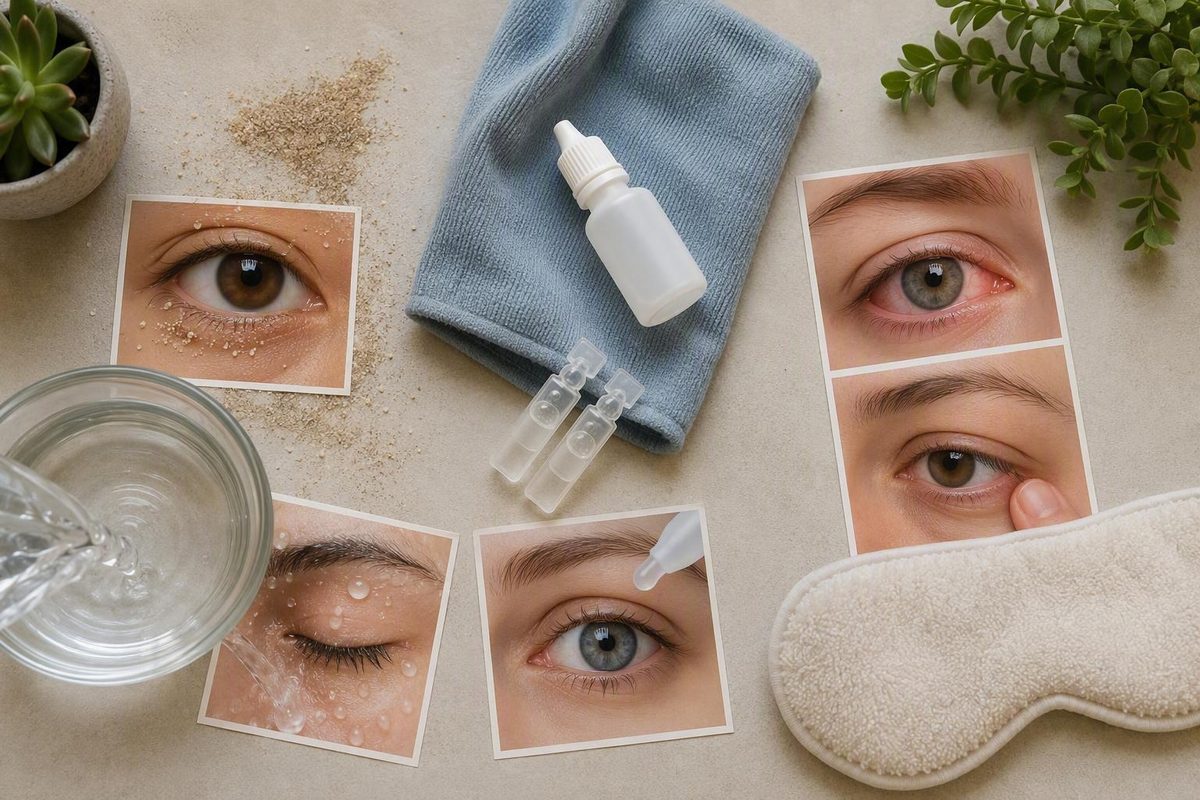
If your eye feels as though it contains sand, do not rub it. Remove contact lenses. If loose sand, dust, or dirt may have entered, gently rinse the eye.
A gritty sensation is nonspecific. Actual debris, a corneal scratch, dryness, allergies, eyelid inflammation, contact-lens irritation, infection, medication effects, and other conditions can all feel similar. The sensation alone cannot confirm dry eye—or any other diagnosis.
First, decide which situation you are dealing with
Choose the pathway that best matches what happened:
-
Chemical exposure: Begin continuous irrigation immediately. Do not wait to identify the substance or try drops or compresses first. Rinse for at least 15 minutes while arranging emergency assessment.
-
Loose sand, dust, or dirt: Stop rubbing, remove contact lenses if they come out easily, blink several times, and gently rinse with clean lukewarm water or sterile saline.
- Unexplained or recurring grittiness: If nothing entered the eye and there was no injury, consider whether the pattern fits dryness, allergy, eyelid inflammation, or contact-lens irritation before choosing a remedy. These injury and foreign-body precautions are consistent with published sand-and-dirt first-aid guidance.
Seek immediate care for a chemical splash, penetrating or high-speed injury, embedded object, sudden vision loss, severe pain, visible blood, or inability to open the eye.
Arrange a prompt or same-day assessment for significant or persistent blurred vision, strong light sensitivity, thick green or yellow discharge, worsening redness, pain associated with contact-lens wear, or a foreign-body sensation that remains after rinsing. Cleveland Clinic likewise identifies sudden vision loss, severe pain, light sensitivity, colored discharge, chemical exposure, and eye cuts or punctures as reasons for immediate attention in its eye-irritation guidance.
This article provides general information rather than an individual diagnosis, consistent with the site’s medical-information limitations. Eye problems can look similar while requiring very different treatment.
What to do when actual sand, dust, or dirt may be in the eye
A plausibly loose surface particle should be flushed away without scraping it across the eye. Use this sequence:
- Stop rubbing. Rubbing may drag the particle across the cornea and worsen irritation.
- Wash and dry your hands. Keep your fingers away from the eye itself.
- Remove contact lenses. Do this before rinsing if the lenses come out easily.
- Blink several times. Natural tearing may move a loose particle toward the corner of the eye.
- Rinse gently. Use clean lukewarm water or sterile saline. Keep the affected eye lower than the unaffected eye and allow a gentle flow to travel from the inner corner near the nose toward the outer corner.
- Continue for 15 to 20 minutes if loose debris is still suspected. Stop home removal attempts and obtain care if the sensation remains, vision is affected, or symptoms are severe. This sequence and rinse period come from practical foreign-body first-aid guidance.
Do not direct a forceful stream at the eye. Ordinary irrigation is appropriate only when loose surface debris is plausible.
Do not use:
- Tweezers or other tools
- Cotton swabs or tissues on the eye surface
- Saliva
- Pressure or rubbing
- Over-the-counter or borrowed numbing drops
- Fingernails to lift or scrape away material
Do not attempt to remove anything sharp, stuck, or embedded.
Continued grittiness does not necessarily mean a particle remains visible. A grain may be trapped beneath an eyelid, or it may have scratched the cornea before being washed away. Blinking can then move the eyelid across the irritated area and reproduce the sensation that something is still present.
If gentle rinsing does not remove the sensation, arrange an eye examination. Seek care sooner for pain, light sensitivity, persistent blur, bleeding, increasing redness, difficulty opening the eye, or any dangerous injury mechanism. Do not keep rinsing indefinitely or repeatedly manipulate the eyelid while searching for a particle.
Chemical exposure is a separate emergency pathway. Begin continuous irrigation immediately and arrange emergency assessment; do not substitute a compress, artificial tears, or an attempt to identify the substance before rinsing.
How to relieve mild dryness or screen-related grittiness
When nothing entered the eye, no injury occurred, and symptoms are mild, dryness may be a reasonable possibility. Eyes can feel gritty when they produce too few tears, tears evaporate too quickly, or the tear film does not spread evenly enough to lubricate the surface.
For a mild, uncomplicated pattern, try:
- Lubricating artificial tears. Choose a product labeled as artificial tears or lubricating eye drops and follow its instructions. These products may provide temporary comfort, but they do not treat retained debris, infection, or injury.
- Deliberate blinking. Periodically close your eyes fully and complete several normal blinks, especially during concentrated screen work.
- The 20-20-20 rule. Every 20 minutes, look at something about 20 feet away for 20 seconds, as described in screen-related gritty-eye guidance.
- More indoor humidity. A humidifier may help when indoor air is dry.
- Less directed airflow. Turn fans away from your face and move away from heaters or air-conditioning vents.
- Less exposure to irritants. Reduce exposure to smoke, dust, wind, and pollution. Use suitable protective eyewear in dusty or windy settings.
Concentrated screen use can contribute because it is associated with reduced or incomplete blinking. That leaves more time for the tear film to evaporate between blinks. Screen breaks are therefore an opportunity to restore regular, complete blinking—not merely to change visual focus.
Watery eyes do not exclude dryness. Surface irritation can trigger reflex tearing, creating a rush of watery tears without restoring a stable tear film. Dry-eye-type blur may also improve briefly after a blink and return as the tear film breaks up, according to this overview of dry-eye symptoms.
Temporary improvement after blinking is a clue, not a diagnosis. Persistent, substantial, or functionally meaningful vision change requires assessment even when dryness seems plausible. Do not assume continuing blur is simply a consequence of screen use.
Match the symptom pattern to the likely next step
The timing, whether one or both eyes are affected, and the accompanying symptoms are more useful than the word “gritty” by itself.
| Pattern | Possible explanation | Low-risk next step | Reasons to seek care |
|---|---|---|---|
| Burning or mild grittiness in both eyes; worse after screens or in dry air; blur briefly clears after blinking | Tear-film instability or dry eye | Try lubricating artificial tears, complete blinking, screen breaks, greater humidity, and less directed airflow | Persistent or significant blur, pain, marked light sensitivity, worsening redness, or failure to improve |
| Intense itching, watery discharge, puffy eyelids, or nasal allergy symptoms | Eye allergy | Avoid rubbing, limit the suspected trigger, and use a clean cool compress | Pain, reduced vision, thick discharge, severe swelling, or symptoms that persist |
| Crusts or flakes around lashes; greasy, red, or swollen eyelid edges; symptoms worse in the morning | Blepharitis or blocked eyelid oil glands | Use a clean warm—not hot—compress and gentle eyelid hygiene | Failure to improve with consistent care, substantial pain, significant light sensitivity, or vision change |
| Sudden symptoms in one eye after sand, dust, a makeup tool, a fingernail, or outdoor exposure | Retained particle or corneal abrasion | Rinse only if loose surface debris is plausible; do not rub or probe | Sensation that persists after rinsing, pain, light sensitivity, blur, blood, or inability to open the eye |
| Grittiness after contact-lens wear, especially overwear or sleeping in lenses | Lens irritation, poor fit, surface injury, or infection | Remove the lens and leave it out | Pain, increasing redness, discharge, light sensitivity, or blurred vision |
| Thick yellow or green discharge with worsening redness | Infection or another inflammatory problem requiring assessment | Stop contact-lens use and avoid prolonged self-treatment | Prompt professional assessment |
| Grittiness with substantial pain, persistent blur, or strong light sensitivity | Possible abrasion, infection, inflammation, or injury | Stop experimenting with home remedies | Prompt or immediate care, depending on severity and onset |
| Chronic gritty eyes with dry mouth, fatigue, or joint pain | Possible systemic contributor | Discuss the complete pattern with a clinician | Arrange medical and eye-care evaluation rather than self-diagnosing |
These patterns can overlap. Intense itching with watery discharge or puffy eyelids may favor allergy, while lash crusting, swollen eyelid edges, and morning-worse symptoms may favor blepharitis. An eye examination may be needed to distinguish these conditions because they can resemble or aggravate one another, as explained in this comparison of dry eye, allergies, and blepharitis.
Blepharitis commonly affects the eyelid edges and may cause greasy or crusted lashes, morning-worse irritation, grittiness, light sensitivity, and blur that improves with blinking. Symptoms that do not improve with regular eyelid care should be assessed, according to Mayo Clinic’s blepharitis guidance.
Warning signs are not tools for self-diagnosis. Thick colored discharge, substantial pain, persistent blurred vision, or strong light sensitivity should shift the decision toward professional assessment rather than trying several competing remedies.
Chronic gritty eyes accompanied by dry mouth, fatigue, or joint pain are worth discussing with a clinician because systemic conditions can affect moisture-producing tissues. That combination does not establish Sjögren’s syndrome or another autoimmune condition by itself.
Use warm and cool compresses for the right reasons
A compress may help when its temperature matches the symptom pattern. It is not a universal treatment for gritty eyes.
Use a clean warm, not hot, compress over closed eyelids when symptoms include:
- Lash crusts or flakes
- Greasy eyelid edges
- Morning-worse grittiness
- Eyelid irritation consistent with blepharitis
- A suspected problem with blocked eyelid oil glands
Warmth may loosen eyelid debris and support the flow of oils that help slow tear evaporation. Afterward, clean the eyelid margins gently. Do not scrub hard, scrape crusts with a fingernail, or allow a cleanser to run into the eye. Warm compresses and gentle eyelid hygiene are intended for an eyelid-related pattern, not every possible cause of grittiness.
There is no single household cleanser shown by the supplied evidence to be suitable for everyone. Rather than assuming baby shampoo, soap, or another cleanser is universally appropriate, ask an eye-care clinician or pharmacist about a suitable eyelid-cleaning product, especially if the skin is sensitive or inflamed.
Use a clean cool compress when prominent itching or puffiness suggests an allergy-dominant pattern. Place it gently over closed eyes without pressure. It may reduce discomfort, but it cannot prove that allergy is the cause.
A compress does not remove a retained particle. It also does not treat an eye infection or repair an injury.
Do not use warm or cool compresses as first aid for:
- Chemical exposure
- Penetrating trauma
- A high-speed fragment
- A sharp or embedded object
Those situations require the injury-specific steps described earlier. If eyelid-focused symptoms fail to improve despite consistent gentle care, schedule an examination because dryness, allergy, infection, and eyelid inflammation can overlap.
Choose eye drops cautiously
“Eye drops” is a broad category. Lubricants, allergy drops, redness-relief products, antibiotics, steroids, prescription dry-eye medicines, and anesthetic drops are not interchangeable.
Lubricating artificial tears
Artificial tears can temporarily lubricate the eye when the pattern is mild and uncomplicated. Check that the label says lubricating eye drops or artificial tears rather than assuming that any product marketed for red or irritated eyes serves the same purpose.
Preservative-free tears may be preferable when drops are needed frequently or when a preserved formula causes stinging or irritation. They are not mandatory for everyone. Follow the product’s directions rather than inventing a dosing schedule.
Thicker gels and ointments may remain on the surface longer, but they can temporarily blur vision. This tradeoff is described in dry-eye home-care guidance. Do not use a thick lubricant as a substitute for assessment of a possible injury, infection, or retained particle.
Allergy drops
Allergy eye drops target an allergy pattern and differ from plain lubricants. Ask a pharmacist or eye-care clinician which type is appropriate if intense itching, watery discharge, or seasonal exposure dominates.
Oral antihistamines are not a universal answer to gritty eyes. They may reduce allergy symptoms but can also contribute to dryness. Their suitability depends on the person’s health, medicines, and symptom pattern.
Redness-relief drops
Drops marketed primarily to “get the red out” may constrict surface blood vessels. They are not equivalent to lubricating artificial tears.
Antibiotic, steroid, prescription, and anesthetic drops
Do not self-treat with leftover antibiotic drops. Antibiotics do not treat dryness, allergy, or every cause of red or gritty eyes.
Steroid drops and prescription dry-eye medicines require clinical assessment and supervision.
Do not use over-the-counter or borrowed numbing drops.
For any eye-drop product, follow the label and ask a pharmacist or eye-care clinician if you are uncertain about its purpose or whether it can be used with contact lenses or other medicines.
Take contact-lens symptoms more seriously
Remove contact lenses whenever an eye becomes gritty, red, painful, or unusually irritated. If loose debris may be present, remove the lens before rinsing when it comes out easily. Do not reinsert lenses while irritation remains.
Contact lenses can cause or amplify grittiness through:
- Wearing them longer than recommended
- Sleeping in lenses not intended for overnight use
- Poor cleaning or replacement practices
-
Contaminated lenses, cases, or solution
-
Poor fit
- An underlying dry-eye or eyelid problem
Lens-related discomfort is not always simple dryness. A lens may trap debris against the eye or accompany a surface injury or infection. Contact-lens cleaning, timely replacement, and professional refitting may reduce avoidable irritation, but they are preventive measures rather than guaranteed fixes, as reflected in contact-lens and gritty-eye guidance.
Seek prompt assessment when contact-lens symptoms include pain, increasing redness, discharge, light sensitivity, or blurred vision. Remove the lens and use glasses while arranging care.
Do not put a lens back in merely to test whether the eye feels better. After a suspected abrasion, retained foreign body, or infection, wait for professional clearance before resuming lens wear. Symptom improvement alone does not establish that the eye has recovered safely.
If one eye repeatedly feels gritty with a particular lens, take the lenses and details of the cleaning solution, replacement schedule, and wear pattern to the appointment. That information may help the clinician assess fit, deposits, handling, or replacement problems.
Know when home care has gone on long enough
The safest timing depends more on the symptoms and mechanism than on a single clock.
Immediate emergency care
Seek immediate professional or emergency help for:
- Chemical exposure
- A penetrating injury
- A high-speed or metal fragment
- A sharp or embedded object
- Sudden vision loss
- Severe eye pain
- Visible blood in or around the eye
- Inability to open the eye
For a chemical splash, begin continuous irrigation immediately while arranging help. For an embedded or penetrating object, do not rinse, remove it, or press on the eye.
Prompt or same-day assessment
Arrange prompt assessment for:
- Significant or persistent blurred vision
- Marked light sensitivity
- Thick green or yellow discharge
- Worsening redness
- A persistent foreign-body sensation after rinsing
- Pain, redness, discharge, light sensitivity, or blur in a contact-lens wearer
- Symptoms after metal grinding, drilling, hammering, or another high-speed exposure
- Increasing pain or difficulty keeping the eye open
These features can occur with an abrasion, retained particle, infection, inflammation, or another problem that cannot be distinguished safely at home.
Routine appointment
If symptoms are mild, there was no dangerous exposure, and no warning signs are present, failure to improve within about 24 to 48 hours is a practical reason to arrange an examination. It is not a guarantee that waiting that long is safe; worsening symptoms should be assessed sooner. Cleveland Clinic advises evaluation when even mild irritation persists beyond approximately this period in its clinical overview of eye irritation.
Also make a routine appointment when:
- Symptoms recur frequently
- You rely on drops every day
- Discomfort interferes with reading, work, sleep, or driving
- One eye repeatedly feels gritty
- Eyelid crusting does not improve with consistent gentle care
- Contact lenses repeatedly become uncomfortable
An eye professional may examine the tear film, eyelid margins, blinking, and contact-lens fit. When hidden debris or a scratch is possible, the clinician may use magnification, inspect beneath the eyelid, and apply fluorescein dye to highlight damaged areas.
Bring a list of medications and supplements. Antihistamines, antidepressants, decongestants, some blood-pressure medicines, diuretics, hormonal medicines, and certain acne treatments may contribute to dryness in some people. Do not stop a prescribed medicine independently; discuss the symptom and possible alternatives with the prescriber. Medication-related dryness and the need to consult rather than stop treatment independently are addressed in this gritty-eye clinical overview.
Frequently asked questions
Why do my eyes feel sandy when there is nothing in them?
The surface of the eye may be irritated even when no particle is present. Too few tears, rapidly evaporating tears, or poor tear quality can leave the surface insufficiently lubricated. Allergies, blepharitis, blocked eyelid oil glands, contact-lens problems, medication effects, infection, UV injury, and a previous scratch can create a similar sensation.
Gradual symptoms in both eyes after screen use or dry-air exposure may fit dryness better than sudden symptoms in one eye after outdoor work, dust, or makeup use. Patterns provide clues rather than proof. Recurring, persistent, painful, or vision-affecting symptoms warrant an examination.
Can I flush sand out of my eye with tap water?
Yes. Clean lukewarm tap water can be used to rinse plausibly loose sand or dirt when sterile saline is unavailable. Wash your hands, remove contact lenses if they come out easily, keep the affected eye lower, and let a gentle flow travel from the inner corner toward the outer corner. Do not use a forceful jet.
Do not rinse an object that appears embedded or an eye exposed to a sharp, metal, penetrating, or high-speed fragment. If the gritty feeling remains after ordinary rinsing, a particle may be trapped beneath the eyelid or the cornea may be scratched.
Chemical exposure also requires immediate continuous irrigation, but it should be treated as an emergency rather than as routine debris removal.
Are preservative-free artificial tears better for gritty eyes?
They may be preferable when drops are used frequently or when preserved products cause irritation. They are not automatically necessary—or better—for everyone.
The more important question is whether lubrication fits the situation. Artificial tears may help mild, uncomplicated dryness, but they do not remove embedded debris or treat an infection, chemical injury, or corneal wound. Follow the product label and consult a pharmacist or eye-care clinician if you are unsure which product fits your symptoms.
Why do dry eyes water so much?
Dryness can irritate the eye surface and trigger reflex tearing. The eye may then produce a sudden volume of watery tears that drain without restoring a stable lubricating layer.
Seek assessment if tearing is persistent, one-sided, painful, associated with discharge, or accompanied by light sensitivity or vision change.
Can I wear contact lenses while my eye feels gritty?
No. Remove the lenses and leave them out while the eye is irritated. Continuing to wear a lens may trap debris or worsen friction, and it can make a scratch or infection more difficult to recognize.
Seek prompt assessment if grittiness occurs with pain, increasing redness, discharge, light sensitivity, or blurred vision. After a suspected abrasion, retained foreign body, or infection, wait for professional clearance before wearing lenses again rather than relying only on symptom improvement.
Action recap: Stop rubbing and remove contact lenses. Rinse only when loose surface debris is plausible. For mild, uncomplicated dryness, try lubricating artificial tears, complete blinking, screen breaks, greater humidity, and less directed airflow. Match a warm compress to eyelid crusting and a cool compress to prominent allergy-type itching. Persistent one-eye grittiness after rinsing may indicate hidden debris or a scratch. Pain, vision change, strong light sensitivity, colored discharge, chemical exposure, or a penetrating or high-speed injury should override home care and prompt professional assessment.