
Can I Wear Expired Contacts? No—Use a Fresh Pair
Don’t wear contacts past the date on the blister pack. Learn which date matters, what to do after accidental use, and when symptoms need urgent care.
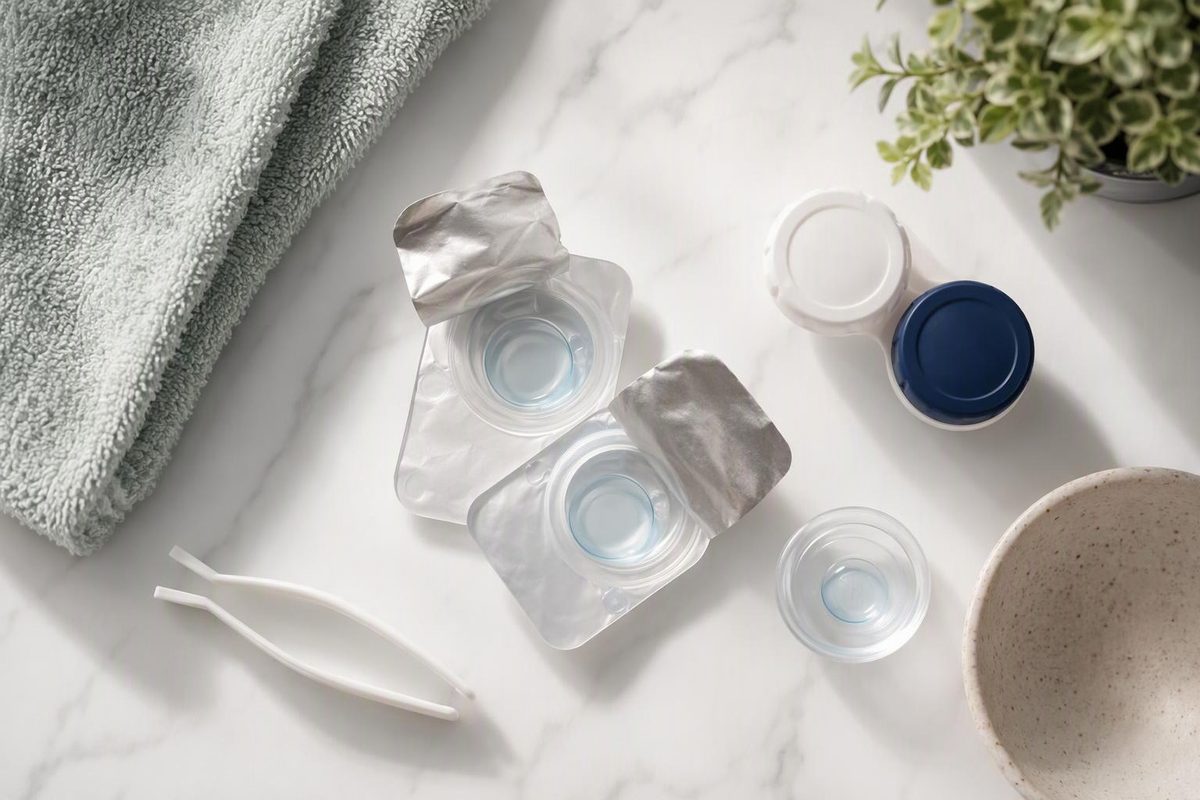
No. If the expiration date printed on a contact-lens blister pack has passed, discard the lens and use an in-date replacement—even if the foil seal looks intact and the lens looks normal.
Manufacturer instructions say not to wear expired lenses, and FDA-hosted product labeling likewise directs users not to use lenses beyond their expiration date (CooperVision; FDA-hosted labeling). There is no established grace period for a lens that expired yesterday, last month or last year.
Why an unopened contact lens can expire
A soft contact lens is supplied in a sealed blister containing sterile packaging solution. The printed date marks how long the manufacturer supports the product’s stability and sterility when it is stored as directed.
After that date, you cannot confirm sterility by looking at the package. Johnson & Johnson Vision explains that the lens material, packaging or solution may degrade over time and that contamination is possible even when an expired blister appears intact and is not leaking (ACUVUE).
Do not try to “refresh” an expired lens by rinsing or soaking it in contact solution. That does not extend the manufacturer’s expiration date. Starting with a fresh, in-date lens avoids an unnecessary risk to the cornea—the clear front surface of the eye.
Discard a lens before its expiration date if its blister is open, leaking, punctured, dried out or otherwise damaged.
Three different deadlines are easy to confuse
“Expired contacts” can refer to three separate limits. They do not mean the same thing.
1. The package expiration date
This date appears on the outer box and individual blister packs, often beside an hourglass symbol or “EXP.” Check the blister itself if the box is gone. If the date has passed, discard that unopened lens.
2. The replacement deadline after opening
This is how long the lens may be used once opened, based on its prescribed replacement schedule. A daily disposable is discarded after one use; two-week and monthly lenses have their own schedules. The countdown does not restart because a reusable lens spent several days in its case or was worn only briefly.
Follow whichever limit comes first: symptoms, the prescribed daily wearing limit or the replacement deadline. See how long contacts can be worn and why daily contacts should not be reused.
3. The prescription expiration date
An expired prescription does not make sealed, in-date lenses physically expire that day. Instead, it affects whether more lenses can be sold under that prescription.
In the United States, the federal Contact Lens Rule generally sets a minimum prescription duration of one year unless a documented medical reason supports a shorter period. State law or the prescriber may allow a longer duration (Federal Trade Commission).
Obtain a current prescription before buying more lenses, and ask your eye-care professional whether lenses already on hand remain appropriate for you. More detail is available in how long a contact-lens prescription lasts.
If you already put in an expired lens
Remove it, discard it and switch to glasses. Do not put that lens back in, even if it felt comfortable. If your eye feels completely normal after removal, monitor it; one accidental use does not mean an infection is inevitable.
Contact lenses are medical devices. Wearing, cleaning or storing them outside their directions can increase the risk of microbial keratitis, a potentially serious infection of the cornea (CDC).
If you develop an irritated or red eye, worsening pain, light sensitivity, sudden blurry vision, unusual watering or discharge, remove your lenses and call an eye doctor immediately. The CDC lists these as possible symptoms of microbial keratitis and advises against resuming contact wear until an eye doctor says it is safe (CDC).
What to do with the rest of the box
Check every blister rather than relying only on the carton. Discard expired or damaged packs, and confirm that the remaining lenses match the prescribed brand, power, base curve and diameter for each eye. Use the oldest in-date supply first and keep glasses available so running out does not pressure you into wearing an expired lens.
Contact-lens solution has separate expiration and after-opening discard dates. Do not use it beyond either limit, and never use expired solution to rinse or store a lens. See why contact solution can go bad.